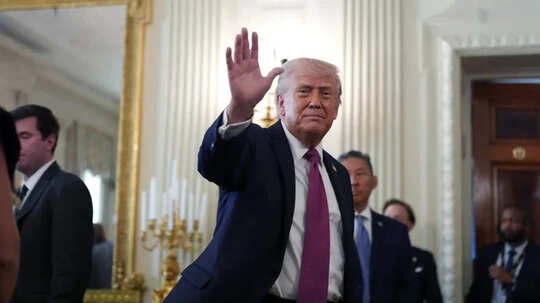
US President Donald Trump said on Wednesday that eight Iranian women protesters he believed were facing imminent execution would no longer be put to death, describing the development as a response to his direct appeal to Iran’s leadership.
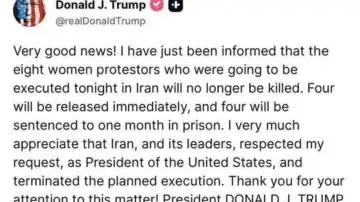
“Very good news!” Trump wrote on Truth Social. “I have just been informed that the eight women protestors who were going to be executed tonight in Iran will no longer be killed. Four will be released immediately, and four will be sentenced to one month in prison.”
“I very much appreciate that Iran, and its leaders, respected my request, as President of the United States, and terminated the planned execution,” he added.
His statement followed days of public pressure in which he urged Iran to release the women as a gesture of goodwill ahead of peace talks in Pakistan.
However, the circumstances surrounding the women remain disputed. Trump had shared a post suggesting that all eight – including two teenagers – were facing execution by hanging. However, human rights organizations said that only one woman, identified as Bita Hemmati, had been confirmed as having received a death sentence.
Iranian officials “Trump was misled once again by fake news,” a statement published on the judiciary’s official website said. “The women who were claimed to be on the verge of execution, some of them have been released, while others face charges that, if convictions are upheld, would at most result in imprisonment.”
Who Are the Women?
According to the human rights organization Hiwa, the group includes several women detained during recent anti-government protests. Among them are Panah Movahedi Salamat, 24, who disappeared after participating in demonstrations in Tehran’s Punak district, and Ensieh Nejati, a mother of a five-year-old child arrested in January in Darab.
Others identified include Mahboubeh Shabani, accused of “waging war against God” for aiding injured protesters; Golnaz Naraghi, an emergency doctor detained in Tehran; and Venus Hosseini-Nejad, who activists say was forced to deliver a false televised confession.
Two of the detainees, Ghazal Ghalandari and Diana Taherabadi, are 16 years old.
Human rights groups have raised concerns that confessions in such cases are often obtained under coercion.
Sardar Pashaei, executive director of Hiwa, said he had recently appealed publicly for the United States to tie humanitarian concerns to negotiations with Iran. “My message was very clear: the condition of ‘no nuclear weapons’ should go hand in hand with ‘no execution of political prisoners,'” he said.
He added that the situation inside Iran remained dire, with dozens of detainees at risk of execution. “In just the past month, more than 16 prisoners have been hanged,” he said. “At least five women political prisoners are currently facing execution.”
“A halt to executions, the release of political prisoners and restoring internet access must be on the negotiating table,” he said. “Without addressing humanitarian issues … any agreement with the government alone will not bring lasting stability or peace.”