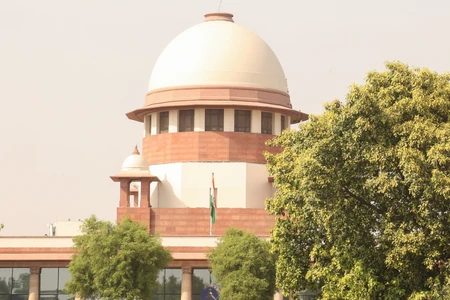
The Supreme Court has dismissed an appeal filed by a woman seeking maintenance for her minor daughter after a DNA test established that the respondent was not the biological father, holding that such scientific evidence would prevail over the statutory presumption of legitimacy under the law.
A Bench of Justices Sanjay Karol and N.K. Singh dismissed an appeal filed by a woman challenging a Delhi High Court order which had refused maintenance for her daughter while remanding her own claim for reconsideration.
The case arose from a dispute where the appellant alleged that the respondent, for whom she had worked as a domestic help, had established a relationship with her on the pretext of marriage.
The parties later married in March 2016, and a child was born the following month. Following matrimonial discord, the woman sought interim maintenance under the Protection of Women from Domestic Violence Act, 2005. During the proceedings, the respondent denied paternity and sought a DNA test, which was allowed by the trial court.
The report concluded that he was not the biological father of the child. Relying on the DNA report, the trial court had rejected the plea for maintenance for the child, a decision subsequently upheld by the appellate court and the High Court.
Before the apex court, the primary contention revolved around the presumption of legitimacy under Section 112 of the Indian Evidence Act, which treats a child born during a valid marriage as legitimate unless non-access is proven.
Examining the legal position, the apex court observed that while such a presumption exists to protect children from the stigma of illegitimacy, it is not absolute in cases where scientific evidence is available and has attained finality.
“The legislative intent is clear. Despite technological advancements by leaps and bounds, this presumption has been retained to save any child from the stigma of illegitimacy,” the Justice Karol-led Bench observed.
At the same time, the apex court said that where conclusive scientific evidence is available, it cannot be ignored. Citing precedent, it said: “When there is a conflict between a conclusive proof envisaged under law and a proof based on scientific advancement accepted by the world community to be correct, the latter must prevail over the former.”
In its order, the Justice Karol-led Bench noted that in the present case, the DNA test had been conducted with the consent of the parties and was never disputed thereafter. “It has, in other words, attained finality,” the apex court recorded.
On this basis, the apex court held that the Delhi High Court was justified in denying maintenance to the child and concluded that the appeal was “bereft of merit”. However, the Supreme Court expressed concern over the welfare of the child, whose parentage dispute had reached the highest court of the land.
“As such, in the interest of wanting to ensure the security and well-being of the child in question,” the Justice Karol-led Bench directed the Delhi government’s Department of Women and Child Development to assess the child’s living conditions.
It ordered that an officer be deputed to visit the appellant’s residence and evaluate the child’s “education, nutrition, health, as also the availability of basic material goods required to maintain a minimum standard of living”.
“It would be expected that wherever the said child’s situation is found to be lacking, the Department would step in to take remedial measures,” the Justice Karol-led Bench added.
While upholding the denial of maintenance to the child, the apex court noted that the issue of maintenance payable to the appellant herself had already been remanded by the Delhi High Court to the trial court for fresh consideration. The appeal was accordingly dismissed.