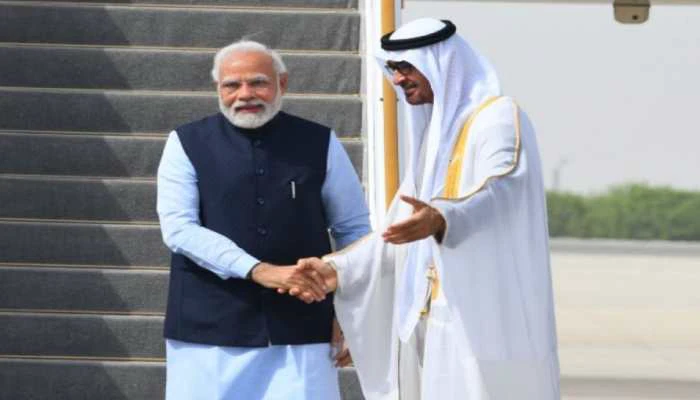
New Delhi: Indias growing partnership with the United Arab Emirates comes at a time when regional alliances are changing due to conflict, energy pressure and evolving diplomatic priorities.
While New Delhi continues to strengthen economic and strategic ties with Gulf nations, Pakistans position in the region appears to be under pressure.
India and the United Arab Emirates (UAE) have built stronger ties over the past decade. This growth has been supported by trade, energy cooperation and a large Indian community living in the Gulf. Nearly 3.5 to 4 million Indians reside in the UAE. They work across sectors such as construction, finance, logistics and services. This workforce has become an important bridge between the two economies.
Recent diplomatic engagement has strengthened this direction. Minister of External Affairs S. Jaishankar has visited the country as part of ongoing high-level exchanges, while Indian ministers have also increased outreach across the wider Gulf region, including Qatar and Saudi Arabia.
These visits show a wider effort by New Delhi to maintain strong ties with energy suppliers and investment partners.
The India-UAE partnership is also part of the I2U2 grouping, which includes India, Israel, the United States and the UAE. The platform is built around cooperation in infrastructure, energy, food security and technology. It has added a structured layer to Indias engagement with West Asia.
Pakistans gulf relations under pressure
Pakistans relationship with Gulf countries, including the UAE, has witnessed complications in recent years. Economic dependence on external financing has pushed Islamabad to seek repeated financial support from regional partners, but repayment issues and policy differences have created friction.
Reports suggest that the UAE had previously placed funds in Pakistans central banking system to support economic stability, but later requested their withdrawal in the wake of changing regional conditions. This has added pressure on Pakistans already weak external financing situation.
A separate point of tension emerged after Pakistan signed a defence cooperation agreement with Saudi Arabia in 2025. The agreement, which included mutual military support in case of external attack, was viewed in some Gulf capitals as a realignment of security commitments.
The development was not welcomed uniformly across the Gulf, particularly in Abu Dhabi, where concerns were raised about changing strategic preferences within the region.
Trust factor driving new partnerships
Diplomatic observers point to trust and consistency as important factors influencing Gulf relationships. India has established itself as a stable economic partner with predictable policy engagement, especially in energy trade, infrastructure development and skilled labour mobility.
The UAE is one of New Delhis largest trading partners in the Gulf, with bilateral trade covering crude oil, refined petroleum products, precious metals, food items and industrial goods. The two countries also share cooperation in renewable energy projects and digital infrastructure, expanding beyond traditional oil-based trade.
In contrast, Pakistans financial reliance on Gulf support has increased exposure to policy change in the region. Economic challenges along with external debt pressures have limited Islamabads ability to diversify partnerships at the same pace as other regional players.
Wider regional context
West Asia is presently experiencing overlapping pressures, including energy market volatility, maritime security concerns and geopolitical competition among major powers. These factors are influencing how countries reassess partnerships and economic dependencies.
Irans relations with regional states also are uneven, with trade routes, energy transit and maritime access influenced by broader political tensions.
Meanwhile, Israels expanding economic ties with several Gulf countries through technology and defence cooperation has added another layer to the changing regional structure.
Indias expanding role in the Gulf
Indias engagement in West Asia is increasingly built around economic interdependence rather than short-term diplomacy. Energy imports from the Gulf, remittance flows from expatriate workers, and long-term infrastructure investments have created a stable foundation for cooperation.
With Gulf countries also seeking diversification away from oil dependence, India has emerged as an important partner in sectors such as renewable energy, digital services and manufacturing supply chains. This has contributed to a steady strengthening of ties across multiple fronts.
Changing balance in West Asia
The evolving dynamics show a gradual redistribution of influence in the region. While Pakistan continues to navigate economic and diplomatic challenges, Indias consistent engagement strategy with Gulf nations has strengthened its position as a long-term partner.
As West Asia continues to adjust to economic and geopolitical pressures, partnerships are increasingly being influenced by stability, economic reliability and long-term cooperation rather than short-term alignments.