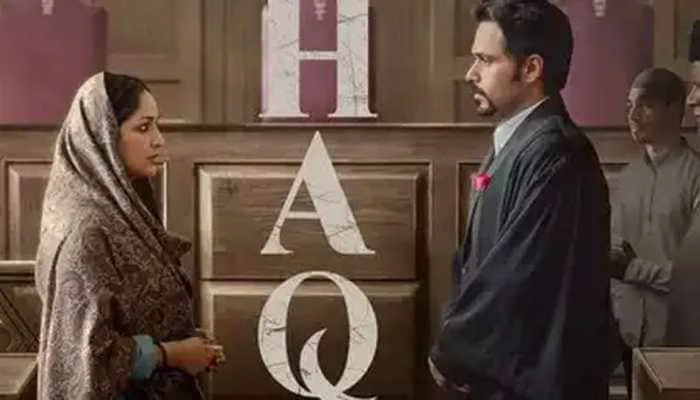
Dialogue of the day: When it comes to watching an entertainer at home or on OTT, it is the screenplay, performance and powerful dialogues from a movie which remain etched in viewers’ memory for long.
A film which released some months back – Haq – left a similar lasting impact with its heard-hitting one liners. Today, let’s take a look at one of the most famous dialogues from this Bollywood release.
“Baat yaha tak nahi pochni chahiye thi.. tumhe kya laga main darr jaunga” (Emraan Hashmi). “Baat sirf aapki zabaan ki thi” (Yami Gautam). “Nahi peechli baar tumhe kaha thatumhare izzat ki baat hain” – (Emraan).
Meaning of the dialogue
These powerful hard-hitting dialogues are from Haq. Emraan Hashmi utters these words questioning Yami Gautam, who plays his on-screen wife. The exchange between their characters shows how the equation between them changes overnight. One big decision wreaks havoc in their marital lives – hitting hard on wife’s self-respect and moral being.
The husband’s character is layered as well. How religion gets intertwined in a crumbling marriage after the former marries a second time.
Self-respect is supreme for an individual and how even a loving relationship can also crush your ego in times of turmoil.
About Haq and Shah Bano case
Haq is a courtroom drama which released in 2025. The . It stars Yami Gautam Dhar and Emraan Hashmi, alongside Sheeba Chaddha in a pivotal role. The movie is inspired by journalist Jigna Voras book Bano: Bharat ki Beti which is based on the landmark Supreme Court judgement of Mohd. Ahmed Khan v. Shah Bano Begum.
The movie received a warm response for its performances and bold social commentary.
Shah Bano’s case is considered one of the legal milestones in the battle for the protection of the rights of Muslim women in India. In 1978, Shah Bano filed a petition in a court in Indore, demanding maintenance from her divorced husband, Mohammed Ahmed Khan, a well-known lawyer. The two had married in 1932 and had five childrenthree sons and two daughters.
In 1985, the Supreme Court ruled that Shah Bano was entitled to maintenance under section 125.
The verdict stirred major controversy, leading to protests from certain Muslim organizations that viewed it as an infringement on Sharia law. Her lawyer husband challenged that under Muslim Personal Law, his obligation to provide maintenance was limited to the ”iddat period” only. The All India Muslim Personal Law Board supported Khans stance, stating that courts could not interfere in matters governed by Muslim Personal Law, as doing so would violate the Muslim Personal Law (Shariat) Application Act, 1937.
In response to political pressure, the government enacted the Muslim Women (Protection of Rights on Divorce) Act, 1986. This Act limited a husbands responsibility for maintenance to the iddat period, shifting subsequent support obligations to the womans relatives or the Waqf Board.
The case ignited a nationwide debate on gender justice, the scope of religious personal laws, and the demand for a Uniform Civil Code (UCC) in India.
Shah Bano eventually withdrew her case as it became politically charged. She passed away in 1992 following a brain haemorrhage.