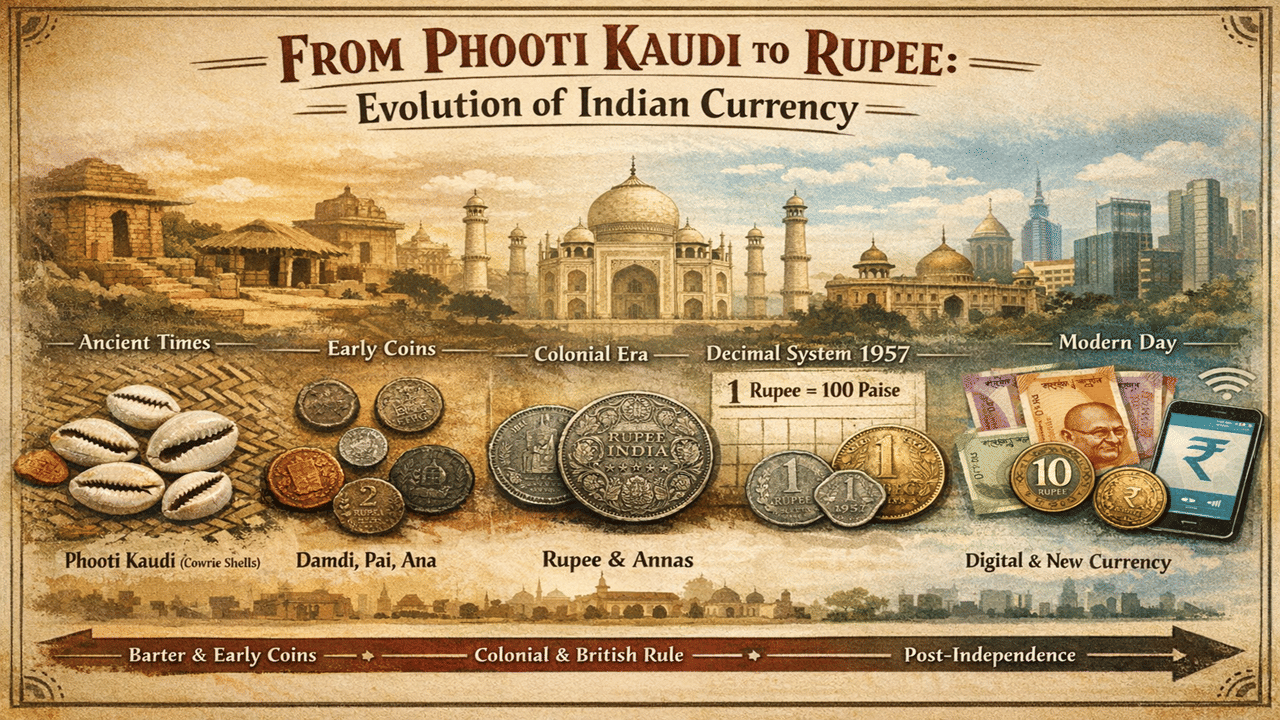
New Delhi: A post on social media platform ‘X’ by a user with the handle named Gabbbar Singh has gone viral for tracing the journey of Indian currency in its various forms, from the humble ‘phooti kaudi’ to the modern rupee. The post has sparked fresh interest in the long and layered evolution of India’s monetary system. The post captures, in a simple visual timeline, how India moved from primitive barter-like tokens to today’s structured currency that is recognised and used globally.
Some interesting sayings
In the post, the ‘X’ user pointed out how throughout history there have been many popular sayings that have been associated with Indian currency denominations. It pointed out that as the denominations increased, the tones of the sayings started to get more optimistic in nature.
Some of those included in the viral X post are, “Mai apni जायदाद se tumhe Ek phooti Kaudi nahi dunga,” “Do kaudi ki shakal hai teri”, “Dhele bhar ki aukaad nahi hai teri”.
Continuing the trend were quoted, “Zamindar saab, Mai aapki Pie Pie chuka dunga,” “Paisa hi Paisa hoga”, “Char chavanni ghode pe” (char aana) and finally “Solah aana sach baat”.
The journey of Indian currency
The post was well received, with many users in the comment section participating in a conversation on Indian currency’s historical evolution.
Historically, some of the earliest forms of money in the Indian subcontinent were cowrie shells, locally called ‘kaudi’ or ‘phooti kaudi’. It was believed that 3 ‘phooti kaudi’ amounted to 1 ‘kaudi’. Meanwhile, 10 ‘kaudis’ would get you 1 ‘damdi’. These ‘kaudi’ like denominations were small, naturally occurring shells used in everyday transactions, especially for low-value exchanges. Their usage was long before formal coinage emerged.
Over time, these gave way to metal-based systems, and denominations such as damdi, pai, and anna, which reflected a gradually formalising economy, came into being. Their introduction saw the market and financial system being tied to more standardised trade and formal governance.
The transition to a standardised currency began in earnest under medieval and later colonial rule, eventually crystallising into the rupee, a term popularised during the reign of Sher Shah Suri and institutionalised under British India.
Post-independence reforms marked a decisive shift. In 1957, India adopted a decimal system, redefining the rupee into 100 paise, simplifying calculations and aligning with global standards.
Today, the Indian rupee (₹) is issued and regulated by the Reserve Bank of India and remains the backbone of the country’s financial system, circulating now in not just physical forms but increasingly in digital forms as well.