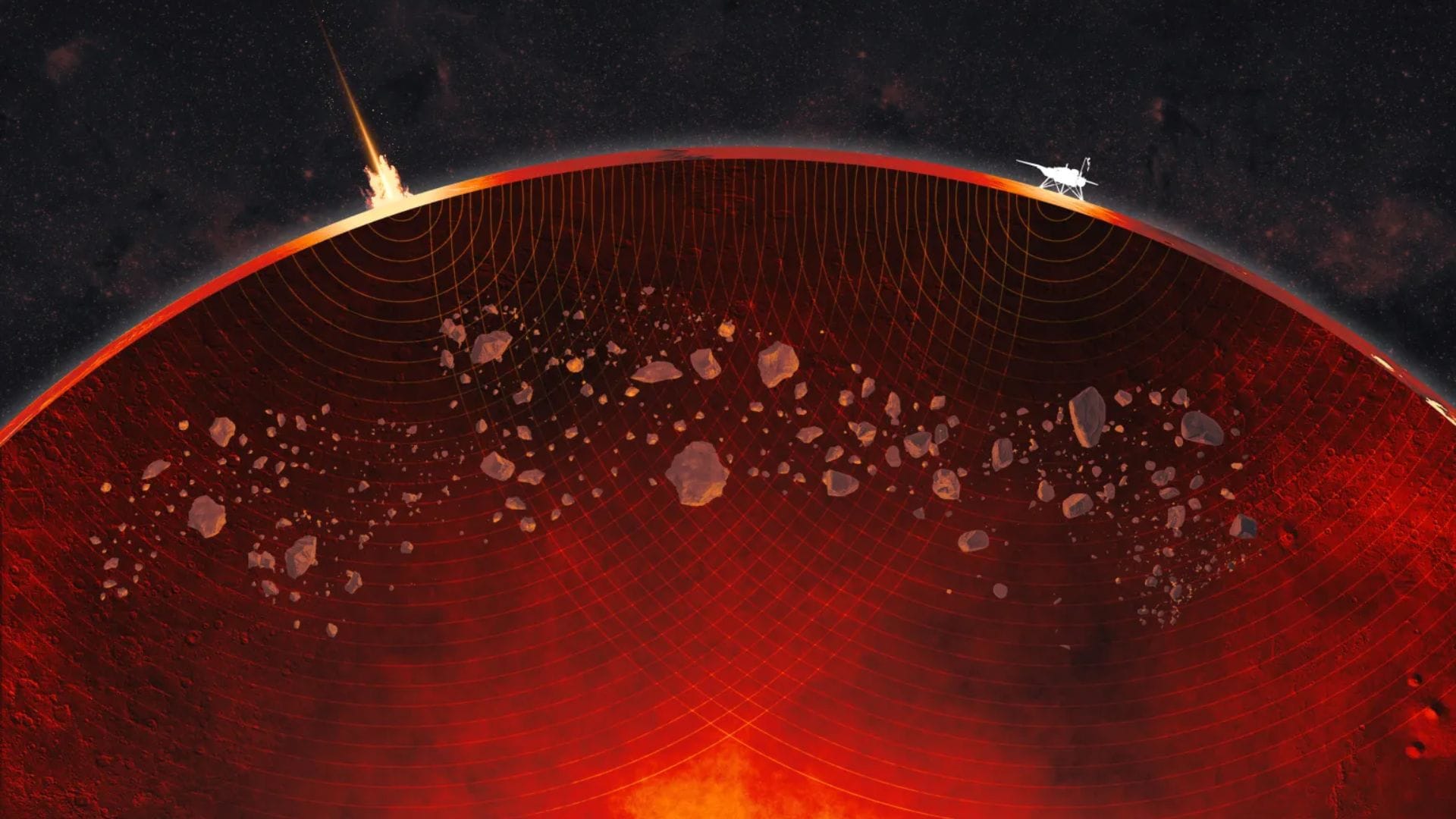
New Delhi: Earth has a number of continental plates that subduct where they overlap, churning the mantle, or the interior of the Earth for billions of years. Mars lacks plate tectonics, with the crust or surface made up of a single plate. Previous research based on observations conducted by NASA’s retired InSight lander had indicated heterogeneities in the mantle of Mars, ancient material accreted by the planet in the infancy of the Solar System, frozen in place, deep within the interior of the Red Planet, as the crust solidified and the mantle convection slowed down. Now, new research challenges this interpretation.
Ludovic Margerin, a researcher from the Institute of Research in Astrophysics and Planetology (IRAP) examined the analysis and determined that the InSight seismic data contains observational and theoretical flaws, so the conclusion that the Martian mantle is highly heterogenous can not be determined using that data. To reanalyse the data, the researcher developed a method for measuring the arrival times and the signal-to-noise ratio, tailored for the P-waves detected by InSight. These Primary Waves are the fastest seismic waves generated by Marsquakes. Margerin also reexamined the possibility of explaining the observations in terms of multiple scattering through a heterogenous medium.
Probing the remote interiors of distant worlds
The results of the study shows that the decrease in the signal-to-noise ratio causes anomalies in P-wave propagation, rather than a multipath effect caused by ancient heterogeneities embedded in the mantle. The study also reveals that the waves sampling the surface layer of Mars are also subject to the same detection biases. A paper describing the research has been published in Geophysical Research Letters. There are few tools available for researchers to probe the remote interiors of distant worlds, and seismometers provide among the best methods that scientists have to probe the interiors of planets. Much is left to be understood on the extent to which the Martian mantle is heterogenous.