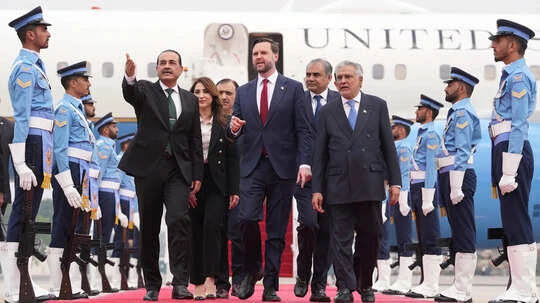
ISLAMABAD (AP) – The United States and Iran wrapped up a third round of crucial negotiations in Pakistan before dawn on Sunday, shortly after a fragile two-week ceasefire was declared.
The discussions come as the ongoing conflict, which has claimed thousands of lives and disrupted global markets, enters its seventh week.
Officials from Pakistan indicated that further talks between the heads of the delegations will continue following a scheduled break. Meanwhile, some technical personnel from both teams are still engaged in discussions, according to sources who requested anonymity due to the sensitive nature of the talks.
U.S. Military Activity in the Region
The U.S. military reported that two destroyers have transited the Iran-controlled Strait of Hormuz in preparation for mine-clearing operations, marking the first such movement since the conflict began. However, Iranian state media contested this claim, stating that the joint military command denied the U.S. activity.
President Trump commented to reporters as negotiations unfolded, stating, “We’re sweeping the strait. Whether we make a deal or not makes no difference to me.” He described the negotiations as “very deep,” while Iranian state television highlighted significant differences between the two sides.
Key Participants in the Negotiations
The U.S. delegation, led by Vice President JD Vance, engaged with Iranian representatives headed by Parliament Speaker Mohammad Bagher Qalibaf. They discussed strategies to maintain the ceasefire, which faces challenges from ongoing tensions and continued Israeli strikes against Iranian-backed Hezbollah in Lebanon, where the health ministry reported over 2,000 fatalities.
This round of talks marks a significant moment in U.S.-Iran relations, with the most direct contact since 2013, when President Obama communicated with then-President Hassan Rouhani regarding Iran’s nuclear ambitions. The current discussions are broader in scope, addressing not only the ceasefire but also regional security concerns.
Iran’s Stipulations for Negotiations
According to Iran’s state-run news agency, the three-party discussions commenced following the fulfillment of Iranian preconditions, which included a decrease in Israeli strikes on southern Lebanon. Iran’s delegation outlined “red lines” to Pakistani Prime Minister Shehbaz Sharif, demanding compensation for damages caused by U.S.-Israeli actions and the release of frozen Iranian assets.
The conflict has resulted in significant casualties, with reports indicating at least 3,000 deaths in Iran, over 2,020 in Lebanon, and additional fatalities in Israel and Gulf Arab states. The war has severely impacted infrastructure across multiple Middle Eastern nations and significantly disrupted oil exports through the Strait of Hormuz, contributing to rising energy prices.
Regional and International Involvement
Amid these high-stakes discussions, officials from China, Egypt, Saudi Arabia, and Qatar are reportedly present in Islamabad to facilitate the negotiations indirectly. Sources indicated that these officials are working to ensure a stable dialogue amidst the complex geopolitical landscape.
In Tehran, residents expressed a mix of skepticism and cautious optimism regarding the negotiations, with one local stating, “Peace alone is not enough for our country because we’ve been hit very hard, there have been huge costs.”
U.S. Military Operations in the Strait of Hormuz
The closure of the Strait of Hormuz by Iran has been a pivotal strategic advantage in the ongoing conflict, as approximately 20% of the world’s traded oil typically passes through this critical maritime route. U.S. Central Command announced that operations to clear the strait have commenced, with additional U.S. forces, including underwater drones, set to join the effort in the coming days.
Iranian Foreign Minister Abbas Araghchi expressed his nation’s deep distrust entering the negotiations, citing past attacks during previous discussions. He emphasized that Iran would respond if provoked again, underscoring the volatile nature of the current situation.
Negotiations Between Israel and Lebanon
As the ceasefire talks continue, Israel has intensified its military operations in Lebanon, asserting that no ceasefire exists in that region. Negotiations between Israeli and Lebanese representatives are scheduled to begin on Tuesday in Washington, following Israel’s unexpected announcement to engage in dialogue despite the lack of formal relations between the two nations.
Lebanese Prime Minister Nawaf Salam has postponed a trip to Washington amid internal unrest, but the initial round of talks is expected to proceed at the ambassadorial level. Israel’s strategy aims to compel the Lebanese government to take responsibility for disarming Hezbollah, a challenge that has persisted for decades.
Recent Escalations in Lebanon
On the day the Iran ceasefire was announced, Israeli airstrikes resulted in over 300 deaths in Beirut, marking the deadliest day in Lebanon since the conflict began, according to the Lebanese Health Ministry. This escalation highlights the fragile nature of the ongoing negotiations and the complexities involved in achieving a lasting peace.