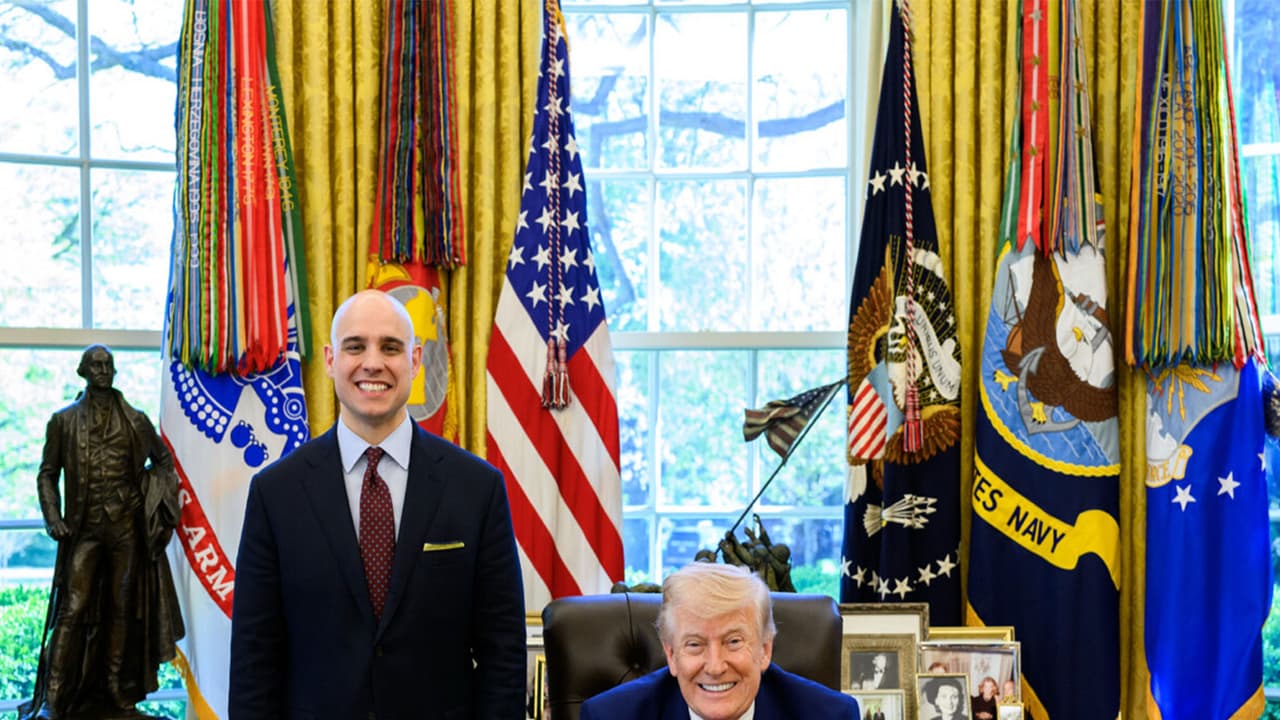
President Trump announced that Deputy Chief of Staff James Blair will temporarily lead the GOP’s outside political operations for the 2026 midterms, an aggressive strategy to defy historical trends and solidify Republican control of Congress.
In a high-stakes personnel shift ahead of the 2026 midterm elections, US President Donald Trump on Friday (local time) announced that James Blair, the White House Deputy Chief of Staff for Legislative, Political, and Public Affairs, will take a temporary leave of absence to helm the administration’s outside political operations. The move signals the President Trump’s aggressive strategy to defy historical mid-term trends and solidify Republican control of Congress.
In a post on Truth Social, Trump said, “James Blair, my Deputy Chief of Staff, is one of the brightest political minds in the Country who has done tremendous work to prepare Republicans to DEFY LONGSTANDING HISTORY AND WIN the Midterms, just as he helped me do in 2024, BY A LANDSLIDE. James never wavered from the fight because he is a Political WARRIOR! Now, James will be taking a short leave of absence to lead the charge from the outside against the Radical Left, Country Destroying Democrats. He will do a fantastic job, and then, after the Election, return again to the White House, so we can finish the job and, KEEP AMERICA GREAT! President DONALD J. TRUMP.”
Blair, widely regarded as one of the most formidable political strategists in the country, played a pivotal role as the Political Director for Trump’s 2024 campaign. His efforts were credited with modernizing the GOP’s ground game and securing a decisive victory. Blair’s departure is a strategic deployment. He will lead external political efforts–likely through a combination of Super PACs and GOP committees–to counter the Democratic platform. With Blair “leading the charge,” the administration is doubling down on a message of total victory to “finish the job.”
The 2026 Midterm Battleground
The 2026 U.S. Midterm Elections, scheduled for Tuesday, November 3, 2026, are shaping up to be a historic referendum on President Donald Trump’s non-consecutive second term. With Republicans currently holding a “trifecta” (control of the White House, House, and Senate), the stakes involve whether the GOP can defy the “iron law” of politics–where the president’s party typically loses ground in the midterms. Blair, who was political director of the 2024 Trump campaign and has run the White House political operation, has been responsible for Trump’s 2026 midterm strategy, as per POLITICO.
The 2026 U.S. Midterm Elections, scheduled for Tuesday, November 3, 2026, are shaping up to be a historic referendum on President Donald Trump’s non-consecutive second term. With Republicans currently holding a “trifecta” (control of the White House, House, and Senate), the stakes involve whether the GOP can defy the “iron law” of politics–where the president’s party typically loses ground in the midterms.
What’s on the Ballot
Voters will decide the composition of the 120th United States Congress, along with critical leadership roles across the states. All 435 House of Representatives seats are up for election. Democrats currently need a net gain of just 3 seats to reclaim the majority. 35 Senate seats will be contested (33 Class 2 seats plus 2 special elections). Florida (to fill Marco Rubio’s seat, currently held by appointee Ashley Moody) and Ohio (to fill JD Vance’s seat, currently held by appointee Jon Husted). 39 states and territories will elect governors, serving as a pulse check for state-level leadership.
Meanwhile, the House of Representatives is currently under Republican control. Historically, the incumbent party loses ~25 seats; models suggest a potential GOP loss of 28 seats.
Senate under Republican control, favors the GOP, who defend 20 seats compared to the Democrats’ 13.
Key Issues Influencing Voters
The “pocketbook” remains the primary driver for the electorate, though geopolitical events have introduced new volatility. Despite a “roaring economy” touted by the administration, voters are grappling with a deepening housing crisis and high costs for groceries and utilities. The median income ($85,000) currently falls short of the $120,000 required to afford a median-priced home.
Economic and Geopolitical Pressures
The military conflict in Iran has become a polarizing focal point. While intended as a show of strength, surging oil prices and a spike in gas costs–attributed to risks in the Strait of Hormuz–have pressured Republican candidates to defend the war’s economic fallout.
Legislative Impact and Healthcare
The “One Big Beautiful Bill” Act (OBBBA): The administration’s signature tax and regulatory legislation is a double-edged sword. While it provides significant tax refunds in 2026, critics point to its impact on healthcare subsidies and senior care as a liability for the GOP.
Democrats maintain a polling lead on “trust” regarding health costs, focusing their campaign on the “caregiving crisis” affecting families with children and elderly members.
Competing Party Strategies
The Republican strategy focuses on turning the election into a choice between “MAGA stability” and what they characterize as “Radical Left disruption,” while Democrats aim to capitalize on voter anxiety over the cost of living and geopolitical overreach. (ANI)
(Except for the headline, this story has not been edited by Asianet Newsable English staff and is published from a syndicated feed.)