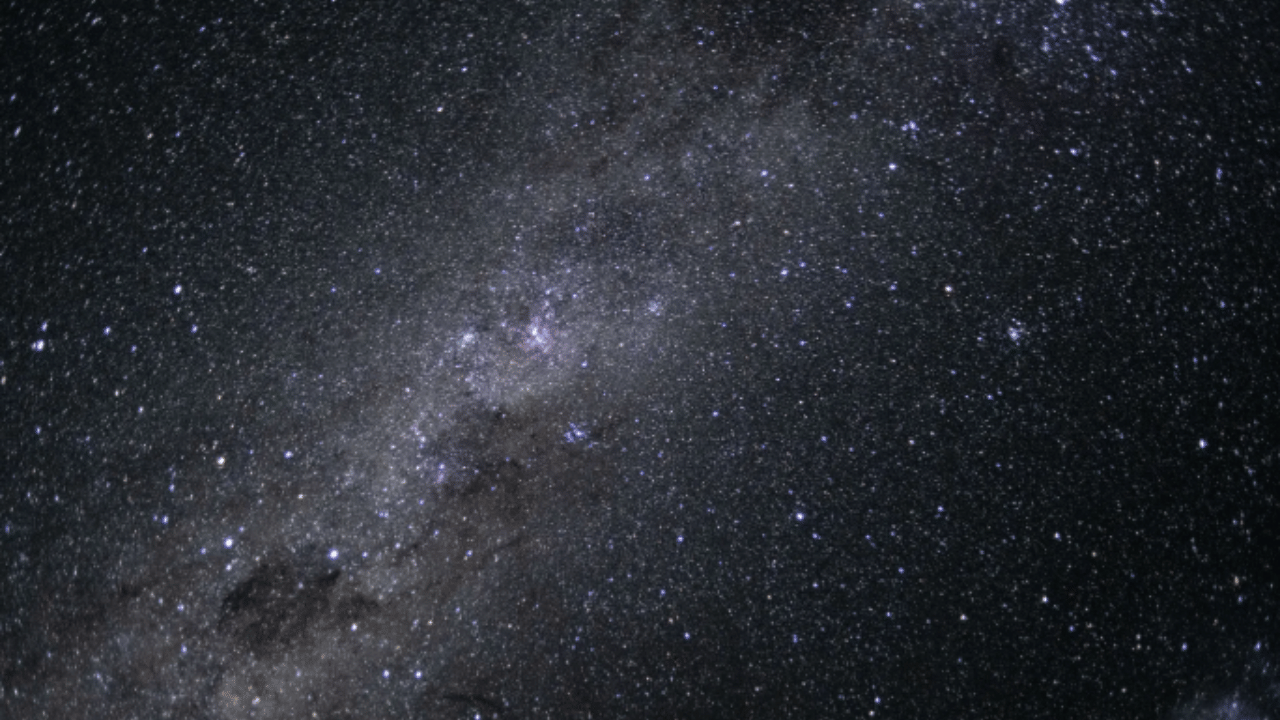
New Delhi: Astronauts aboard NASA’s Artemis II mission have captured a remarkable image of the Milky Way while returning from their historic lunar flyby. The deep space photo provides a unique, clear view of our own galaxy. It brings out thick concentrations of stars, small nebulae, and far-off cosmic arrangements seldom seen on Earth.
This shot was captured on April 7, 2026, almost two days after the crew had made their historic trip around the Moon. Commander Reid Wiseman, Pilot Victor Glover and Mission Specialists Christina Koch and Jeremy Hansen used the Orion spacecraft window to focus their camera on the galaxy and took the picture in such beautiful detail. NASA claimed that there was extraordinary clarity due to the absence of the atmosphere of the Earth.
A rare view of the galactic plane
According to NASA, the picture shows a stripline of stars called the galactic plane. The majority of the stars of the Milky Way are located in this area. The photo looks down one of the spiral arms of the galaxy, rather than in the centre of the galaxy. These regions are full of gas, dust and new stars.
There are also scattered clusters of stars and faint nebulae in the frame. There is a cloudy area in the vicinity that is thought to be the Large Magellanic Cloud, a dwarf galaxy. According to scientists, this level of detail is hardly visible on the Earth because of the effects of the atmosphere.
Understanding our place in the galaxy
The Milky Way is a 4-armed barred spiral galaxy. The two most notable ones are the Perseus Arm and the Scutum-Centaurus Arm. The solar system is situated in a smaller section known as the Orion Spur, which is approximately 26,000 light-years away.
Sagittarius A is a supermassive black hole at the centre of the galaxy. NASA explains that our solar system travels around the galaxy at nearly 515,000 miles per hour. This speed notwithstanding, a complete orbit will require approximately 225 million years.