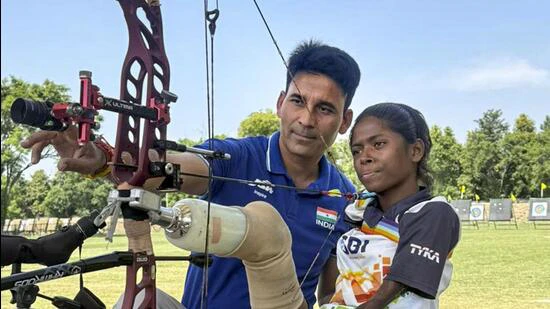
Raipur/Mumbai: By now, Sheetal Devi is familiar with the drill. Soon after receiving their medal – a silver this time for the Indian archer – podium finishers turn toward the flag for the national anthem of the gold-medal winner.
For a few fleeting moments however, at the Bangkok Archery Centre last Saturday, she strayed from the protocol.
Instead, she walked to the gold-medallist, Payal Nag, to help her turn her wheelchair 180 degrees.
Since Sheetal announced herself on the world stage by becoming the first armless woman archer to win a World Championship medal, in 2023, she has conquered almost everything her sport has to offer. But at the inaugural World Archery Para Series event, Payal, the first and only quadruple amputee international archer, beat the player she idolises.
“Earlier, it felt like I was alone here winning medals, but now it is great that (Payal) is here and India will get even more medals,” Sheetal said on Thursday during a virtual interaction organised by the Sports Authority of India.
“It feels very good. Defeats happen in the game, but I’m not taking this negatively. I am happy that more archers are coming and doing so well.”
By no means, though, was this defeat a flash in the pan. Though Sheetal has been the best in her class in the world for a few years, Payal had beaten her at the Nationals in January 2025. Since then, the 18-year-old from Odisha has only grown in strength, leaving behind the disaster that forced doctors to amputate her arms and legs.
In 2015, eight-year-old Payal was playing on the terrace of an under-construction building in Raipur, where her migrant parents had moved for work, when she stepped onto a puddle of water that had been in contact with a livewire.
“(Payal) was in a very bad shape and her parents had no means to support her treatment,” IAS officer Santosh Mishra told HT. Mishra and his wife, IPS officer Sonali Mishra, read about the accident in the local newspaper and took it upon themselves to help Payal’s treatment.
The family had to sell their land in Balangir district of Odisha to pay for the treatment, and were forced to place her in an orphanage since they did not have the means to support her.
Payal though, remained determined to prove her worth. She eventually got in touch with archery coach Kuldeep Vedwan, who was Sheetal’s first coach.
“The first time I spoke to her was over a video call,” Sheetal recalled her first interaction with Payal.
“She said ‘didi, I also want to do archery,’ and I told her ‘aajao.’ Initially, I wondered how she would do it because she doesn’t have arms and legs. But then (Vedwan) sir made a special device for her, and I felt she could do it. I was very happy when she shot her first arrow. I felt she would have to work a little harder, but she would be able to do it. She is doing it very well now.”
The accident may define who she is but she has not let that restrict her.
“At one phase we lost all hope, but she fought her battle,” Payal’s father Vijay told this publication. “We had never imagined that she would survive and make us and the country proud.”
Payal, though, has set her sights on bigger targets.
“It has been a long and difficult journey for me, from Raipur to winning the gold in Bangkok,” she said. “I am now focusing on the 2026 Asian Games and 2028 Paralympics.”