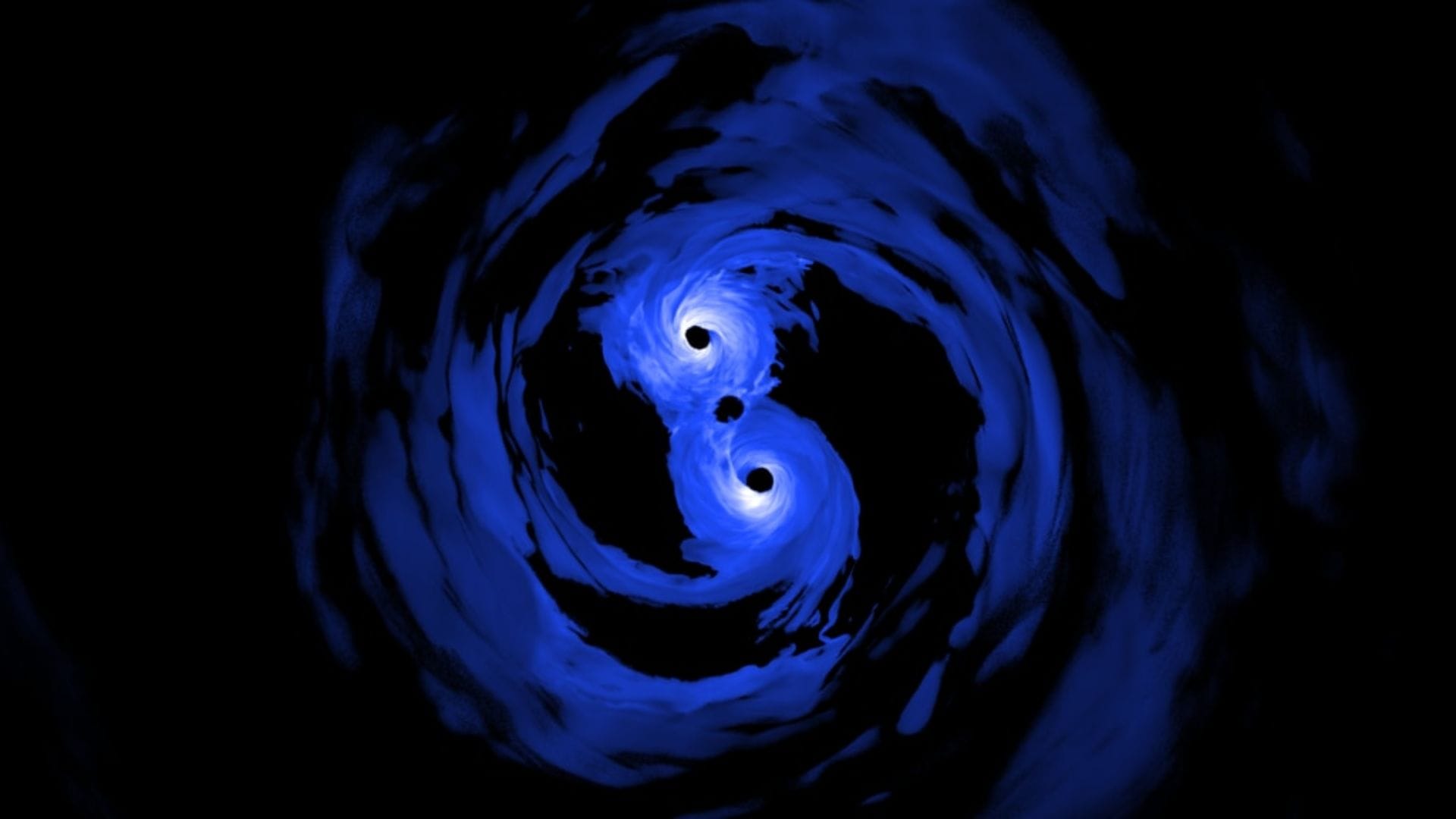
New Delhi: A supermassive black hole (SMBH) occupies the core of every large, evolved galaxy like the Milky Way. These SMBHs can contain millions or even billions of solar masses, and scientists are not sure how these monsters are formed and reach such enormous masses. Growing by merely scooping up gas and dust from the galaxy would take too long, so they probably grew by merging with other black holes. Collisions between galaxies have been observed throughout the universe, that suggest that the central SMBHs merge too. In these interactions, the SMBHs are likely to orbit ever closer to each other, before coalescing into one more massive object.
Theoretical models cannot accurately describe the final phase, and no close pair of massive black holes have been detected yet. An international team of astronomers may have discovered such a binary pair of massive black holes for the first time, occupying the core of a galaxy designated as Markarian 501, based on years of radio observations. The observations reveal the presence of not one, but two jets at the core of the galaxy, indicating the presence of two massive black holes. A paper describing the research has been accepted for publication in the Monthly Notices of the Royal Astronomical Society.
The dance of the black holes
The scientists were able to determine that the two black holes orbit each other with a period of about 121 days. They are between 250 and 540 Astronomical Units (AU) apart, with a single AU being the distance between the Earth and the Sun. The masses of the black holes are not known, but the distance between them is expected to rapidly reduce, with a merger possible in as little as 100 years. The galaxy is located at about 480 million lightyears away, and is too distant for the most powerful astronomical instruments to resolve the individual black holes. Astronomers however, will be able to track the progression of the system.