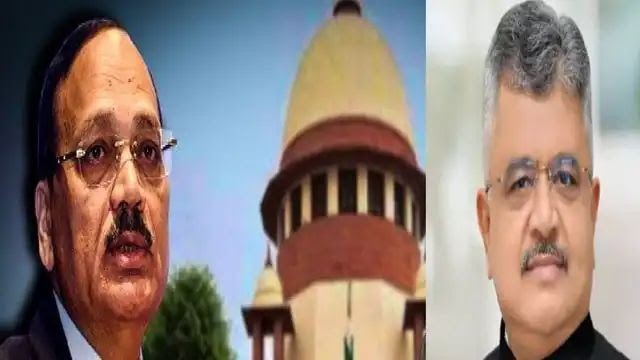
The Supreme Court on Wednesday said it has the authority to decide which practice in a religion is superstition and is based on it. The court made this comment in response to the central government’s argument that it does not have the jurisdiction of the court to decide on matters related to religion, because judges are experts in law, not religion.
A nine-judge Constitution bench headed by Chief Justice (CJI) Justice Surya Kant is hearing petitions related to alleged discrimination related to women’s entry into religious places, including the Sabarimala temple in Kerala, and the scope of religious freedom among various religions.
At the beginning of the hearing, Solicitor General Tushar Mehta, appearing for the Centre, questioned how the court would decide whether a practice is based on superstition. He said, “Even if we assume that a practice is based on superstition, it is not for the court to decide so. Under Article 25(2)(b) of the Constitution, it is the duty of the legislature to make laws for its reform.” Mehta further said that Parliament or state legislatures can make laws against any practice considering it a superstition, such as laws related to stopping black magic.
This argument is very simple
On this, Justice Ahsanuddin Amanullah said that this argument is very simple, because the court has the authority to decide whether a practice is based on superstition or not. He said, “The legislature can decide what steps to take after this, but it cannot be said that whatever the legislature decides will be final.” After this, Solicitor General Mehta said that a secular court cannot call any religious practice as superstition, because it does not have expertise in religious matters. He said, “The honorable judge is an expert in law, not religion.”
Will witchcraft be considered superstition or not?
Mehta said that in a diverse society like India, a practice that is religious in one place may be considered superstition in another. During this, Justice Joymalya Bagchi raised the question that if witchcraft is said to be a part of any religion, will it not be considered superstition? He questioned that if the legislature is silent on the matter, can’t the court intervene on the grounds of public order, morality and health? To this, Mehta replied that the court can review, but not on the basis of ‘superstition’, but on the basis of ‘health, morality and public order’.
should be seen from the perspective of religious philosophy
Amid heated debate, Justice B. V. Nagarathna said that to understand any religious practice, it should be seen from the perspective of the philosophy of that religion. He said, “From the perspective of any other religion, it cannot be said that it is not an essential religious practice. The court should decide on the basis of the principles of that religion, but all this should be subject to health, morality and public order.” Hearing on the case is going on.
Let us tell you that in September 2018, a five-judge Constitution bench, with a majority of 4:1, had lifted the ban on entry of women aged between 10 to 50 years and declared it illegal and unconstitutional. Later on 14 November 2019, a second bench of five judges headed by then Chief Justice Ranjan Gogoi had referred the issue of discrimination against women to a larger bench by a majority of 3:2.