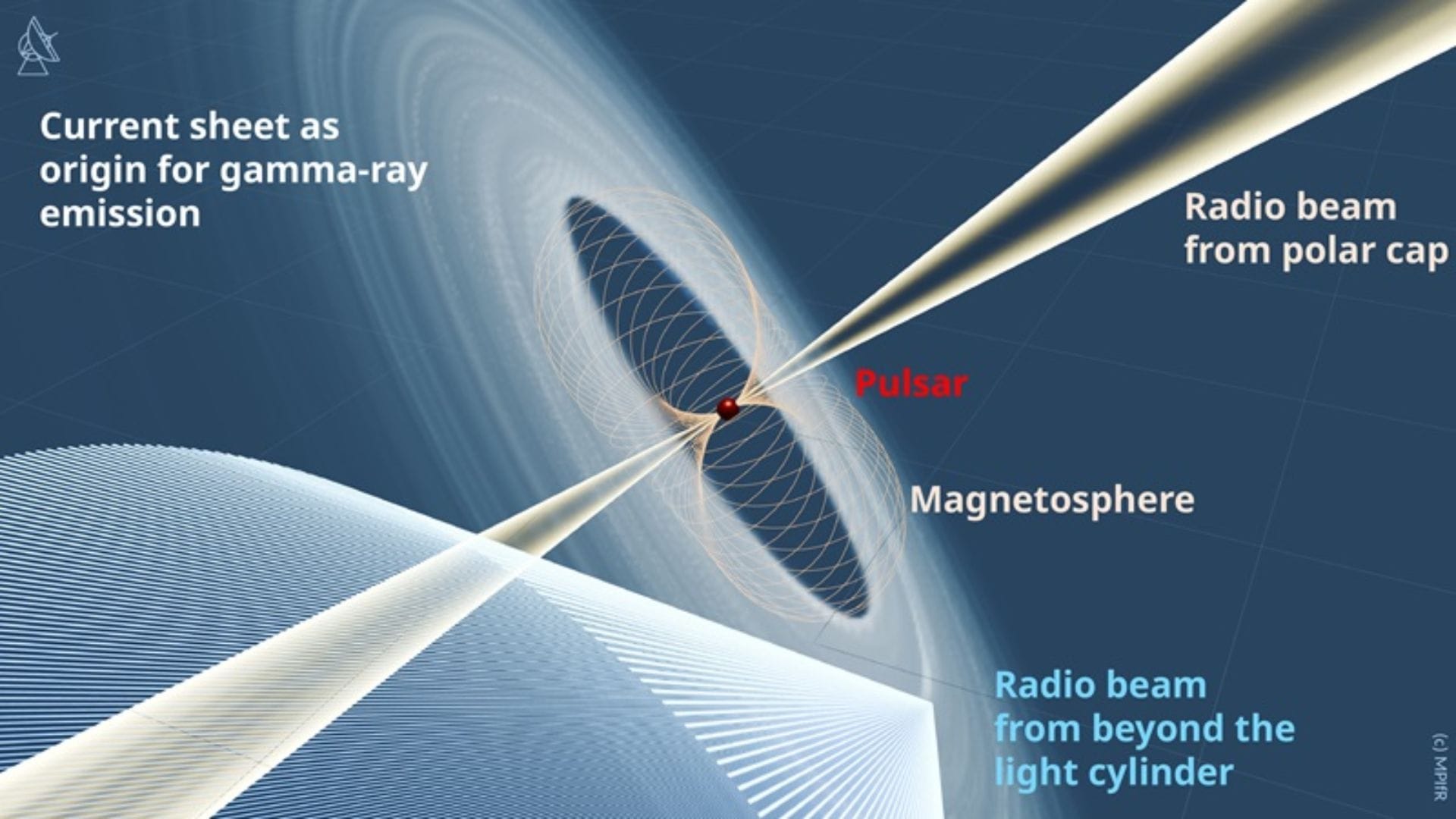
New Delhi: Astronomers compared the radio and gamma-ray emissions from 200 millisecond pulsars, rapidly rotating cores of death stars and discovered something remarkable and unexpected in the large data set. About a third of the millisecond pulsars showed radio signals coming from two or more separated regions, a behaviour that is observed in only three per cent of the slow rotating pulsars. Many of the isolated radio pulses lined up perfectly with gamma-ray flashes, indicating that both the signals were produced at the same extreme region of space.
The scientists suspect that the millisecond pulsars are producing radio waves in two very different regions. One is close to the magnetic poles of the dead star, which was traditionally assumed, and another in the swirling current sheet of charged particles, just beyond what is called the light cylinder. These are located in a perpendicular plane, away from the magnetic poles, where the magnetic fields sweep around at nearly the speed of light to keep up with the extreme rotation of the star. This current sheet is already believed to be responsible for the gamma-ray flashes, with the precise alignment of the radio waves indicating similar origin.
All gamma-ray millisecond pulsars also emit radio waves
The discovery has a number of significant implications. More pulsars can be discovered with the radio emissions so widespread. The discovery also helps explain why astronomers struggle to interpret the orientation of radio waves from millisecond pulsars, and suggests that all gamma-ray millisecond pulsars also emit radio waves, even if the signals are faint. The scientists still need to better understand the processes responsible for producing the radio waves in the extreme and turbulent environment away from the dead star. The research shows that pulsars are even more complex than previously thought. A paper describing the findings has been published in The Monthly Notices of the Royal Astronomical Society.