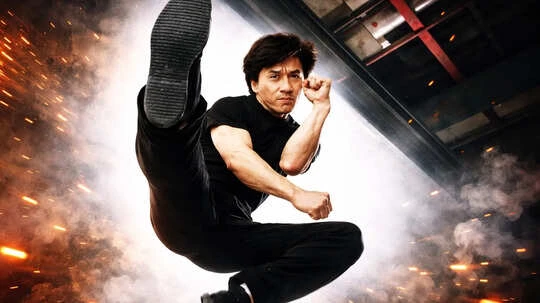
When Bruce Lee died in 1973, something strange happened in Hong Kong, Taiwan and South Korea. Filmmakers started casting Bruce Lee look-alike actors to star in imitation martial arts films.
The exploitation film subgenre got coined as Bruceploitation. However, there was an actor who strongly decided to step away from that subgenre.Jackie Chan, once in his career had said, “I never wanted to be the next Bruce Lee. I just wanted to be the first Jackie Chan.” This was a strong statement by the actor who celebrates his birthday today (April 7), for Lee was not just a star – he was a phenomenon. His screen presence in films Enter the Dragon redefined masculinity, power and global stardom. A young stuntman during the Bruceploitation era, Jackie Chan simply refused to follow that path, and would instead, one day go on to reinvent the action hero entirely.
The Anti-Bruce Lee
When Jackie Chan started his career, the industry tried hard to turn him into the next Bruce Lee. Early films like Lo Wei’s 1976 New Fist of Fury cast him in roles that were eerily similar to Lee’s intense, stoic persona. However, it did not click. Chan lacked neither skill nor charisma, but possibly, what he lacked was the desire to imitate. Instead, where Bruce Lee was composed, lethal and mythic, Chan became expressive, championing his vulnerability. His acts saw him bleed, stumble, get scared and ultimately make audiences laugh. It was not a flaw, but became his greatest strength.
Jackie Chan’s Reinvention Of The Martial Arts Hero
With the 1978 Snake in the Eagle’s Shadow and Drunken Master, Jackie Chan came into his own, fusing martial arts with comedy. The Rush Hourstar seemingly drew inspiration from silent film legends Charlie Chaplin and Buster Keaton, crafting a persona who was physically brilliant and emotionally accessible – a far cry from the Bruce Lee school of films. Chan’s rebellion to conventional norms, if we are to call it so, was more than just innovation. Martial arts films, until the, were usually tales of stoicism, revenge and honour codes. Chan, on his part, introduced chaos, improvisation and above all – humour. His characters were not invincible hero of traditional cinema, instead he championed underdogs who won through resilience, creativity, and sheer stubbornness. Jackie Chan managed to expand the genre.
Jackie Chan’s Everyman Appeal
What turned Chan into an everyman hero lay in his relatability. His characters often start at a disadvantage, often being outnumbered, outmatched and sometimes outright unprepared, but they persist. This everyman quality turned his appeal universal. The audience did not only admire Jackie Chan, they sometimes saw themselves in him. His pain felt because it was exactly so. Chan famously performed his own stunts, at great personal risks. He started off doing his own stunst in the 1980 The Young Master, before doing elaborate action scenes in the 1985 Police Story. Whether sliding down a skyscraper in Police Story or hanging off a clock tower in the 1983 Project A, his physical commitment added authenticity that CGI-heavy films still struggle to replicate. His vulnerability made him more human, and his films more appealing.
Comedy As A Weapon
What also worked for Chan was his incorporation of humour. For Jackie Chan, comedy was not an add-on. Instead, it was integral to the action in his films. Fight sequences were turned into elaborate choreographies of rhythm, precision, surprise and choreography, while everyday objects like ladder, chair table became both props and elements of humour. This was a distinct step away from Bruce Lee’s philosophy-driven combat style. While Lee fought with precision, Chan championed chaos and invention. With films like the 1998 Rush Hour, co-starring Chris Tucker, Jackie Chan brought this formula to the US and subsequently the global audiences.
Jackie Chan And The Bridging Of East And West
Jackie Chan’s rise also came at a crucial moment in global cinema, there was an increasing crossover between Hong Kong and Hollywood, and while Bruce Lee, undoubtedly had opened the door, Chan walked through it with a varied energy. Films like Shanghai Noon and the Rush Hour series allowed him to retain his comedic identity while appealing to international audiences. Chan, in many ways, became a cultural bridge, bringing his Hong Kong-style action choreography to the West while also introducing a softer, more humourous version of the action hero archetype to global cinema.
Refusal To Imitate Bruce Lee
Jackie Chan’s refusal to imitate Bruce Lee was perhaps not only a career choice, the actor understood the importance of authenticity in a medium, which is quick to forget. One might argue that even the evolution of superhero cinema owes something to Chan’s approach. Characters who crack jokes mid-battle, who struggle and improvise, echo the template he popularised decades ago. Gone was the stoic battle-hardened cowboy from Westerners, instead, Chan had introduced a hero who was simply put – more human.
A Different Kind of Hero And His Impact
In a cinematic world that is obsessed with perfection, Jackie Chan started out as an anomaly but went on to prove that imperfection, when used judicially can be powerful. He did not seek to replace Bruce Lee, or try surpass him, instead, he carved a parallel legacy built on laughter, resilience and authenticity. Where Bruce Lee redefined what it meant to be strong, Jackie Chan redefined what it meant to endure and find strength in vulnerability. And perhaps that is why his legacy is so enduring. In Jackie Chan, the audience did not just find a hero, but saw themselves.
As cinema continues to evolve, the hero archetype is bound to see change. Technology will advance, spectacle will grow and new stars will emerge, but Jackie Chan’s influence will remain embedded in the DNA of storytelling. Chan proved that action could be funny, that heroes could be flawed that humour could win. Jackie Chan championed the everyman hero, and in doing so, he didn’t just change martial arts cinema, he made it more human.