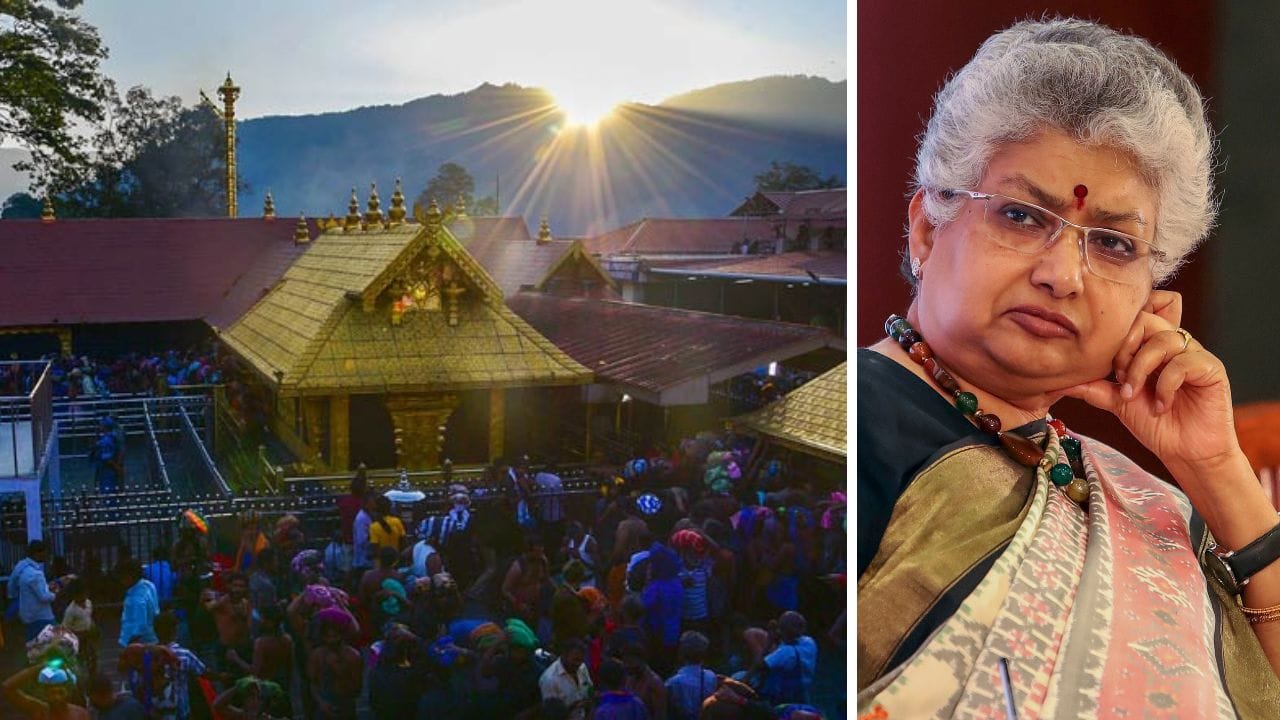
Supreme Court judge B V Nagarathna made a pointed observation on Tuesday (April 7) while hearing petitions related to discrimination against women at religious places. The case primarily pertains to the ban on the entry of women in the Sabarimala temple, with petitions also raising questions on the ambit and scope of religious freedom practised by multiple faiths.
Women in the age group of 10–50 years are not allowed entry into the Sabarimala premises. Incidentally, this is the age when women menstruate, and Justice Nagarathna’s reference was to this period.
Remark that reframed the debate
“Speaking as a woman,” Justice Nagarathna said, “there cannot be a three-day untouchability every month, and on the fourth day, there is no untouchability.”
The comment came amid arguments over whether restricting women of a certain age group from entering the Sabarimala temple amounts to “untouchability” under Article 17 of the Constitution. The Centre, represented by solicitor general Tushar Mehta, has opposed that interpretation.
Yet Justice Nagarathna’s remark does something more than respond to a legal argument. It reframes the question itself.
The issue is no longer only about entry into a temple. It is about how dignity is defined and who gets to define it.
Beyond Sabarimala, a wider constitutional tension
The Sabarimala case has long stood at the intersection of faith and equality.
In its 2018 judgment, the Supreme Court held that excluding women from entering the Sabarimala temple, whether based on age or menstrual status, violated constitutional principles. Justice D Y Chandrachud had then argued that such exclusion was a form of “untouchability”, placing women in a “subordinate” position. He further added that such exclusion reinforced notions of “impurity”, was derogatory to the dignity of women, and perpetuated patriarchy.
The Centre’s position, however, attempts to narrow the frame. It argues that the restriction is not about menstruation but about a specific age group, making Sabarimala a unique or “sui generis” case.
This distinction matters. If the restriction is purely age-based, it may be seen as a denominational practice. If it is tied, even indirectly, to ideas of purity and impurity, it invites scrutiny under the Constitution’s equality framework. That line of distinction has to be decided by the judiciary.
Language of faith vs. language of rights
At the heart of the case lies a familiar tension. Religious practices often operate within their own internal logic. Constitutional law, on the other hand, demands consistency and universality. When a practice excludes a group of people, the court must ask whether that exclusion is essential to the religion or whether it reflects social attitudes that the Constitution seeks to move beyond.
Justice Nagarathna’s remark cuts through this tension. It questions the coherence of a practice that appears to mark women as temporarily impure. Even if framed differently, the underlying logic becomes difficult to ignore.
The question then is not merely whether a temple has the right to regulate entry. It is whether such a regulation can stand when it conflicts with the idea of equal dignity.
Is “untouchability” the right frame?
The debate over Article 17 adds another layer. Traditionally associated with caste-based discrimination, “untouchability” carries a specific historical meaning. The Centre has argued that extending this concept to the Sabarimala case stretches the Constitution beyond its intended scope. This is not a trivial concern. Expanding constitutional terms risks diluting their original purpose.
Yet the counterargument is equally strong. If the essence of untouchability lies in exclusion based on notions of purity, then its application cannot be limited only to caste. The court must then decide whether the principle can evolve with changing understandings of “discrimination”.
A case that refuses to remain confined
What began as a dispute over entry into one temple has now grown into a broader constitutional inquiry. A nine-judge bench is examining not just Sabarimala but also the limits of religious freedom across faiths. Justice Nagarathna is the lone woman on the bench, which comprises Chief Justice Surya Kant and Justices M M Sundresh, Ahsanuddin Amanullah, Aravind Kumar, Augustine George Masih, Prasanna B Varale, R Mahadevan and Joymalya Bagchi.
This judgment is significant because the outcome will likely shape how the Indian judiciary approaches similar disputes in the future, whether in temples, mosques or other religious spaces. It will also test how far the Constitution is willing to go in confronting practices rooted in tradition.
The larger question
Justice Nagarathna’s remark lingers because it is simple. It strips away legal complexity and returns to a basic question of fairness.
Can a society that rejects untouchability in principle accept it in practice, even if only for a few days?
The answer will not be found in one hearing or one judgment. But the direction is becoming clearer. The Supreme Court is no longer just interpreting faith. It is examining whether faith, as practised, can stand alongside the Constitution’s promise of dignity.