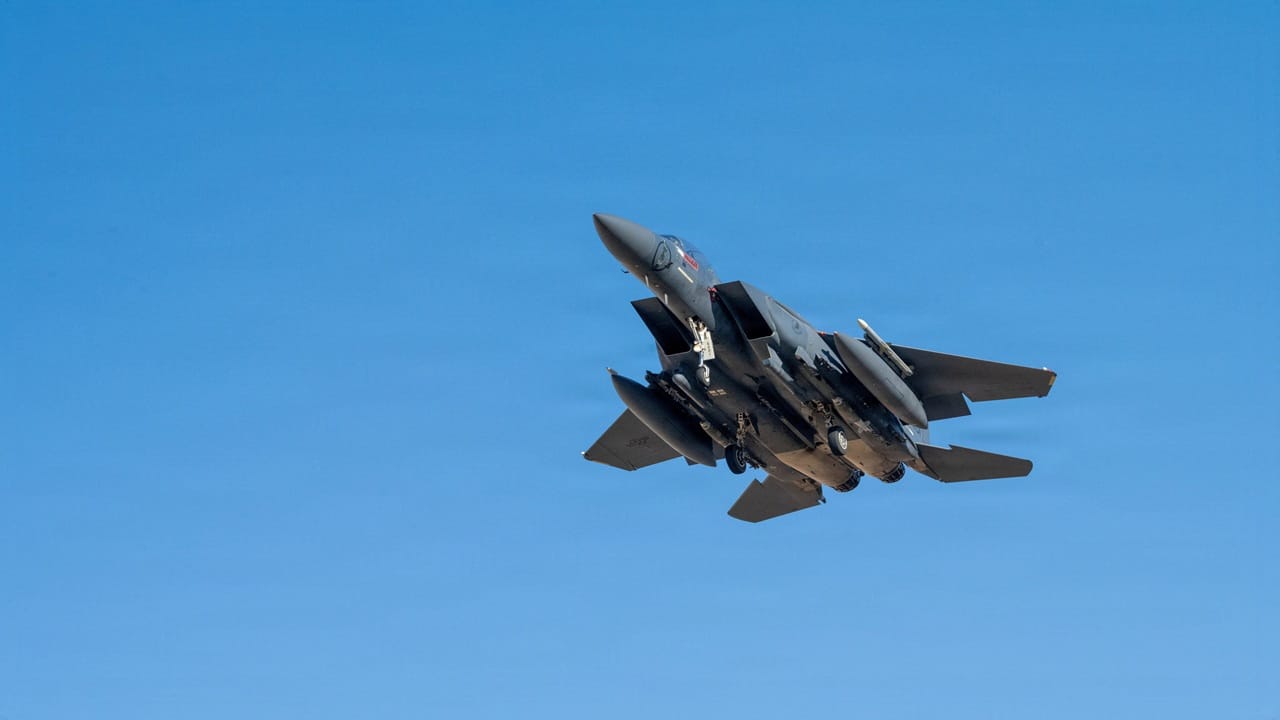
New Delhi: During the ongoing US–Iran conflict, an American F-15E Strike Eagle fighter jet was shot down deep inside Iranian territory last Friday. Both crew members ejected, but one ended up stranded behind enemy lines in mountainous terrain. What followed was a high-stakes combat search-and-rescue (CSAR) mission, which US President Donald Trump later described as “one of the most daring in US history.” Iran meanwhile offered rewards to anyone who would turn in an ‘enemy pilot’.
Mishap occurs
The F-15E Strike Eagle fighter jet that was shot down by Iran last Friday was part of a package targeting Iranian military infrastructure. According to several reports, it was likely hit by a surface-to-air missile from Tehran’s layered air defence network. The F-15E is among the US Air Force’s most advanced strike platforms, often used in missions that require penetration into heavily defended airspaces.
After the F-15E was struck in Iran, both crew members ejected safely. One though ended up stranded behind enemy lines in mountainous terrain, and it was in response to this that a combat search-and-rescue (CSAR) mission was launched by the US.
Deception employed
The rescue mission reportedly started with a covert deception campaign run by the Central Intelligence Agency (CIA) of the US. It was designed to mislead Iranian forces in the critical hours before extraction.
According to reports, US intelligence operatives deliberately seeded false information inside Iran suggesting that the stranded airman had already been located and was being moved elsewhere. This effectively sent Iranian search efforts in the wrong direction, creating confusion on the ground which bought valuable time for US special forces to locate the real position and plan the extraction without immediate interference.
Mission impossible
The actual extraction of the stranded US pilot reportedly unfolded as a tightly coordinated combat search-and-rescue operation. It combined airpower, special forces, and real-time intelligence.
Once the position of the stranded airman was narrowed down, US Central Command assembled a large rescue package that included special operations troops, armed helicopters, fighter jets, and surveillance drones. According to reports by Politico and Reuters, aircrafts were used not just for cover but for active battlefield shaping, striking nearby roads and suspected Iranian positions to slow any approach toward the extraction zone. Electronic warfare systems were also used to disrupt local radar and communications. Subsequently during nighttime, rescue helicopters pushed into hostile airspace, navigating mountainous terrain to reach the isolated pilot, who had been evading capture using survival training.
Further, as reported by Reuters and the Associated Press, Iranian forces were already converging on the general area, forcing US troops to move quickly once contact was made. The airman was brought to a pickup point and loaded onto a helicopter while US aircraft continued to provide suppressive fire overhead. Despite one rescue aircraft getting damaged during combat and others forced into rapid adjustments mid-mission, all mission personnel were successfully extracted, in what was one of the most successful high-risk search and rescue operations in US military history.