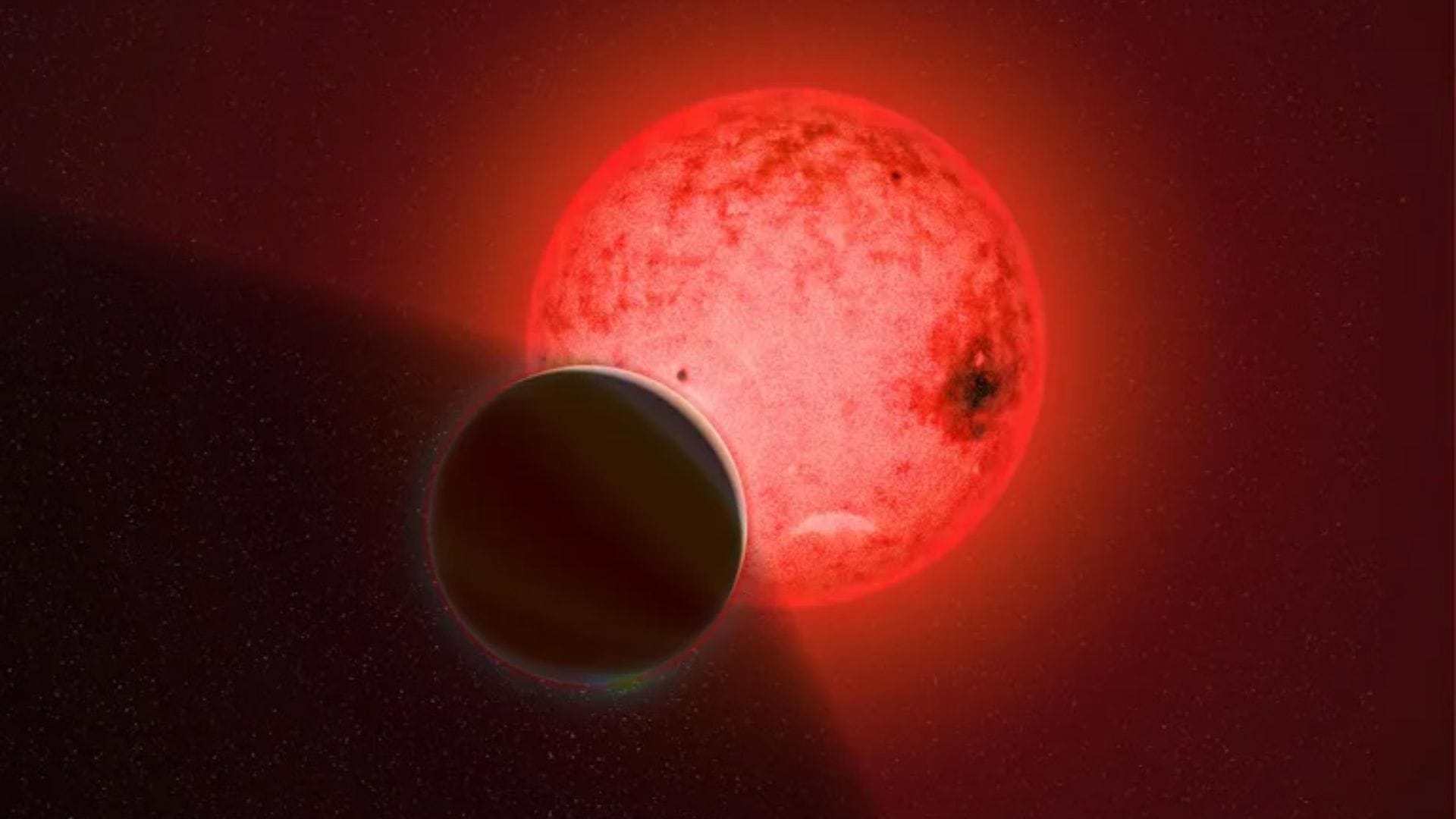
New Delhi: The James Webb Space Telescope has peered into the atmosphere of the exoplanet designated as TOI-5205 b, and discovered that the atmosphere has fewer heavier elements than its host star. The observations improve the scientific understanding of the formation of gas giants, and the processes at work in the infancy of a star. TOI-5205 b is a gas giant, about the size and mass of Jupiter orbiting a host star that contains only four times the mass of Jupiter, or 40 per cent the mass of the Sun. Such a large exoplanet simply should not form around such as small star according to conventional models of planet formation, leading to TOI-5205 b being dubbed a ‘forbidden planet’.
When TOI-5205 b passes in front of the host star from the vantage point of the Earth, a transit takes place, where the large world blocks about six per cent of the light from the host star. The configuration of the system is well-suited for characterising the atmosphere. By observing transits through spectrographs that split the light up into its constituent wavelengths, scientists can determine the chemical composition of the atmosphere, and learn about the history of the planet and its relationship with the host star. These observations revealed something else that astronomers struggled to explain, apart from the relatively large size of the planet.
An unusual chemical composition
The atmosphere of the planet has fewer heavy elements relative to hydrogen, than gas giants in our own Solar System. TOI-5205 b also has a lower metallicity than its host star, which makes the world stand out among all the gas giants studied so far. The scientists were able to calculate the metallicity of the entire planet based on the measurements of its mass and radius, indicating a composition about 100 times more metal rich than the atmosphere. The findings indicate a carbon-rich, oxygen-poor planetary atmosphere. A paper describing the research has been published in The Astronomical Journal.