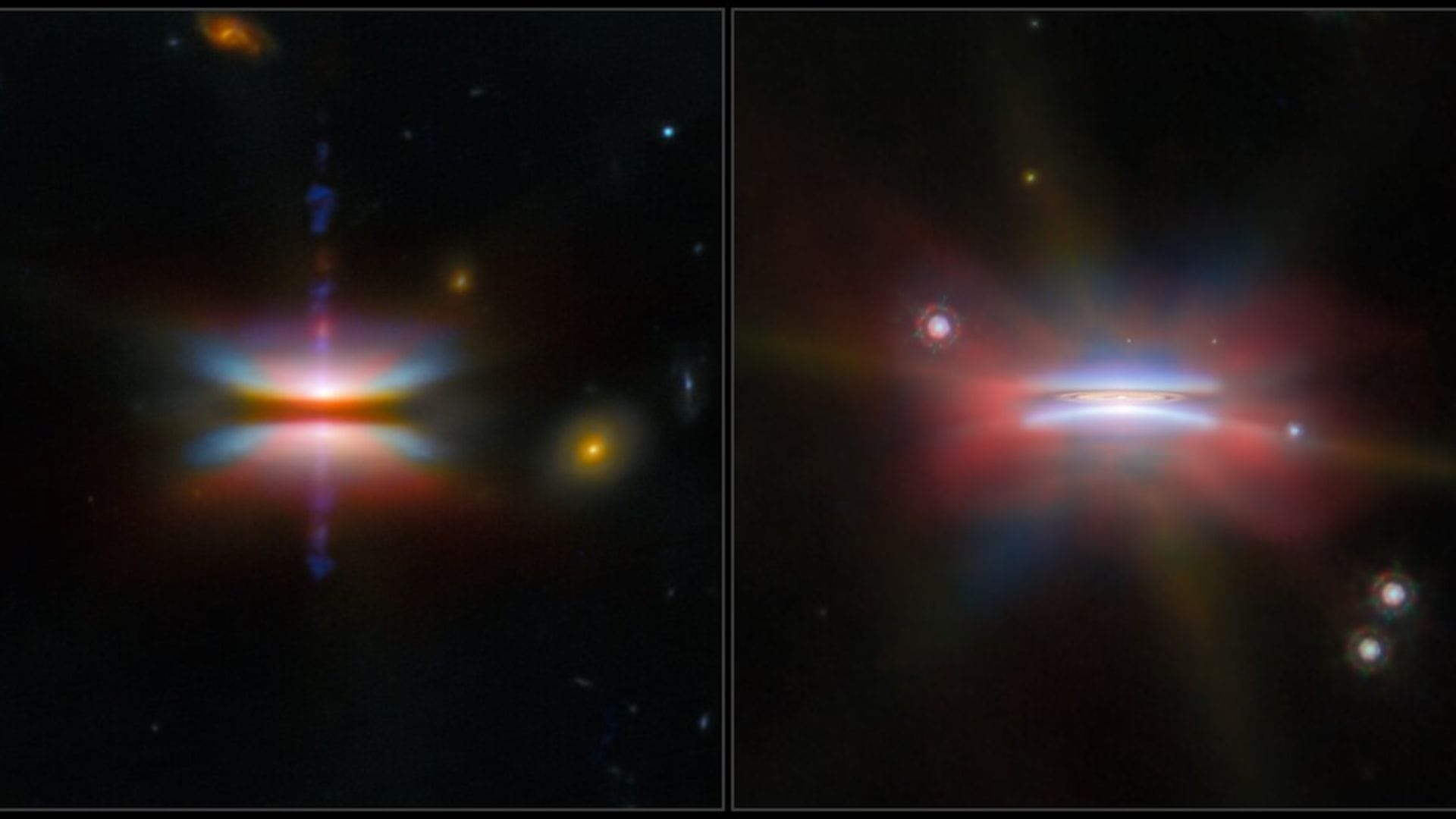
New Delhi: The James Webb Space Telescope has captured the images of a pair of protoplanetary disks, Tau 042021 at a distance of about 450 lightyears from the Earth in the constellation of Taurus and Oph 163131, at a distance of about 480 lightyears in the constellation of Ophiuchus. Such protoplanetary disks are a swirl of gas and dust where planets are assembled from the material leftover from the birth of a star. Stars are born from dense clumps in vast molecular clouds, with the infalling material flattening into a disk. Objects in the disk that do not clump into planets remain small, pristine bodies such as asteroids and comets.
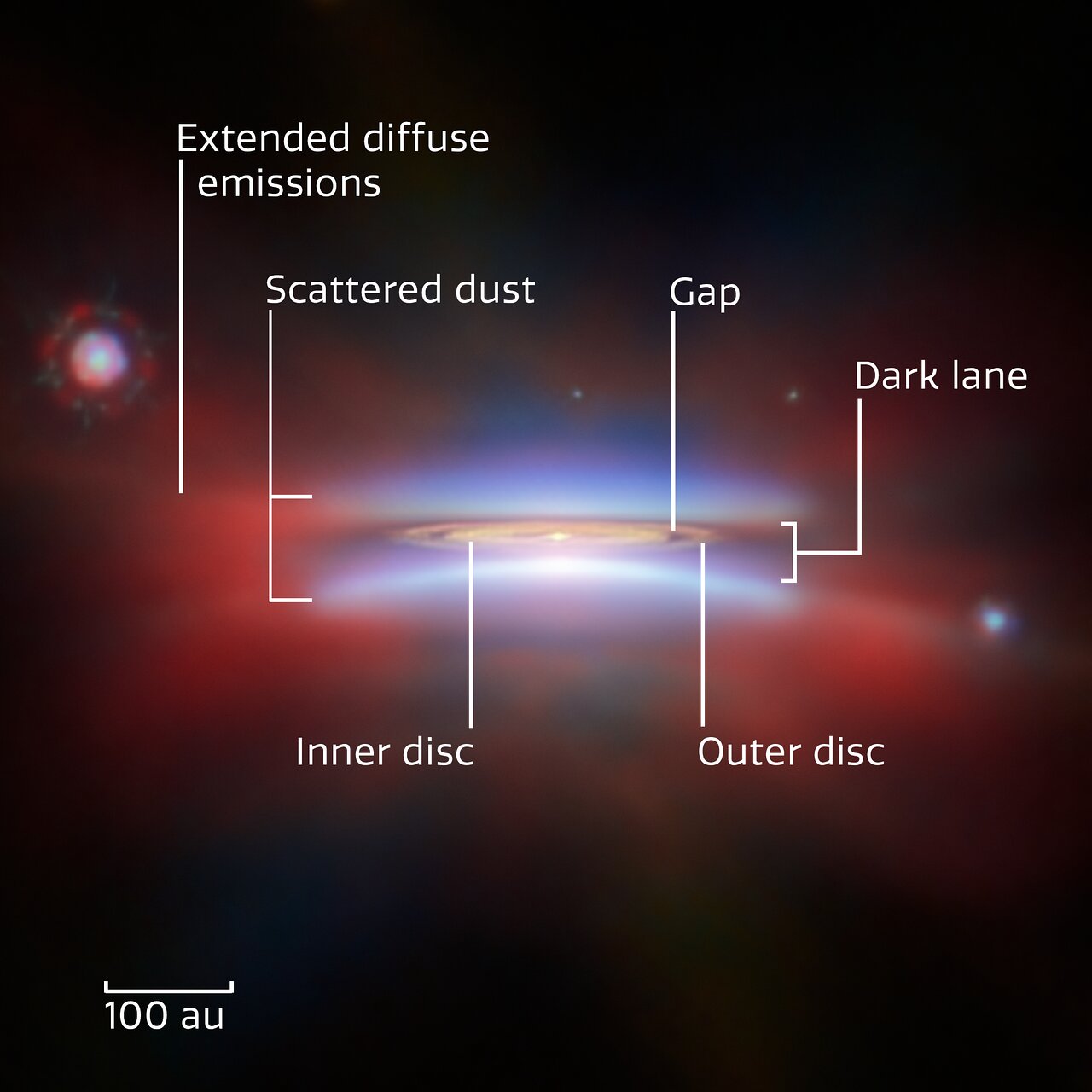
Observed features of Oph 163131. One AU or Astronomical Unit is the distance between the Earth and the Sun. (Image Credit: ESA/Webb, NASA and CSA, ESA/Hubble, ALMA (ESO/NAOJ/NRAO), M Villenave).
Both the disks are oriented edge-on to Webb, with most of the light from the host star being blocked. Perpendicular to the disk, the dust has risen in both directions, appearing as a nebula. The distribution of the dust in the disk, as well as above and below it, determine the regions where planet formation can occur. Both the images also incorporate observations captured by NASA’s other flagship deep space observatory, the Hubble Space Telescope.
What the images tell us
Once a star begins to sustain nuclear fusion, the radiation blows away the remaining gas and dust, dissipating the protoplanetary disk. The planets have only a short window to scoop up enough material. What planets are formed, and where they are assembled depends on the migration of the larger and smaller grains of dust through the protoplanetary disk. The observation allows scientists to better understand the processes that lead to the formation of worlds. The larger grains of dust are concentrated in the central plane of the disk, with the finer grains in the lobes. The different colours in the wings indicate the presence of different molecules.