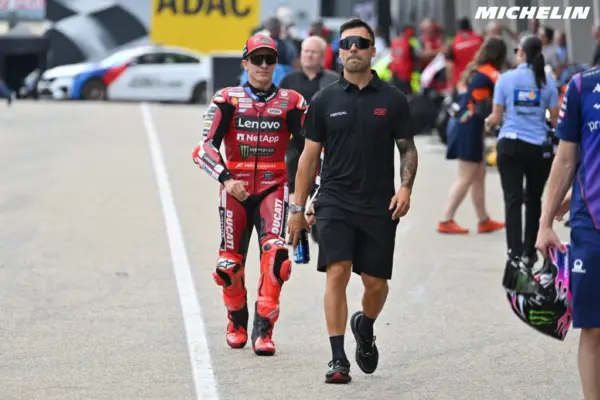
Unveils the Intensity of His Weekends: “From Thursday to Sunday, I Remember Nothing But the Bike”
Marc Márquez has peeled back the curtain on the relentless physical and mental demands of a weekend, revealing the absolute focus required at the highest level of motorcycle racing. Speaking candidly in an interview on the YouTube channel Soy Blak, the Ducati Lenovo Team rider and nine-time world champion admitted that during a , every aspect of his life is consumed by the sport.
“My partner knows, and so does my family, that from Thursday to Sunday, anything they tell me unrelated to the bike-I won’t remember it,” Márquez confessed. “Even what they tell me on Monday after a , I probably won’t remember either.” This tunnel vision underscores the intensity with which Márquez approaches each race, shutting out all distractions as he chases perfection on track.
The Spanish star also lifted the lid on the challenges of rest and recovery during race weekends. Far from being kept awake by nerves, Márquez pointed to the sheer adrenaline generated by ‘s sprint races and main events as the main culprit behind his insomnia. “The adrenaline you get from a sprint race or a main race means you sleep very little,” he explained. He detailed how, even before falling asleep, his mind remains occupied with technical details-pondering tyre choices, fine-tuning set-up, and strategizing overtaking points.
Physical hardship remains a constant companion for Márquez, who continues to deal with the aftereffects of injuries, particularly to his right shoulder. “You live with discomforts. Obviously, sleeping on my right side is forbidden-I have to sleep on my left because of my shoulder,” he revealed. Should he inadvertently turn onto his injured side at night, the pain is sharp enough to wake him instantly.
Looking to the future of the sport, Márquez expressed skepticism about the impact of ‘s forthcoming technical regulations, particularly the reduction in engine displacement to 850cc. “They’ll be slower, but I think from the grandstands people won’t even notice,” he said. However, he voiced disappointment that the planned reduction in aerodynamic downforce was not more drastic: “I would have liked them to take away much more.”
Márquez elaborated on the effects of reduced aero, noting it makes bikes trickier to handle in close-quarters : “When you’re behind another bike, it’s harder to ride.” Still, he acknowledged that each era of presents its own set of challenges and advantages.
Asked about race starts and the opening corners, Márquez highlighted instinct and improvisation as his greatest assets. “That’s instinct, and that’s what I do best-following my instincts and improvising,” he stated, emphasizing the impossibility of predicting rivals’ moves and the importance of being able to adapt on the fly.
On mental health, Márquez stands apart from many elite athletes, stating he has never worked with a sports psychologist. “My main psychological support is my inner circle,” he said, adding that he protects his mental health by disconnecting from social media entirely during weekends.
As the conversation wound down, Márquez offered advice to athletes facing tough recoveries, stressing patience and resilience. “The first weeks are the hardest, but time changes everything. The body is wise-it remembers, but it also forgets,” he reflected. Summing up his hard-earned perspective, he concluded: “The body forgets the bad and remembers the good.”