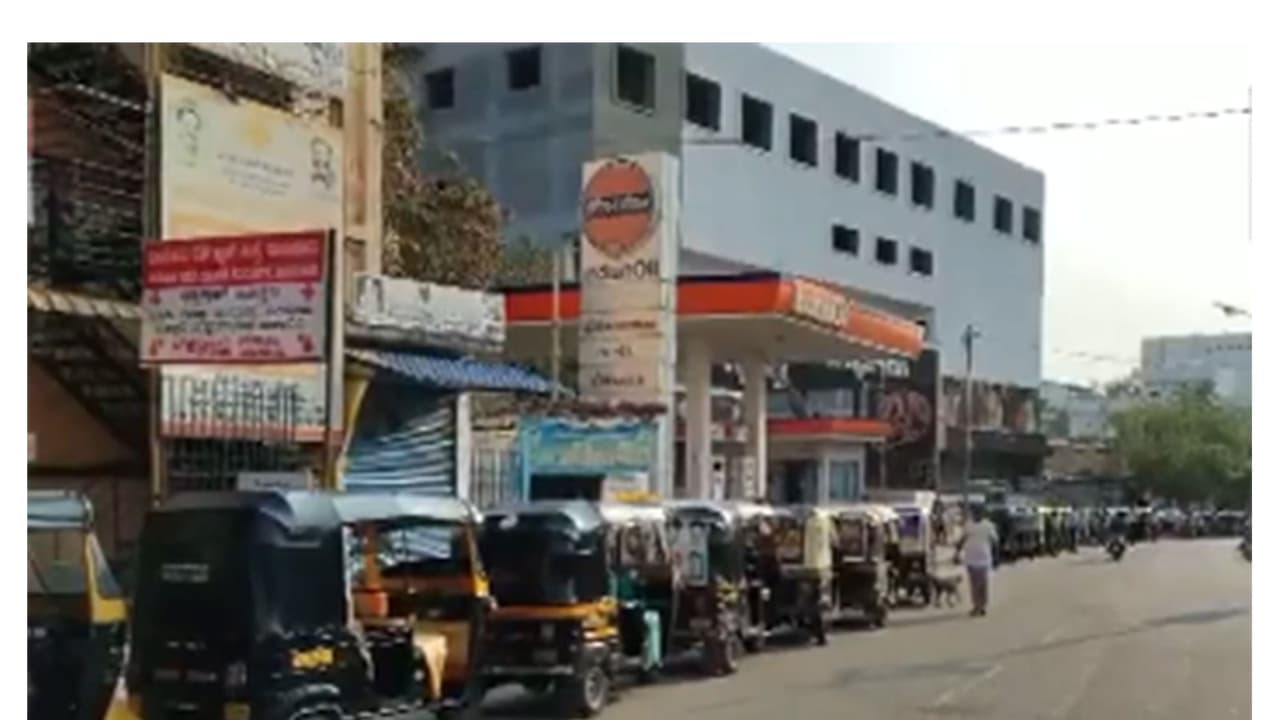
LPG shortage rumours in North Karnataka spark panic buying, forcing Raichur’s auto drivers into long queues. Despite govt assurances and measures against hoarding, protests continue over price hikes, threatening daily livelihoods.
Thousands of autorickshaw drivers in Raichur and surrounding districts have been forced into gruelling, hours-long wait times at refuelling stations this week as rumours of a severe LPG shortage sweep through Northern Karnataka. The panic, largely fueled by the closure of several private outlets and global supply chain disruptions linked to the ongoing West Asia crisis, has seen “serpentine” queues stretching past city landmarks.
State Government and PSUs Respond
While the state government and major Public Sector Undertakings (PSUs) like IndianOil have assured the public of adequate stock and scaled-up distribution, the disparity between government-fixed rates and hiked private prices continues to trigger protests among the driver community, whose daily livelihoods hang in the balance. The Karnataka Food and Civil Supplies Minister, K.H. Muniyappa, has reiterated that there is no “actual” shortage for domestic or public transport needs. The government directed IndianOil to ramp up daily sales (currently at 59.53 Metric Tonnes per day). It warned private distributors against black marketing and unauthorised price hikes, as well as, established district-level monitoring committees to conduct raids on hoarding sites.
The Government of India on Saturday issued a strong assurance to the public, confirming the adequate availability of petrol, diesel, LPG, and PNG across the country. Meanwhile, on Friday, Indian Oil Corp clarified that its five kg Free Trade Liquefied Petroleum Gas (FTL) cylinders are supplied continuously by the oil marketing companies to migrant labourers and adequate arrangements have been made to maintain steady availability and added that there is no disruption in supplies, the government-owned company said.
Hindustan Petroleum Corp said that it delivered a record 14,10,000 cylinders under its LPG segment from its 55 bottling plants and also supplied 27,800 free trade LPC cylinders in the 5 kg segment and 1,500 cylinders in the 2 kg segment.
CM’s Earlier Appeal on Commercial LPG Shortage
Earlier, in March, Karnataka Chief Minister Siddaramaiah wrote to Union Petroleum Minister Hardeep Singh Puri, seeking urgent intervention to tackle the severe shortage of commercial LPG in Bengaluru, which has disrupted supply and livelihoods across the state.
In a post on X, CM Siddaramaiah wrote, the state is currently receiving just 1,000 cylinders per day against a demand of around 50,000, forcing businesses and hotels to halt operations despite government measures to prioritise supply for essential sectors. “I have written to the Union Petroleum Minister Hardeep Puri seeking urgent intervention to address the severe shortage of commercial LPG in Bengaluru, which is impacting supply and livelihoods across Karnataka,” Karnataka CM said. He added, “The State Government has already taken steps to regulate and prioritise supply for essential sectors. However, with demand at around 50,000 cylinders and supply limited to just 1,000 per day, the situation remains critical – forcing businesses and hotels to shut down. I have requested immediate allocation support to ensure adequate availability of commercial and auto LPG for Karnataka.”
India’s Response to West Asia Tensions
Meanwhile, India is actively engaging with global partners to safeguard its energy security and the safety of Indian nationals in the Gulf as tensions in West Asia continue to disrupt trade and logistics. In view of the disruptive situations, the Central government has also announced a financial relief package of Rs 497 crores aimed at helping exporters affected by disruptions in West Asia.
Ministry of External Affairs spokesperson Randhir Jaiswal said the ongoing situation has posed challenges for countries across the world. “It has been a testing time for not just us, but for the entire global community. Our leaders have been in touch with their counterparts,” Jaiswal said. India is continuing to coordinate with stakeholders to ensure uninterrupted energy supplies and the safety of its citizens in the Gulf region, he added.
At the second meeting of the Informal Group of Ministers (IGoM), which monitors the evolving situation in West Asia and suggest proactive measures for its minimum impact on India, Defence Minister Rajnath Singh said that in view of the “uncertain situation”, the Defence Minister underlined the importance of round-the-clock monitoring of the situation and the need to respond in a calibrated manner to deal with any eventuality. He stressed the need to leave no stone unturned to ensure that the people of the country face the minimum effect of the conflict. (ANI)
(Except for the headline, this story has not been edited by Asianet Newsable English staff and is published from a syndicated feed.)