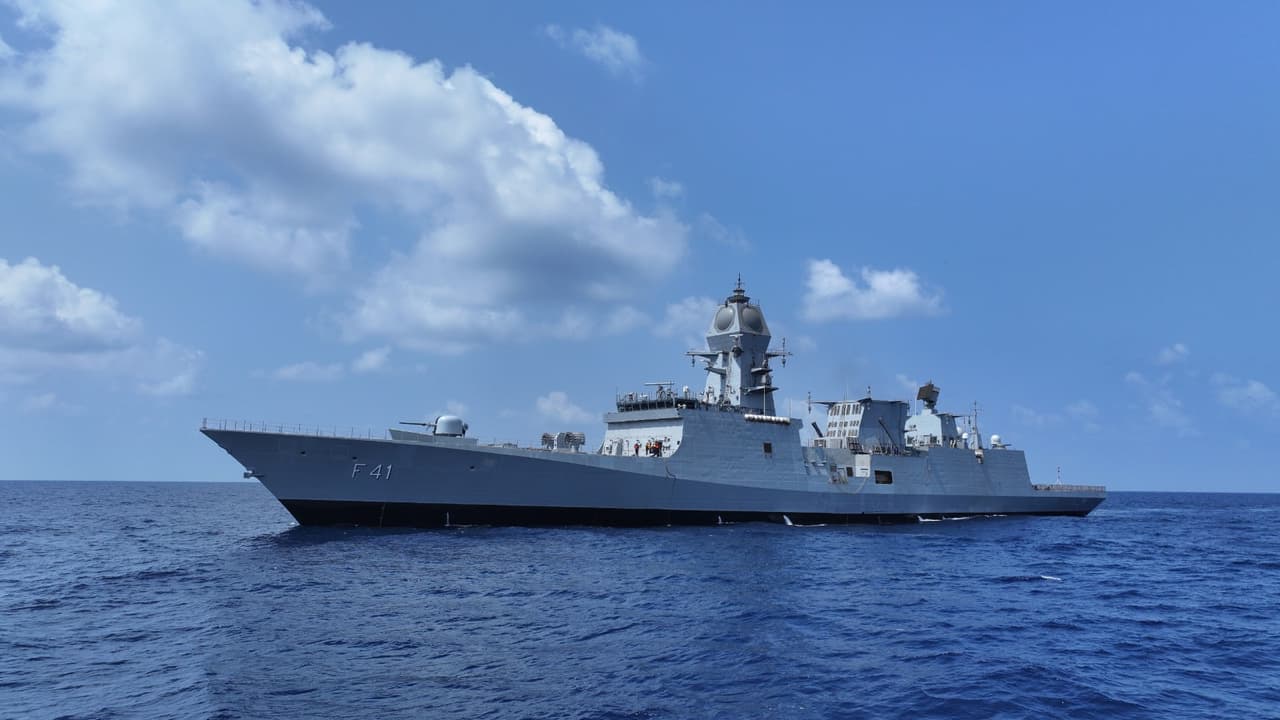
India has added a major boost to its naval strength with the commissioning of INS Taragiri in Visakhapatnam. Stealth frigate, part of Project 17A, is equipped with advanced radar, sonar and BrahMos missile systems. With over 75% indigenous content, it highlights India’s growing defence capability. Rajnath Singh said it boosts maritime security.
New Delhi: Defence Minister Rajnath Singh on Friday commissioned the fourth platform of the Project 17A class – INS Taragiri into the Indian Navy at Visakhapatnam in Andhra Pradesh. A master-class in modern naval shipbuilding, this latest stealth frigate, with a displacement of approximately 6,670 tonnes, has been designed by the Warship Design Bureau and built by Mazagon Dock Shipbuilders Limited, with the support of MSMEs, for multi-role operations.
“It utilizes advanced stealth technology to achieve a significantly reduced radar signature, providing a lethal edge in contested environments,” Indian Navy PRO Captain Vivek Madhwal said.
With over 75% indigenous content and built in significantly reduced timelines, INS Taragiri exemplifies India’s shipbuilding prowess and strong public-private collaboration.
Rajnath Singh on INS Taragiri
In his address, Rajnath Singh described INS Taragiri as not merely a warship but a symbol of India’s growing technological prowess, self-reliance, and formidable naval power.
“This ship is capable of high-speed transit and can remain deployed at sea for extended periods. It is equipped with systems designed to monitor enemy movements, ensure its own security, and if necessary, deliver an immediate response.”
“It features modern radar, sonar, and missile systems, such as BrahMos and surface-to-air missiles, which further augment its operational prowess. From high-intensity combat to maritime security, anti-piracy operations, coastal surveillance, and humanitarian missions, it fits perfectly into every role, making it a unique naval platform,” he said.
Rajnath Singh asserted that India, with a coastline stretching over 11,000 kilometers, is surrounded by the sea on three sides, and it cannot view its development in isolation from the ocean.
He added that approximately 95 percent of the country’s trade is conducted via maritime routes, and energy security is dependent on the sea, which makes building a strong and capable Navy not merely an option, but an absolute necessity.
Highlighting the immense significance of the maritime domain in the evolving security landscape, the defence minister stated that the Indian Navy maintains a round-the-clock presence across the Indian Ocean region amidst the global uncertainties.
“The vast expanse of the ocean contains numerous sensitive points, where our Navy has consistently maintained an active presence to ensure the smooth flow of goods. Whenever tensions flare, the Indian Navy steps-in to guarantee the security of commercial vessels and oil tankers. It is not only safeguarding India’s national interests, but is also prepared to take every necessary measure to protect our citizens and trade routes across the globe. It is this capability that firmly establishes India as a responsible and formidable maritime power,” he said.
“We must not limit ourselves to safeguarding our coastlines; we must also ensure the security of critical sea lanes, choke points, and digital infrastructure that are inextricably linked to our national interests.”
“The Indian Navy is proactively engaged in all these security endeavors. This approach prepares us for future challenges. Whenever India constructs and deploys advanced vessels such as INS Taragiri, it serves as a guarantee of peace and prosperity for the entire region,” he said.
Rajnath Singh also pointed out that whenever a crisis arises, be it evacuation operations or humanitarian assistance, the Indian Navy invariably stands at the forefront, serving as a symbol of India’s core values and unwavering commitment.
“INS Taragiri will further augment the strength, values, and commitment of our Navy,” he said.
Speaking on the occasion, Chief of the Naval Staff (CNS) Admiral Dinesh K Tripathi highlighted INS Taragiri’s rich legacy, recalling the erstwhile Leander-class frigate commissioned in 1980, which played a pioneering role in advancing India’s anti-submarine warfare capabilities and operational innovation.
Reflecting on the evolving maritime security environment, he underscored the growing complexities of the Indian Ocean Region, shaped by dynamic geopolitics, emerging technologies, and non-traditional threats.