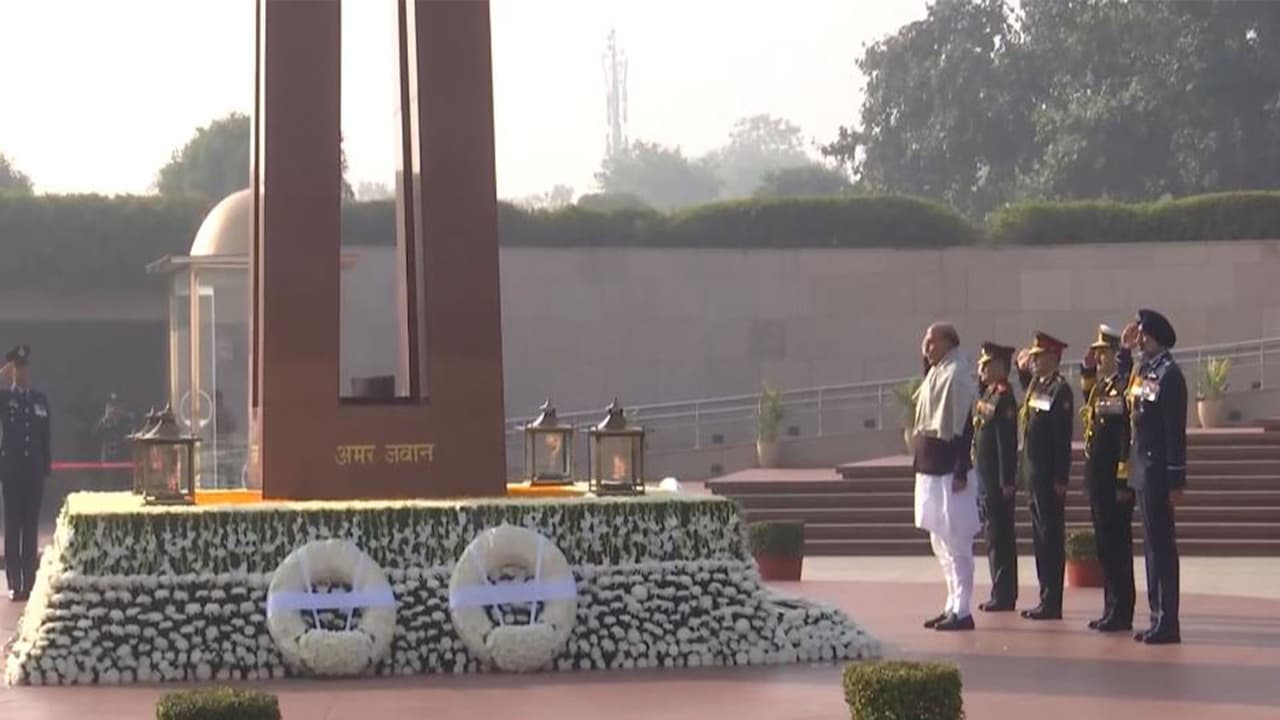
A wreath-lying ceremony was held at the National War Memorial for the 54th Vijay Diwas. Defence Minister Rajnath Singh and the Tri-Service Chiefs paid tribute to honour the Indian Armed Forces’ decisive victory in the 1971 war.
Commemoration at National War Memorial
A wreath-lying ceremony was held at the National War Memorial in New Delhi on Tuesday to commemorate the 54th Vijay Diwas, marking the decisive victory of the Indian Armed Forces in the 1971 War. The event was attended by Defence Minister Rajnath Singh, CDS Chief General Anil Chauhan, COAS General Upendra Dwivedi, Air Chief Marshal Amar Preet Singh, and Chief of Naval Staff Admiral Dinesh Kumar Tripathi.
Singh walked up to the Amar Jawaan jyoti with the Tri-Service Chiefs and offered a white wreath in honour of the brave soldiers and their contribution to the war. Rajnath Singh, along with the CDS Chief, the COAS General, Air Chief Marshal, and the Chief of Naval Staff, paid their respects to the courageous armed forces who fought in the battle of 1971, which led to the liberation of Bangladesh.
The Historic Surrender of 1971
The 1971 war came to an end when the defeated fair and square Lt Gen AAK Niazi, Cdr Pak Army Eastern Command, surrendered & signed the Instrument of Surrender at 1631 IST on 16 Dec and a new nation “Bangladesh” was born, the Eastern Command of Indian Army said.
Terms of the Instrument of Surrender
After defeat, the Pakistan Eastern Command agreed to surrender all Pakistani Armed Forces in Bangladesh to Lieutenant-General Jagjit Singh Aurora, General Officer Commanding in Chief of the India and Bangladesh forces in the Eastern Theatre. The historic surrender included all of the Pakistani land, air, and naval forces, along with all the para-military and civil armed forces, to surrender at the places where they were located in the nearest regular troops, and lay down their weapons, under the command of Lieutenant-General Jagjit Singh Aurora.
The surrender also meant that the Pakistan Eastern Command would fall under the orders of Lieutenant-General Aurora, immediately after signing. Any disobedience to the orders was notably considered as a breach of the surrender terms, and strict action followed with the accepted terms of laws and usages of war. According to the “Instrument of Surrender,” the decision of Lieutenant-General Aurora was final. He also assured that the surrendered soldiers will be treated with the dignity and respect that soldiers are entitled to, in accordance with provisions of the GENEVA Convention and guaranteed the safety and well-being of all Pakistani military and para-military forces who surrendered. Along with this, Lieutenant-General Aurora promised protection to be provided to foreign nationals, ethnic minorities and personnel of West Pakistan origin by the forces under the command of Lieutenant-General Aurora.
The Legacy of Vijay Diwas
Since then, Vijay Diwas is annually observed on December 16, commemorating India’s decisive victory in the 1971 war, which led to the freedom of Bangladesh. (ANI)
(Except for the headline, this story has not been edited by Asianet Newsable English staff and is published from a syndicated feed.)