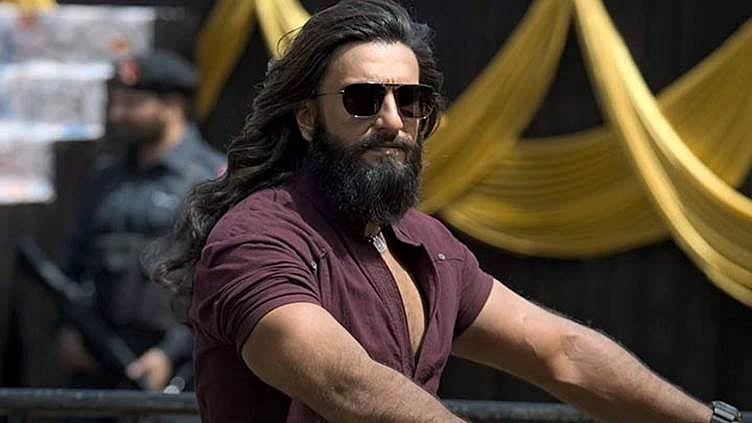
However, Aditya Dhar does not consider this to be a framework for action. Rather, he sets it up like a political chessboard, with each move being examined, tested, and postponed.
No generic Middle Eastern music
This reality is enhanced by the music. Generic Middle Eastern signals are frequently used in Hindi spy movies to indicate Pakistan. That shorthand is rejected by Dhurandhar. Saswath, composer. In order to unnerve rather than exoticised the environment, Sachdev incorporates unexpected textures into the story, such as vintage qawwali themes, retro Bollywood tunes, Punjabi folk, and disco echoes.
 Ranveer Singh in DhurandharCharacters are built for survival, not to be ‘cool’
Dhurandhar recognises a basic fact that many spy movies overlook: spying is most effective when characters control the world, not the other way around. With remarkable restraint, Ranveer Singh approaches Hamza. His composure is planned, his stillness tactical. The movie recognises that an undercover agent in dangerous territory cannot afford to let go of their feelings. After being suppressed for so long, violence eventually breaks out.
Violence was a consequence rather than a display
Dhurandhar’s violence is unadulterated and frequently uncomfortable to witness. However, it is never aspirational, in contrast to stylised action movies. It mirrors the known ferocity of Lyari’s gangland past, where acts of violence are commonplace rather than unusual. Dhar depicts motion with little to no filtering, as opposed to choreographing it like a ballet. The discomfort is deliberate. Violence is thrilling in most Bollywood espionage movies. It makes a mark here. Brutality is not viewed as a spectacle to be applauded, but rather as context and consequence.