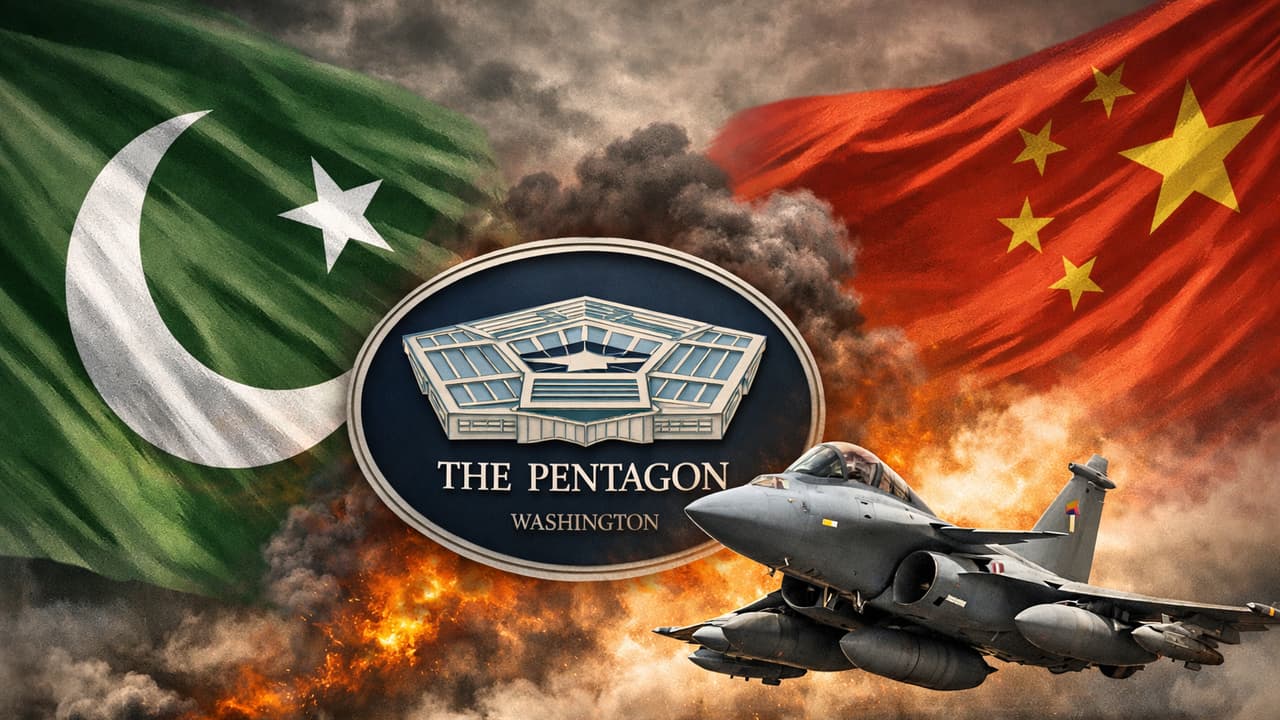
Pentagon report reveals China has delivered 36 J-10C jets and 4 frigates to Pakistan, eyeing a military base, escalating regional tensions amid India’s Rafale expansion.
New Delhi: A new report by the Pentagon claims that China has delivered 36 J-10C fighter jets and four frigates to Pakistan, and is now exploring the possibility of establishing a military base in the country. This development comes just months after India carried out Operation Sindoor — military operations against Pakistan in response to the horrific Pahalgam attack — sharpening the strategic edge of an already tense regional security environment.
The report also lands at a time when New Delhi’s relationships with both Washington and Beijing remain delicately balanced, driven by trade frictions on one side and lingering distrust along the Line of Actual Control (LAC) on the other.
Scroll to load tweet…
A Growing Strategic Embrace
According to the report, China has already delivered a significant tranche of advanced military hardware to Pakistan.
“As of May 2025, Beijing has delivered 20 J-10C fighter jets to Pakistan – the only export orders of this aircraft – as part of two deals signed since 2020, totalling 36 aircraft.”
Beyond fighter jets, China has supplied strike-capable Caihong and Wing Loong UAVs to Pakistan and other nations, cementing its status as the world’s fourth-largest arms exporter.
The report further suggested that China is expected to widen its naval export footprint in the next five years, beyond its current buyers — Bangladesh, Malaysia, Pakistan and Thailand. The People Liberation Army (PLA) “is actively considering and planning for additional military facilities to support naval and air projection with associated ground security forces,” the report highlighted.
“China has likely also considered basing in Angola, Bangladesh, Burma, Cuba, Equatorial Guinea, Indonesia, Kenya, Mozambique, Namibia, Nigeria, Pakistan, Papua New Guinea, Seychelles, Solomon Islands, Sri Lanka, Tajikistan, Thailand, Tanzania, United Arab Emirates, and Vanuatu,” it added.
Pakistan’s Push for Air Parity With India
Pakistan’s military leadership has been increasingly focused on maintaining air parity with India — particularly following the induction of Rafale jets into the Indian Air Force and Navy.
Speaking to Asianet Newsable English, Major General Sudhakar Jee (Retd.) explained the motivation, saying:
“Pakistan is interested in acquiring 4.5-generation fighters—likely Chinese-made, potentially J-10CE, FC-31, or similar—to match India’s growing Rafale fleet (36 plus 26 Naval Rafale-M) and to bolster Pakistan Air Force (PAF) capabilities with 25–36 or more jets across multiple squadrons, enhancing its air power and countering Indian advancements.
He added that the scale and pace of procurement is also a key factor:
“While exact figures vary, the acquisition is initially for around 25 jets, with the potential for more—possibly reaching 30–36 or beyond to form multiple squadrons. These 4.5-generation fighters are intended to counter India’s Rafale fleet and significantly enhance the Pakistan Air Force (PAF).”
India’s Rafale Edge — and Pakistan’s Response
India’s induction of both land-based and carrier-based Rafales has altered the balance of air power in the region.
As Major General Sudhakar Jee (Retd.) pointed out:
“India operates 36 land-based Rafales and is adding 26 carrier-based Rafale-M jets, bringing its total to over 62 advanced 4.5-generation fighters—a significant boost. To maintain air parity, the PAF seeks similar capabilities, often turning to China for cost-effective, advanced options.”
What Jets Is Pakistan Looking At?
Pakistan’s search for modern fighters has unsurprisingly led it back to its closest defence partner — China.
The retired Army officer noted the potential platforms under consideration:
“While the user mentions 4.5-generation fighters, Pakistan has been eyeing or acquiring the J-10CE, a powerful single-engine jet, and potentially the FC-31 (J-31), a twin-engine stealth fighter, or even more advanced variants of the J-10/J-16. The initial procurement of around 25 jets, with plans to expand to 30–36 or more, is aimed at forming multiple operational squadrons—a substantial force multiplier.”
And his strategic conclusion is blunt:
“In essence, this acquisition is a direct response to India’s Rafale induction, aiming to modernize and expand the PAF’s combat edge.”
Beijing’s Bigger Military Vision
The Pentagon frames these moves as part of China’s wider national strategy. Beijing seeks to realize “the great rejuvenation of the Chinese nation” by 2049 under its National Strategy vision, aiming to elevate its “influence, appeal, and power to shape events to a new level.” It intends to field a “world-class” military capable of “fight and win” and to “resolutely safeguard” the country’s sovereignty, security, and development interests.
China asserts three “core interests,” described as matters so vital to its national rejuvenation that its official stance on them is considered non-negotiable and uncompromising.
These include:
- The Chinese Communist Party’s (CCP’s) control
- Promoting China’s economic development
- Defending and expanding China’s sovereignty and territorial claims
“China’s leadership has extended the term “core interest” to cover Taiwan and China’s sovereignty claims amid territorial disputes in the South China Sea, the Senkaku Islands, and the Northeastern Indian state of Arunachal Pradesh,” the report stated.
A Fragile Calm With India
The report suggests Beijing may be using the current lull along the LAC to stabilise ties with New Delhi — and to prevent India from drifting deeper into the US strategic orbit. But mistrust continues to cast a long shadow.
“Continued mutual distrust and other irritants almost certainly limit the bilateral relationship,” it said.
Scroll to load tweet…
A Region on Edge
With India–US ties grappling with trade tensions and India–China relations still brittle, the deepening China–Pakistan military partnership adds another layer of complexity to an already sensitive regional equation.
In this high-stakes environment, the delivery of fighter jets and frigates — and the prospect of a Chinese military base in Pakistan — are not merely defence transactions. They are strategic markers in a contest where power, perception, and preparedness are inseparably linked.