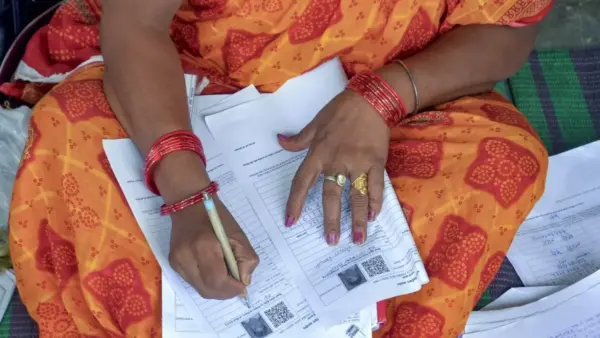
Nearly 20 to 25 per cent names may be deleted from Delhi’s existing electoral rolls during the ongoing Special Intensive Revision (SIR), with election officials attributing the estimate to Delhi’s highly mobile population, frequent transfers of government employees and people shifting homes without updating their voter registration.
A senior official in the office of Delhi chief electoral officer said the figure is only a broad estimate and the actual number would become clear only when the draft electoral rolls are published on August 17.
“Delhi has a very large migratory population. Migrating labourers keep shifting from one address to another — sometimes in Delhi, sometimes outside. Government employees are posted here, and then move out. There are also new residential clusters. “That is why there will be a substantial number of deletions in Delhi. But the exact figure will emerge only after the draft rolls are published,” the official told PTI on Thursday.
While the citywide figure remains an estimate, some booth level officers (BLOs) deployed across Delhi have told PTI that the exercise largely involved tracing voters who no longer live at addresses where they are registered.
In many cases, the voters have not necessarily left Delhi but have moved elsewhere in the city without transferring their enrolment. Deployed in New Delhi assembly constituency’s Ansari Nagar area, BLO Manish Meena said his polling booth presents this very challenge. The booth covers AIIMS residential quarters, servant quarters and seven student hostels, where the electoral rolls change constantly as doctors are transferred or retire, students complete their courses and government accommodation is allotted to new occupants.
Before the SIR began, the Election Commission (EC) carried out a pre-mapping exercise to identify voters who had shifted from their registered addresses. Meena said his polling station, which earlier had around 1,150 electors, saw around 50 per cent of names removed during that exercise. “I had around 1,150 to 1,200 voters earlier.
Around 500 to 600 have already been deleted because people had shifted long ago,” he said. The polling station now has 570 voters, Meena said, adding that he expects another 300 names to be deleted because the voters could not be found at their registered addresses. He said he had started contacting voters months before the SIR began.
“I started calling people from January. Whoever had a mobile number on the voter ID, I called and asked them to get their registration shifted,” he said. Some updated their voter registration. Many did not. “Now there is no option left for them. The only option is that they will be deleted from here and then they can apply afresh,” he said. According to EC’s guidelines, BLOs are required to visit an address at least three times before recording that a voter has shifted or cannot be traced. They are also expected to make local enquiries before uploading such cases. However, the exercise has left some relocated families uncertain about how they will be covered.
Those who were shifted from the Race Course area near the prime minister’s residence to the Savda Ghevra resettlement colony, after their homes were demolished, said they had not received enumeration forms either at their old addresses or at the places where they now live. Some residents said they approached their BLOs at their old address, who informed them that a special camp will likely be organised after August 8 and they would be issued Form 8 to update their electoral details.
Until then, uncertainty prevails in households still awaiting enumeration forms. BLOs also said the exercise has largely covered voters with identifiable residential addresses, including those inhabiting jhuggi-jhopri clusters, unauthorised slums and resettlement colonies. Reaching street dwellers, who do not have a fixed address, they said, was a challenge.
In an unauthorised colony in Babarpur’s Subhash Mohalla, a BLO said his polling station has around 1,350 electors. Around 250 cases have been flagged during the ongoing exercise for verification, and estimated that nearly 200 names could be eventually deleted. “If a voter is not found, we paste a notice at the house, leave the form if possible and make three visits. We also ask neighbours and elderly people in the locality because they usually know who has moved and who is still living there,” he said.
If the voter is still not found, the case is shown to booth level agents (BLAs) of recognised political parties. “They verify whether the voter has actually shifted. If they confirm it, they sign the form with their party affiliation and phone number. Only then do we upload the case under the shifting category,” he said. He stressed that BLOs only verify and upload cases. “The final decision does not rest with the BLO. It is taken by the Election Commission and the concerned sub-divisional magistrate or electoral registration officer,” he explained.
The exercise has also brought to light duplicate registrations. The BLO said some voters have two or even three voter cards as they applied afresh without deleting an earlier registration. In some cases, the electoral database showed voters enrolled in another state even though they claimed to have been living in Delhi for years.
In another unauthorised colony in east Delhi’s Geeta Colony, BLO Bankey Lal said his polling station has 853 voters. After the pre-mapping exercise, 330 names had been deleted. Verification is often complicated because one house number could have two or three households living in it. Bankey Lal said many residents had originally migrated from Uttar Pradesh’s Bijnor and Farrukhabad districts, while others had come from Bihar and Jharkhand decades ago.
Some remained enrolled as voters in their native villages despite living in Delhi for years. “We explain that a voter should be registered only at one place. If someone has their name in the village, they should not keep another registration in Delhi,” he said. The EC has extended the SIR schedule for Delhi, with house-to-house visits to continue till August 8. The draft electoral rolls are to be published on August 17. Voters whose names are proposed for deletion will be able to file claims and objections before the voter list is finalised. The final electoral rolls are to be published on October 7.