The year 2026 could well be remembered as the point at which India’s second freedom struggle began – not a struggle against foreign rule, but against a political culture that asks citizens to admire the grandeur of the nation while postponing answers to the ordinary problems of their lives.
Its most important protagonists are not the familiar occupants of Parliament, party headquarters or television studios. They are young Indians who have grown up with smartphones. Gen Z has begun asking an inconvenient question: if India’s future is so magnificent, why is entry into that future so difficult?
The explosion of youth anger over examination failures and paper leaks has transformed that question into politics. What began around educational grievances acquired a larger meaning because it collided with accumulated frustration over jobs, recruitment, corruption, the cost of education and the humiliating uncertainty confronting millions attempting to move from classrooms into employment.
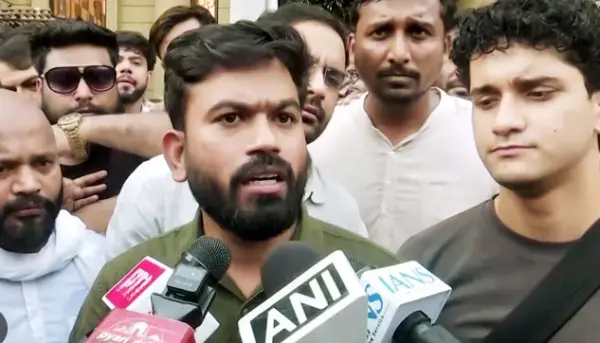
The movement associated with the Cockroach Janta Party and Abhijeet Dipke became a vehicle for that anger, but treating Dipke as its creator would misunderstand what has happened. A social-media post can provide a spark. Dipke did not create the anxieties of aspirants preparing for examinations, graduates waiting for recruitment, families paying for coaching or students wondering whether merit will survive another compromised test. He gave an existing sentiment a vocabulary and, crucially, a platform.
That distinction matters. Movements dependent entirely upon charismatic leaders can often be neutralised by discrediting, absorbing or removing those leaders. A decentralised generational grievance is more difficult. Another Dipke can appear tomorrow because the technology of mobilisation is already in everybody’s pocket.
The government has evidently understood at least part of this transformation. Narendra Modi has directed ministers towards universities and government schools, while plans for sustained ministerial interaction with campuses signal an unmistakable attempt to repair the political connection with younger Indians. The government is also responding on the substance of examination grievances and has moved towards reform, stronger action against paper leaks and expanded educational support. RSS is realizing the need to engage with the youth of the country.
That response is significant precisely because Modi has been one of the most accomplished practitioners of political communication in independent India. His politics has been built partly on the ability to convert large national ideas into emotionally powerful personal messages: Vishwa Guru, New India, Atmanirbhar Bharat, Viksit Bharat and the promise of India becoming one of the world’s dominant economic powers.
These ideas have political value, and India’s economic rise is not fictional. The country remains among the world’s fastest-growing major economies, its international influence has expanded and its technological, infrastructure and manufacturing ambitions are substantial. Any serious assessment of the youth revolt must acknowledge that reality. But macroeconomic achievement and individual economic security are not the same thing.
India’s defining contradiction is becoming sharper. It possesses the world’s largest youth population and is approaching the peak years of its demographic dividend, yet the transition from education to dependable employment remains deeply troubled. Overall unemployment figures can improve while graduate unemployment stays punishingly high. An economy may grow above 6 per cent while an engineering graduate sends hundreds of applications. A country can celebrate semiconductor plants, digital infrastructure and geopolitical influence while a family worries whether a leaked examination paper has destroyed three years of preparation.
For that family, the gap between national narrative and personal experience is where politics begins. This is why the old vocabulary of aspiration is losing some of its protective power. A young Indian who cannot obtain a fair examination does not particularly need to be told that India will become Viksit Bharat by 2047. A graduate without meaningful employment cannot spend a projected $5-trillion economy. A student confronting a broken recruitment system derives little consolation from India being described as a Vishwa Guru.
These slogans are not necessarily false ambitions. The danger for the government is that they can sound irrelevant when governance fails at the point where the citizen actually encounters the state. That is the political lesson of 2026.
For more than a decade, Modi’s extraordinary strength has been his capacity to make the national story personal. India’s achievements became Modi’s achievements, and Modi’s aspirations became the aspirations of millions. The emerging youth politics threatens to reverse that mechanism. It makes the personal experience the test of the national story.
Was the examination fair? Where is the job? Why was the recruitment delayed? Why is the teacher absent? Does the school have a functioning toilet? Can a graduate afford housing? Does merit actually produce mobility? These are less glamorous questions than geopolitics. They are also harder to answer with symbolism.
There are signs that the political impulse is moving further down the age ladder. It would be premature to describe Gen Alpha as a political force comparable with Gen Z: most of its members are children and cannot vote. But schoolchildren using digital platforms to complain about missing teachers, toilets, roads and other basic facilities reveal something important about the society being formed. They are acquiring the habit of publicly interrogating authority before acquiring the franchise. That could have profound consequences.
Earlier generations often encountered the state vertically. Authority spoke; citizens listened. The smartphone generation encounters power horizontally. It records, challenges, mocks, organises and broadcasts. Political prestige therefore has a shorter half-life. A ministerial statement competes with a 30-second video from a broken classroom. A government advertisement about educational achievement can be challenged instantly by photographs from a school without basic facilities. The battle is consequently moving from control of the narrative to credibility of delivery.
This is where the metaphor of a second freedom struggle acquires meaning, provided it is not stretched beyond reason. The young protesters of 2026 are not fighting colonial occupation, and equating their struggle literally with the movement that ended British rule would diminish the historical magnitude of independence. Their rebellion is of another kind: a demand for freedom from arbitrariness, rigged opportunity, administrative indifference and the proposition that citizens should indefinitely exchange material accountability for national spectacle. Parliament Street has therefore become more than an address.
When demonstrations over examinations reached Delhi and protesters marched towards Parliament, Indian politics experienced an inversion. Normally grievances travel into Parliament through political parties. This time pressure travelled towards Parliament from outside it. The subsequent political response, including the change at the education ministry, examination reform measures and the government’s accelerated youth outreach, demonstrated something young Indians notice immediately: street pressure can produce results.