2025 will be remembered as the year India decisively redefined its national security doctrine. Under the leadership of PM Modi, Bharat demonstrated that attacks on its citizens will no longer be met with restraint alone, but with swift, precise and decisive action. PM Modi articulated this through what is termed the “five new normals” 1on terrorism.
These principles were:
• firm response to terror attacks (any attack will be met with a decisive reply);
• no tolerance for nuclear blackmail (nuclear threats will not prevent India from striking terrorist bases);
• no distinction between terrorists and their sponsors (both will be held equally accountable);
• terrorism first in any dialogue (engagement, if it happens, will focus only on terrorism-related issues);
• and zero compromise on sovereignty (“Terror and talks cannot go together, terror and trade cannot go together“)
Amid global uncertainty, India stood confident and prepared, sending an unambiguous message that national security is non-negotiable and sovereignty will be defended at all costs.
Operation Sindoor: Setting the New Normal in Counter-Terror Response
On 7 May 2025, India launched Operation Sindoor, one of the most significant military actions in its recent history. Launched in response to the Pahalgam terror attack, it established a new normal in India’s security posture, “India will strike at the heart of terror, deep inside enemy territory, if its citizens are targeted.”
This marks India’s most significant military action within Pakistani territory in over five decades. It is Indian military’s biggest and deepest strike yet. For the first time, India executed precision strikes on multiple targets deep inside a nuclear-armed enemy nation, demonstrating unmatched strategic confidence.
For the first time since 1971, India struck deep into heart of Pakistan’s Punjab province and killed nearly 100 terrorists. It marked the first offensive where multiple high-value targets were hit simultaneously, neutralizing terror launchpads and infrastructure across the LoC and inside the Pakistan.
India struck 11 Pakistani airbases with precision on May 10, with none of India’s missiles intercepted by Pakistan’s air defence. Operation Sindoor firmly established a new doctrine: if Indian citizens are attacked, India will respond decisively, swiftly and on its own terms, even within enemy territory. This calibrated yet forceful response has reshaped regional security dynamics and reinforced deterrence.
What shocked global observers was that the operation was executed almost entirely with Made-in-India tech. During Operation Sindoor, the Indian Air Force carried out coordinated precision strikes, with the BrahMos supersonic cruise missile drawing particular attention, India’s 4.5-gen Rafale jets, spearheaded the strike with unmatched precision, while kamikaze/loitering drones helped with real-time surveillance and precision hits on targets, including moving ones, across multiple locations.
India’s New Defence Doctrine: Capability Backed by Resolve
India’s defence transformation under PM Modi reached a new peak in 2025. Defence production, driven by Make in India, grew from ₹40,000 crore in 2014 to over ₹1.54 lakh crore today, reflecting India’s emergence as a credible global defence manufacturing hub2
The defence budget rose from ₹2.53 lakh crore in 2013–14 to ₹6.81 lakh crore in 2025–26, underlining sustained investment in modernisation, readiness and infrastructure. India now exports defence equipment to over 100 countries, including the United States, France and Armenia, with Defence PSUs contributing about 77% of production and the private sector accounting for 23%.
Record Defence Acquisitions: Strengthening All Three Services
2025 marked an unprecedented acceleration in India’s defence modernisation, with acquisition proposals worth over ₹4.30 lakh crore approved during the year. The scale and pace of these decisions reflected the Government’s clear focus on rapidly enhancing combat readiness across the Army, Navy and Air Force.
In March 2025, the Defence Acquisition Council cleared capital acquisition proposals worth over ₹54,000 crore, including powerful 1,350 HP engines for T-90 tanks, indigenously developed Varunastra torpedoes, and advanced Airborne Early Warning & Control systems. The same month witnessed a historic milestone with India approving its largest-ever procurement of attack helicopters, a ₹62,000 crore deal for 156 Light Combat Helicopters from HAL.
In July 2025, the DAC cleared 10 capital acquisition proposals valued at approximately ₹1.05 lakh crore including Armoured Recovery Vehicles, Electronic Warfare System. India in April 2025 signed a massive ₹63,000 crore (approximately $7.5 billion) deal with France to acquire 26 Dassault Rafale-M fighter jets for Indian Navy. India earlier bought 36 Rafale jets for the Indian Air Force in 2016.
In August 2025, the DAC approved proposals worth ₹67,000 crore to enhance the operational capabilities of the Armed Forces. This sustained push culminated in October 2025 with additional procurement approvals worth around ₹79,000 crore, reinforcing the Government’s long-term commitment to capability enhancement, self-reliance and a future-ready Indian armed forces.
Major Inductions, Tests and Indigenous Milestones
The first fully 100% indigenous AK-203 assault rifle will be delivered to Indian Army by December 2025. These rifles were produced in Amethi. In Jan 2025, for the first time a destroyer, frigate and submarine (INS Surat, INS Nilgiri and INS Vaghsheer) was commissioned in the Indian Navy.
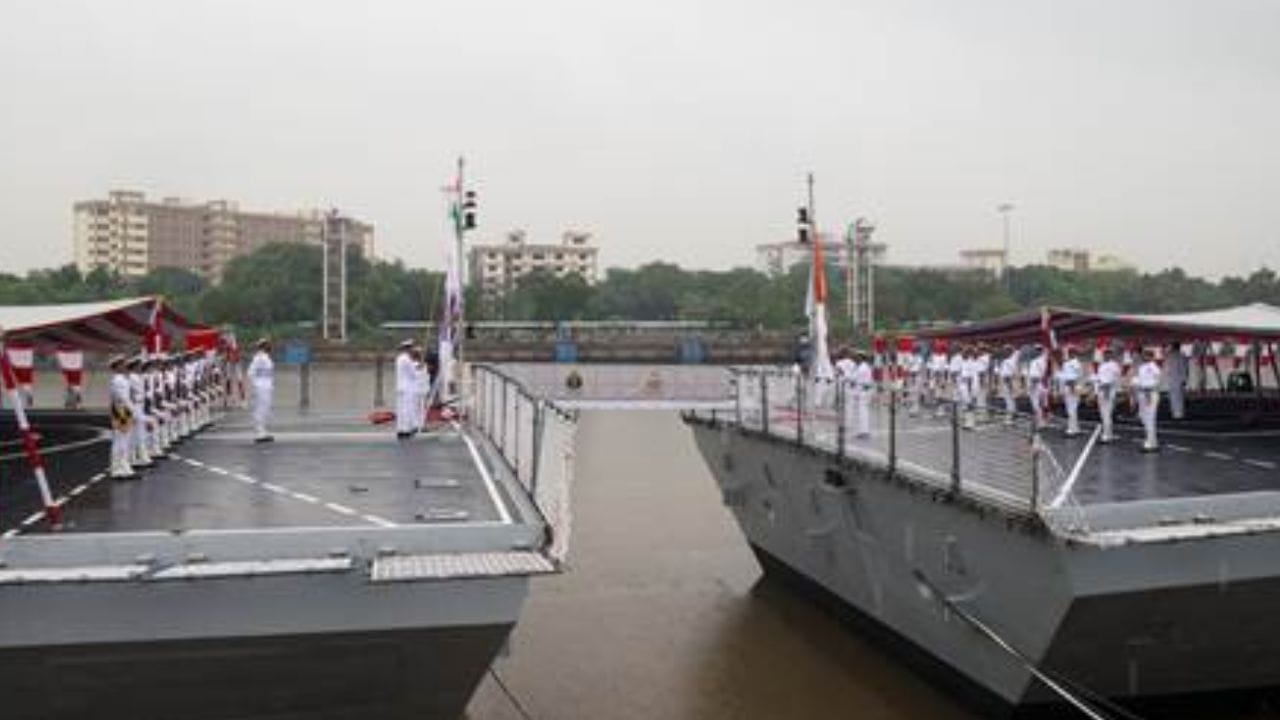
In August 2025, India inducted two stealth frigates, INS Himgiri and INS Udaygiri with over 75% indigenous content. This is the first time that the two major surface combatants from two prestigious Indian Shipyards are being commissioned at the same time.
India in September 2025 tested the nuclear-capable Agni Prime – with a range of 2,000 km from a rail based launcher. With this test India has joined league of select nations like Russia, the United States, and China – capable, or which had the capability, of firing railcar-based intercontinental ballistic missiles, or ICBMs.
India flagged-off the first batch of BrahMos missiles manufactured at the BrahMos Integration and Testing Facility Centre in Lucknow, a key component of UP Defence Industrial Corridor
In September, 2025 BSF opened India’s first drone warfare school in Tekanpur. Recently in December 2025, DRDO has handed over seven advanced technologies developed under the Technology Development Fund (TDF) scheme to the Army, Navy and Air Force.
Also in December 2025, DRDO has conducted a successful high-speed rocket-sled test of fighter aircraft escape system at controlled velocity. This complex dynamic test places India in an elite club of nations with advanced in-house escape system testing capability.
Defence Industrial Ecosystem and Reforms
Effective, 1 November 2025, Defence Procurement Manual 2025 introduces industry-friendly reforms. Two corridors, Uttar Pradesh Defence Industrial Corridor (UPDIC) and Tamil Nadu Defence Industrial Corridor (TNDIC), together have attracted investments worth over ₹9,145 crore, with 289 MoUs signed, unlocking ₹66,423 crore in potential opportunities, as of October 2025. The requirement of a No Objection Certificate (NOC) from Defence Public Sector Undertakings (DPSUs) for private companies and MSMEs participating in open tenders has been removed. In addition, three new chapters are included namely- Promoting Self-reliance through Innovation and Indigenisation, Information and Communication Technology Procurement and Consultancy and Non-Consultancy Services.