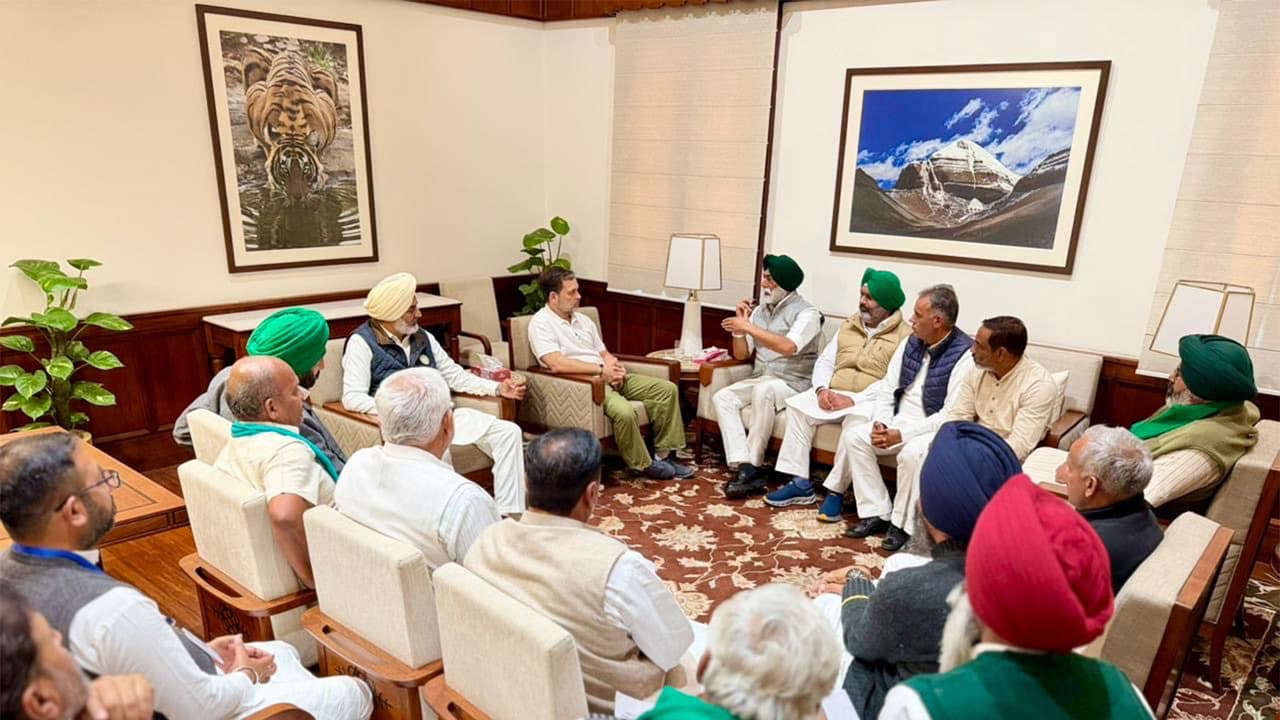
LoP Rahul Gandhi met with 17 farmer unions opposing the India-US interim trade deal. The unions, led by Sukhpal Singh Khaira, called the deal ‘anti-farmer’ and a threat to those growing corn, soyabean, and cotton, urging a nationwide protest.
The information was shared by Sukhpal Singh, MLA from Bholath, former Leader of the Opposition, Punjab, and Chairman of the All India Kisan Congress, on X. “A delegation of various #Kissan #Unions met LoP @RahulGandhi ji in his Parliament office to discuss the anti-farmer Indo-US treaty, which is nothing but a complete surrender before the Americans”, Khaira posted on X.
The farm leaders expressed concerns that the deal would harm Indian farmers, particularly those growing corn, soyabean, cotton, fruits, and nuts. They urged a nationwide movement to resist the deal and protect farmers’ rights and incomes.
Farmer Unions Oppose US-India Trade Deal
“LoP Shri @RahulGandhi met leaders of farm unions from across the country at Parliament House today. The farm leaders expressed their opposition to the US-India trade deal, warning that it poses a grave threat to the livelihoods of farmers cultivating corn, soyabean, cotton, fruits, and nuts. In the discussion, Rahul ji and the union leaders underscored the urgent need for a nationwide mass movement to resist this deal and defend the rights, incomes, and future of farmers and farm labourers across India,” posted Khaira.
The 17-member delegation included prominent voices such as Sukhpal S. Khaira (MLA Bholath), Adv. Ashok Balhara, PT John, and Tejveer Singh, among others. Their unified stance suggests that the “KMM – India” (Kisan Mazdoor Morcha) is gearing up for its most significant challenge since the 2020-21 farm law protests.
List of Participating Unions
“The farm leaders in the discussion were: 1. All India Kisan Congress: Sukhpal S Khaira 2. GKS Rajasthan: Ranjit S. Sandhu 3. Bharatiye Kisan Mazdor Union, Haryana: Adv. Ashok Balhara 4. KMM Kerala: P.T John 5. BKU Krantikari: Baldev S. Zira 6. Progressive Farmers Front: R. NandKumar 7. BKU Shaheed Bhagat Singh: Amarjit S. Mohri 8. All India Kisan Congress: Akhilesh Shukla 9. Aam Kisan Union: Kedar Sirohi 10. Kisan Congress Punjab: Kiranjit S Sandhu 11. RAJSABHA: Gurpreet S Sangha 12. Kisan Mazdoor Morcha – India: Guramneet S Mangat 13. J&K Zamidara Forum: Hameed Malik 14. KMM: Tejveer Singh 15. Haryana Kisan Sangarsh Samiti: Dharamvir Goyat 16. Krishak Samaj: Ishwar Singh Nain 17. South Haryana Kisan Union: Satbir Khatana,” Khaira posted on X.
Details of the Trade Agreement
The India-US Interim Trade Agreement focuses on reducing tariff barriers while balancing India’s domestic agricultural sensitivities with the US’s demand for market access. The US has agreed to reduce reciprocal tariffs on Indian goods from as high as 50% to 18%. This benefits Indian exports in textiles, leather, footwear, and pharmaceuticals.
India has expressed an “intent” (non-binding) to purchase $500 billion worth of US energy (LNG/Crude), aircraft (Boeing), technology, and coking coal over the next five years.
The US will grant duty-free access to Indian agricultural products such as spices, tea, coffee, mangoes, grapes, and cashews, potentially boosting Indian agri-exports, which reached $4.45 billion in 2024-25. The US has agreed to lift the 25% penal duty previously imposed on Indian goods (linked to India’s Russian oil purchases), provided India maintains its commitment to the new trade balance.
Government Asserts Farmer Protections
The government, however, claims that 90-95% of Indian farm products are excluded from the deal, protecting farmers’ interests. The government (via the Commerce and Agriculture Ministries) maintained a “Zero-Compromise” stance on domestic farming interests to prevent a political backlash. The government asserts that 90-95% of sensitive agricultural sectors remain shielded.
No tariff concessions were granted for Wheat, Rice, Maize (Corn), or millets (Jowar, Bajra, ragi); Milk, Ghee, Butter, Paneer, and Chicken products remain fully protected. The government has explicitly banned the import of genetically modified (GM) products. Onions and sugarcane are excluded from the deal.
To reach a compromise, India granted limited access to select American products. For intermediate products such as coconut oil, castor oil, and modified starches, tariffs will be gradually eliminated over 10 years to allow domestic industries to adjust. Limited quantities of almonds, walnuts, and pistachios may be imported at reduced duties. Duties were reduced on dried distillers’ grains (DDGs) and red sorghum (used for animal feed), as well as premium wine and spirits.
Meanwhile, Rahul Gandhi on Thursday assured the farmers of his support, stating, “FIR is filed, a case is registered, or a privilege motion is brought — I will fight for the farmers.” He accused the government of being “anti-farmer” and “selling” the country through the deal. (ANI)
(Except for the headline, this story has not been edited by Asianet Newsable English staff and is published from a syndicated feed.)