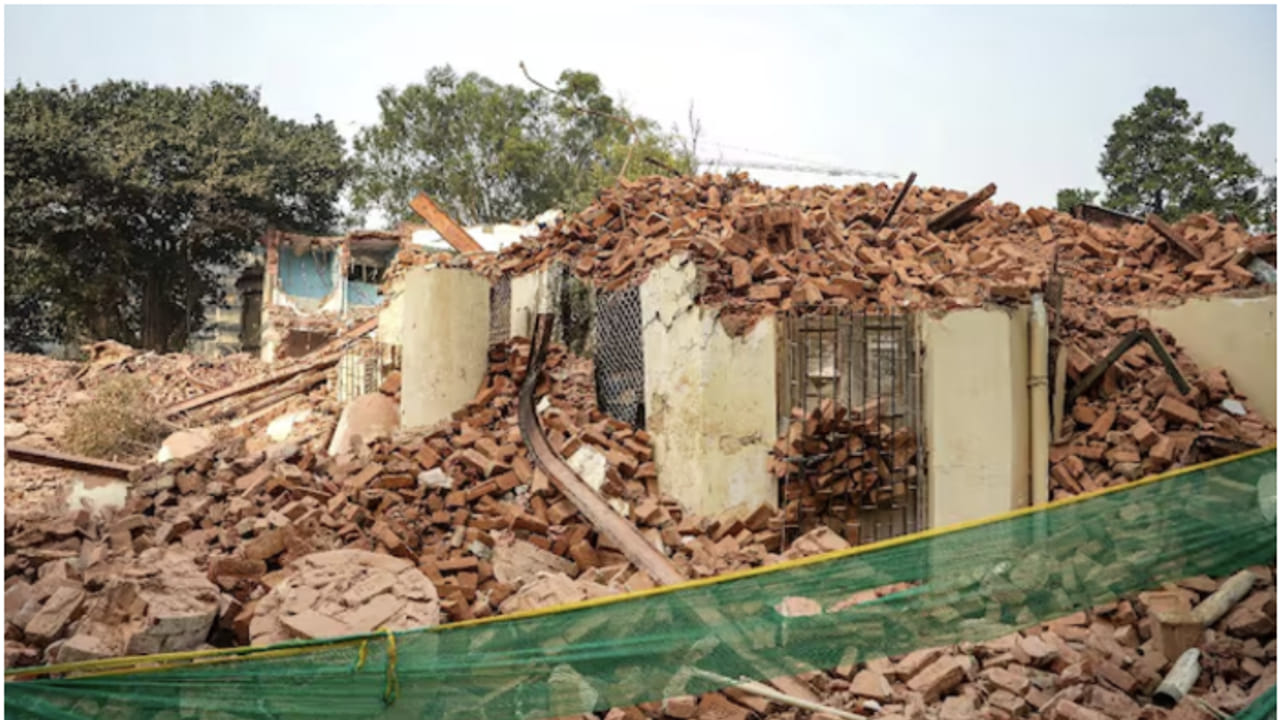
A nearly 120-year-old heritage building at Patna Medical College and Hospital (PMCH), associated with Mahatma Gandhi’s 1947 visit and the freedom struggle, has been demolished despite repeated appeals from heritage conservationists
A historic chapter of Patna’s past has disappeared with the demolition of the nearly 120-year-old Bankipore General Hospital building on the campus of Patna Medical College and Hospital (PMCH). The structure, which had a direct association with Mahatma Gandhi and the Indian freedom movement, was pulled down as part of the hospital’s ongoing redevelopment project.
The demolition took place despite repeated requests from historians, Gandhians, heritage conservationists and former students of the institution to preserve the building. The destruction of its frontal portion has also left fragments of its distinctive Doric pillars scattered across the campus.
The demolition is particularly significant as the building was associated with Gandhi’s visit to Patna in May 1947, just months before India’s Independence. Its destruction also coincided with World Heritage Week, observed from November 19 to 25.
Why Was The Old PMCH Building Special To Mahatma Gandhi?
The building held an important place in history because of an incident involving Gandhi’s grand-niece, Manu Gandhi, in May 1947.
On May 15, 1947, Gandhi arrived in Patna from Calcutta, now Kolkata, amid communal tensions in parts of Bengal and Bihar. On the same day, Manu Gandhi was admitted to the hospital for an appendicitis operation.
According to historical records, Gandhi was so concerned about her health that he remained inside the operation theatre wearing a surgical mask and watched the procedure. Manu subsequently spent nearly a week recovering at the hospital, during which Gandhi reportedly visited her almost every day.
Manu Gandhi was among his closest companions during the final years of his life and played an important role in his personal and political journey. She was also present with him at Birla House in Delhi when he was assassinated on January 30, 1948.
The incident gave the old hospital building a historical connection extending beyond its architectural importance. Both Gandhi’s writings and PMCH’s official website refer to the episode.
Gandhians, Heritage Groups Had Urged Authorities To Save Building
Several organisations and individuals had appealed to the authorities to protect the historic structure before its demolition.
On November 19, the Gandhi Sangrahalaya in Patna wrote to the Union Culture Ministry, requesting urgent intervention to save the remaining portion of the building. The three-page appeal was submitted by 87-year-old Razi Ahmad, a noted Gandhian and the institution’s long-serving secretary.
The Indian National Trust for Art and Cultural Heritage (INTACH), the PMCH alumni association, scholars and other heritage enthusiasts had also raised concerns about the demolition.
Union Culture Secretary Vivek Aggarwal had reportedly responded to the matter on November 22, saying that he would look into the appeal.
The hospital building, constructed around 1904, was part of the Temple Medical School established in 1874. The institution later became Prince of Wales Medical College in 1925 before being renamed Patna Medical College and Hospital after Independence.
With several historic structures already demolished during the redevelopment project, the century-old Administrative Block is now among the few surviving heritage buildings on the campus.
The demolition of the Bankipore General Hospital building has therefore raised fresh questions about balancing modern infrastructure development with the preservation of historically significant public institutions.