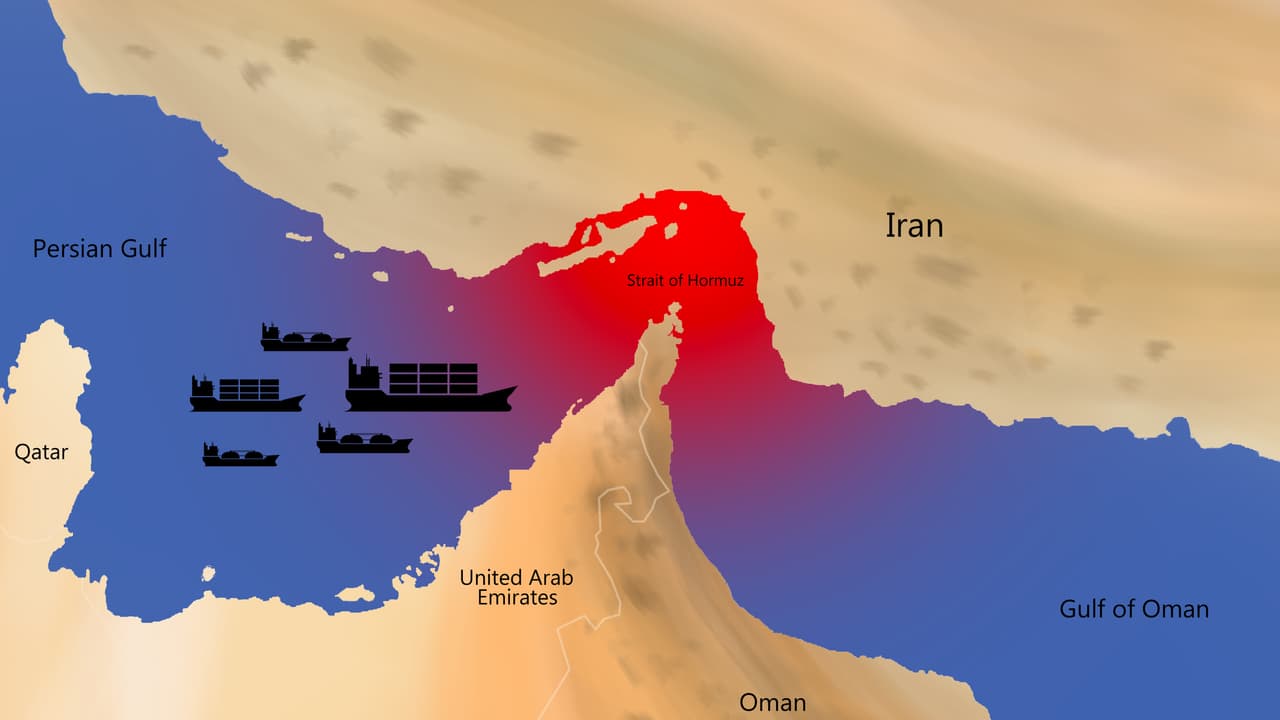
A new study warns that prolonged closure of the Strait of Hormuz could disrupt $1.2 trillion in global trade, sending energy prices soaring and triggering supply chain chaos worldwide.
The Strait of Hormuz has long been regarded as one of the most vital waterways in the global economy — a narrow passage through which a massive share of the world’s energy supply flows.
But three weeks into the escalating Middle East conflict, the battered Iranian regime still maintains an iron grip over the 24-mile-wide maritime corridor, raising fears of severe disruption to global trade.
Now, researchers warn that a prolonged closure of the Strait could trigger widespread economic consequences far beyond the region.
A new simulation by scientists from Delft University of Technology and Complexity Science Hub suggests that exports worth up to $1.2 trillion could be affected if the critical shipping route remains blocked for an extended period.
Also read: Iran Imposes $2 Million Toll Per Ship in Strait of Hormuz, Sparks Global Oil Fears
A narrow passage that powers the global economy
Running between the Persian Gulf and the Gulf of Oman, the Strait of Hormuz is bordered by Iran to the north and the United Arab Emirates to the south.
Its strategic importance lies in a simple reality: it is the only sea route connecting the oil-rich Gulf states to the open ocean.
Every day, roughly 20 million barrels of oil — about one-fifth of the world’s supply — pass through the Strait.
The waterway also handles approximately 1.93 million barrels per day of liquefied natural gas (LNG), making it a crucial artery for global energy flows.
In total, about £447 billion worth of energy trade moves through the Strait each year.
Before the conflict erupted, an average of 138 vessels passed through the passage daily.
Today, that number has collapsed to around eight ships a day.
War brings shipping traffic to a near halt
The dramatic slowdown began after Israel and the United States launched aerial bombardments targeting Iranian assets.
Days after the assassination of Ali Khamenei on February 28, Tehran declared control of the Strait, effectively trapping hundreds of vessels inside the Gulf.
Since the start of the war, only a handful of ships have managed to pass through the waterway. According to the UK Maritime Trade Operations, at least 16 vessels have come under attack during the crisis.
The disruption has already pushed oil prices higher and sent tremors through global markets.
But researchers warn the worst may still lie ahead.
Supply chains could unravel after four weeks
Using a large-scale shipping simulation, researchers analysed how a prolonged closure would affect more than 10,000 tankers travelling between 1,315 ports worldwide.
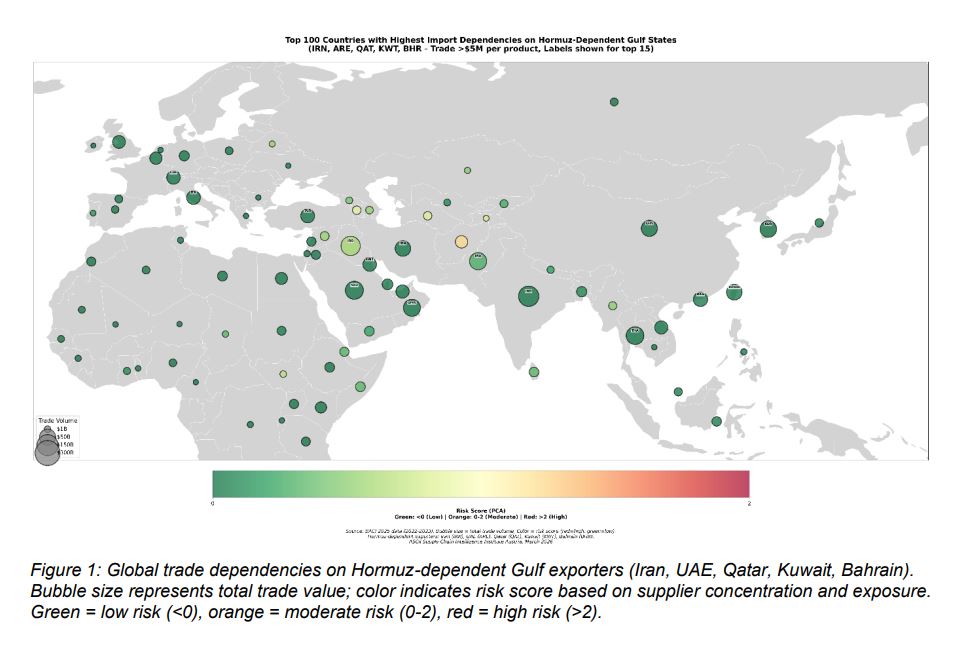
Their modelling focused on five Gulf states — Iran, Qatar, Kuwait, Bahrain, and the United Arab Emirates — all of which rely entirely on the Strait for exports.
Co-author Jasper Verschuur explained why the passage is uniquely vulnerable.
“What is unique about the Strait is that there are no alternatives to reroute goods. This makes it distinct from other strategic maritime passages like Suez, Malacca and Taiwan that ‘handle’ large volumes, but have rerouting alternatives,” Verschuur was quoted as saying in a DailyMail report.
The researchers found that short disruptions lasting around two weeks would have relatively limited consequences.
But once closures stretch beyond four weeks, global supply chains could begin to experience cascading disruptions.
Co-author Stefan Thurner warned that the tipping point may already be approaching.
“The Strait has been closed for about three weeks. Our study finds that a closure of two weeks is practically not relevant, but after that, the effects will become noticeable. After four weeks, cascading effects in the supply chains due to disrupted shipping in the Strait will appear. And this leads to disproportionate losses.”
Their modelling shows that after 56 days of closure, shipping delays intensify significantly as missed port slots, congestion and rescheduled tanker routes ripple across global logistics networks.
Asia faces the biggest economic hit
The study found that the biggest economic shocks would likely hit Asia’s largest energy-hungry economies.
China imports approximately $97 billion worth of goods through the Strait annually.
India relies on about $74 billion in trade passing through the corridor, while Japan imports roughly $63 billion.
Much of this trade consists of LNG and petroleum products, but the disruption could also affect agriculture and manufacturing.
The five Gulf states examined in the study produce 8 to 10 per cent of the world’s fertiliser, meaning prolonged shipping disruption could push up food production costs worldwide.
Military pressure to reopen the waterway
As tensions escalate, Donald Trump has called for US forces to open a new military front to restore shipping through the Strait.
American forces have deployed A-10 Warthog aircraft and Apache attack helicopters, targeting Iranian ships and drones in an effort to reopen the vital maritime corridor.
Meanwhile, a Pakistani-flagged vessel, the Karachi, recently became the first non-Iranian ship to pass through the Strait with its automatic identification system (AIS) switched on since the conflict began.
Also read: No End in Sight? US Has ‘Plenty of Money’ for Iran War, No Tax Hike Planned Says Scott Bessent
Long-term economic consequences still uncertain
Even if the waterway eventually reopens, researchers warn that the economic damage could linger for months.
Higher energy prices, disrupted shipping schedules and supply shortages could ripple through global production networks.
For now, the Strait of Hormuz — often described as the “energy artery” of the world economy — remains one of the most dangerous flashpoints in the ongoing Middle East conflict.
And the longer it stays closed, the greater the risk of a global economic shock.