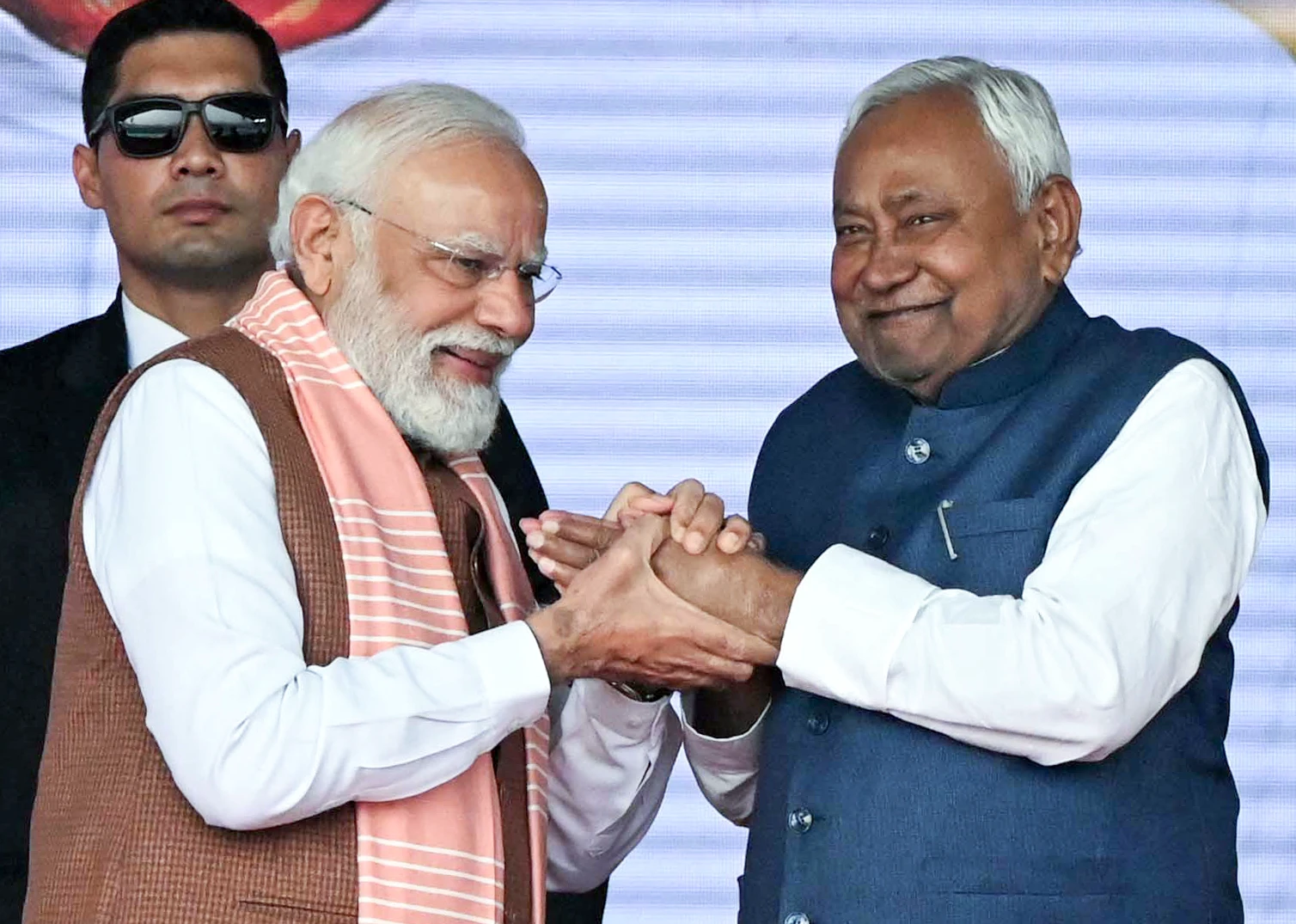
ABOUT a fortnight ago, the Bihar Assembly election results served an overwhelming majority in favour of the National Democratic Alliance (NDA).
With a win of 202 out of the 243 seats, this is perhaps one of the biggest pro-incumbency mandates. The question is how the BJP steered this victory, defying the assumption that anti-incumbency necessarily builds against governments in power. The BJP, with 89 seats, has given its best performance so far with a strike rate of nearly 90 per cent. These numbers are humbling for the party as they reflect people’s trust in PM Narendra Modi’s vision for India and promise that Bihar would be at the forefront of the India story.
The BJP has earned this trust by staying true to its core principles. The party has always valued coalition dharma. The NDA is now almost quarter of a century old. In these 25 years, both through the highs and lows, the party has valued, accommodated and walked with its allies. The BJP has given coalition’s interests precedence over its own. Even when the BJP has won full majorities, it has respected the partners with whom it walked into elections. This is ethical politics. Importantly, the BJP has not stitched alliances based on political expediency, but moral and ideological similarities.
On the contrary, the UPA, formed out of political opportunism, has often found the Congress disrespecting allies. Who can forget the 2004 dinner snub to Samajwadi Party leaders or the 2023 Madhya Pradesh ‘Akhilesh Vakhilesh’ snub by Kamal Nath. In Bihar, Lalu Yadav’s son claimed that Rahul Gandhi refused to shake hands with him on stage. Why the Mahagathbandhan delayed the declaration of Tejashwi Yadav as CM candidate is an open secret.
Truth be told: people cannot be expected to trust a coalition that exhibits zero trust in itself.
But no coalition can win by staying true to its allies alone. Elections are won by winning the trust of the electorate. In Bihar, the NDA had PM Modi’s national leadership and Nitish Kumar’s work in the state to evoke trust.
With nearly 65 per cent of India’s population living in rural areas, rural development has been a priority for the Modi government. Over the past 11 years, efforts have focussed on improving the quality of life in villages. The vision has been to transform lives and livelihoods through socio-economic inclusion and empowerment of rural communities.
Bihar has been a key focus of this agenda. Since 2014, the pace of development in the state has gained momentum. Flagship national programmes deliver tangible benefits in Bihar’s villages today. Modi government schemes are reaching even the remotest parts of the state.
Earlier, rural India spent more than 50 per cent of its income on food and necessities. For the first time since Independence, rural expenditure on food has fallen below 50 per cent, reflecting improved purchasing power. In November 2018, Bihar achieved 100 per cent saturation in household electrification under Saubhagya. As of September 2024, over 53,419 km of rural roads and 1,153 bridges worth Rs 28,292 crore had been constructed in Bihar. As of July 2025, over 1.54 crore Soil Health Cards have been issued to farmers in Bihar. Under the Pradhan Mantri Kisan SAMPADA Yojana, as of June 30, a total of 15 projects worth Rs 748.76 crore have been approved for Bihar. More than 28,000 farmers in the state have benefited from this scheme.
The Centre allocated Rs 105 crore to the Bihar Rajya Jeevika Nidhi Saakh Sahkari Sangh to strengthen rural women’s entrepreneurship and expand community-based enterprises. Bihar set a target to empower 30.21 lakh women to become ‘lakhpati didis’. As of July 2025, over 20 lakh women had achieved this milestone.
At the level of the state government, Nitish Kumar focussed on empowering women with 35 per cent reservation in government jobs, distribution of cycles for schoolgirls, Mukhyamantri Kanya Utthan support to girls from birth to graduation, Jeevika didi initiative for the economic empowerment of rural women. These schemes have transformed lives. For the Opposition to say women voted for money is disrespectful of their agency, which has broken free from being told who to vote for.
Studies show that when women control more income and assets, they invest more in children’s education, nutrition and health. Women’s empowerment and economic development reinforce each other.
And that is the reason why not just women, but men too chose the NDA.
This is precisely why, despite making provocative and divisive statements like ‘will tear the Waqf Bill’, the RJD was limited to 25 seats.
But the biggest blow that this election has served is to the anti-Special Intensive Revision (SIR) sentiment raked by Rahul Gandhi. Driven by arrogance, the Congress scion derided and threatened Election Commission officers. With just six seats in its tally, the Congress must eat humble pie.
The right to vote is a constitutional right of every citizen and hence subject to scrutiny for eligibility. SIR is aimed at ensuring that only Indians vote in the country and that no one votes more than once in any election. It is hardly surprising that Bihar, which was the first state to undergo SIR, voted in its favour.
Good governance, women-led development and coalition dharma have propelled the BJP to 89 and NDA to 202 seats in Bihar. The same factors will script the BJP’s win in Bengal.