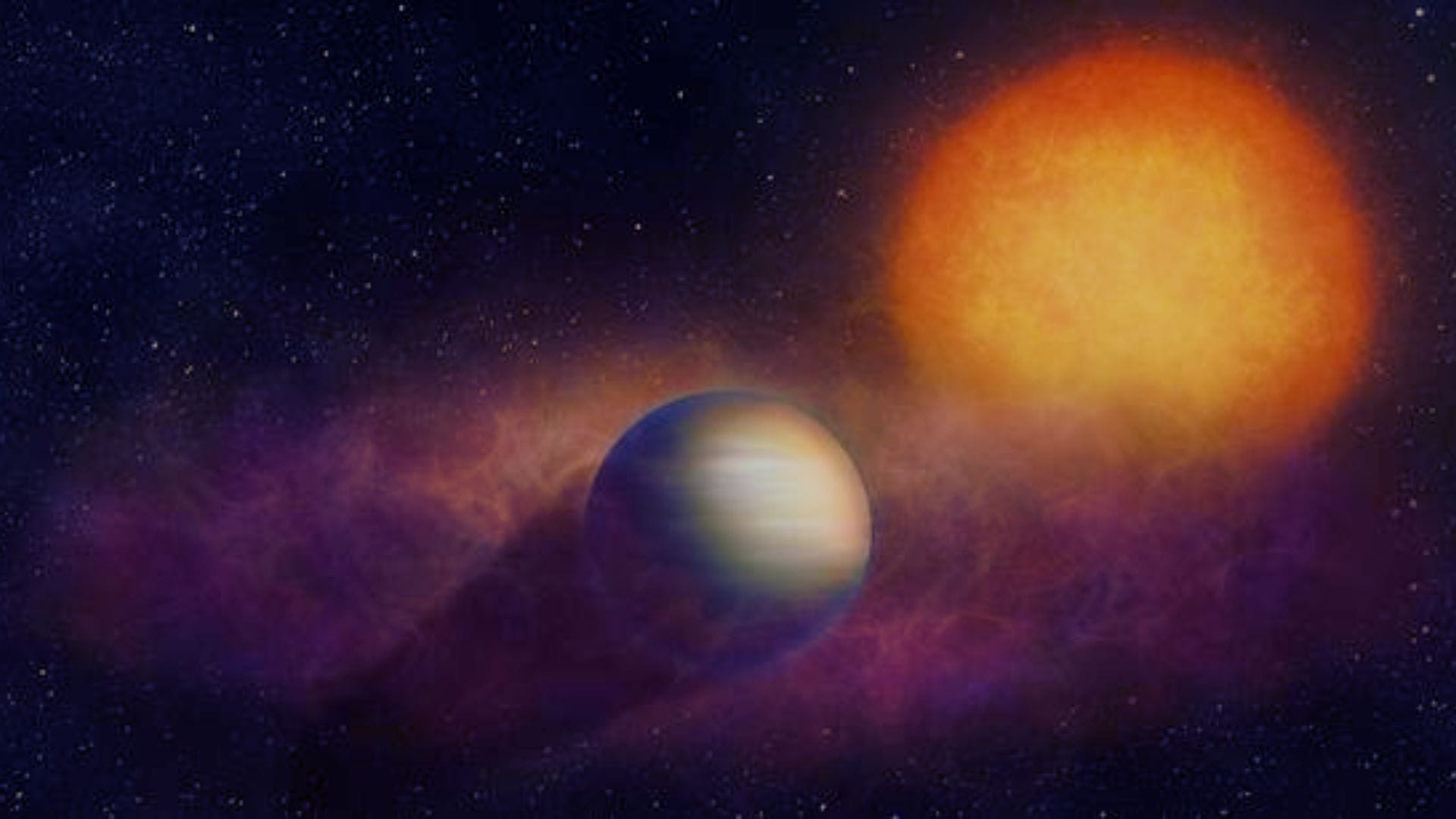
New Delhi: The James Webb Space Telescope has observed giant clouds of helium escaping from the exoplanet WASP-107 b. The exoplanet, located at a distance of 210 lightyears from the Solar System is a warmer version of Neptune with an inflated atmosphere, which is escaping into space. The Earth loses about three kg of hydrogen every second into space, through a process called atmospheric escape. For puffball exoplanets in tight orbits around their host stars, the injection of heat can accelerate the process of atmospheric escape, which subsequently plays a major role in the evolution of the world.
This is the first detection of helium by Webb on an exoplanet. First spotted in 2017, WASP-107 b is seven times closer to its host star than the Sun is to Mercury. As a consequence, the world has inflated, much like a hot air balloon, making in nearly the size of Jupiter. WASP-107 b belongs to a category of planets with extremely low densities, and the whole world would float in a liquid water ocean large enough to accommodate it. The helium flow was detected in the exosphere, with the helium cloud extending in both the leading and trailing directions of the orbit around the host star.
Water and other chemicals
The researchers were able to confirm the presence of water, carbon monoxide, carbon dioxide and ammonia in the atmosphere of WASP-107 b apart from the helium. Methane, which Webb is capable of detecting, was not spotted. Previous research indicates that the planet could be tidally heated. Webb has also spotted clouds of gaseous sand on the exoplanet. The observations provide valuable clues into reconstructing the history of WASP-107 b, which is believed to have formed at a great distance from the host star, then migrated inwards. A paper describing the research has been published in Nature Astronomy.