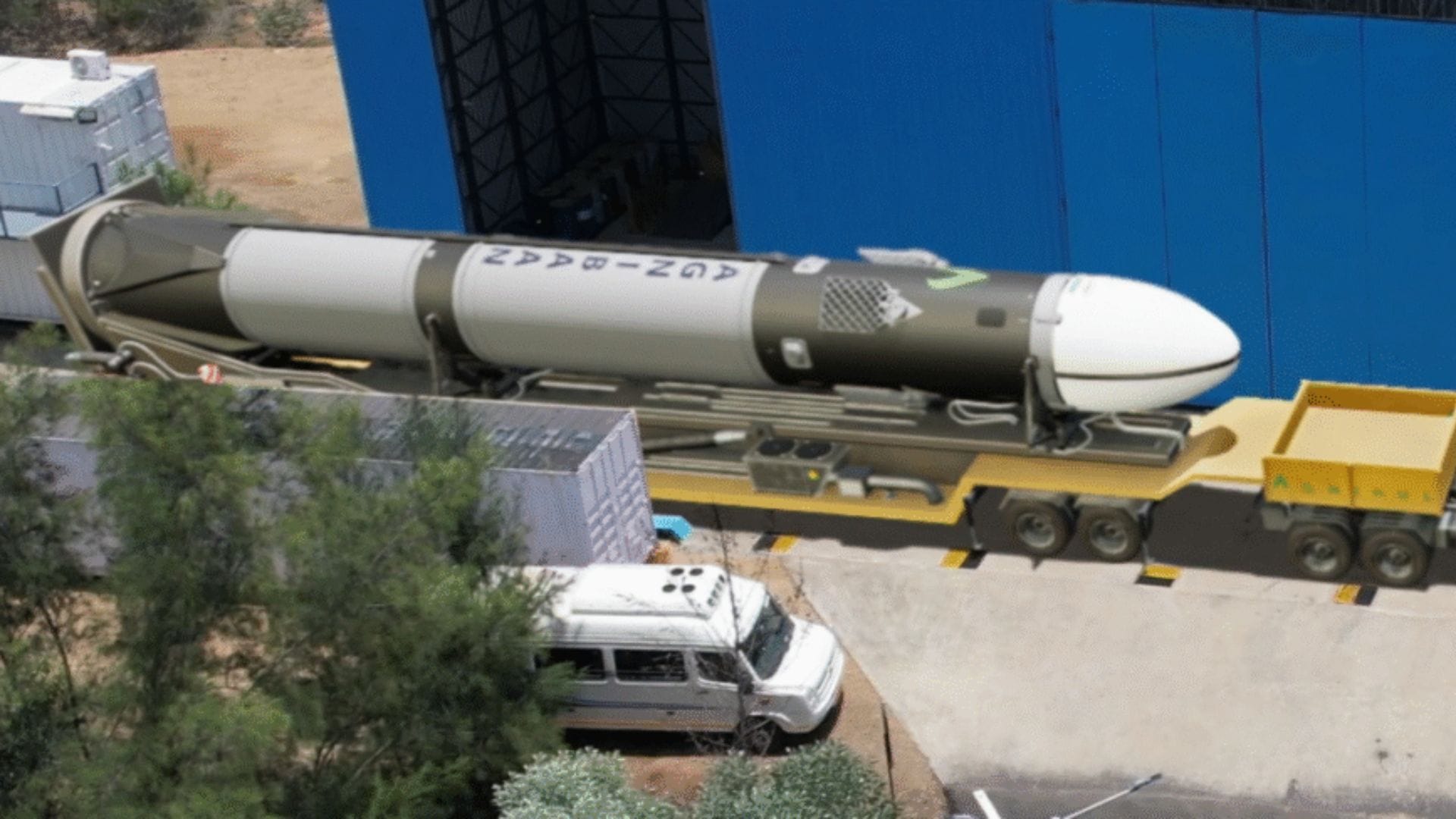
New Delhi: A number of new space startups across the country tested out their rocket engines, demonstrated technologies in Earth orbit, and expanded their manufacturing facilities over the course of 2025. During the inauguration of Skyroot’s Infinity Campus in Hyderabad last month, Prime Minister Narendra Modi said, “In just the past six to seven years, India has transformed its space sector into an open, cooperative, and innovation-driven ecosystem.” The Infinity Campus is capable of producing one launch vehicle every month, and is in addition to Skyroot’s Max-Q HQ. Skyroot also unveiled the Vikram I launcher, which is expected to fly for the first time in February 2026.
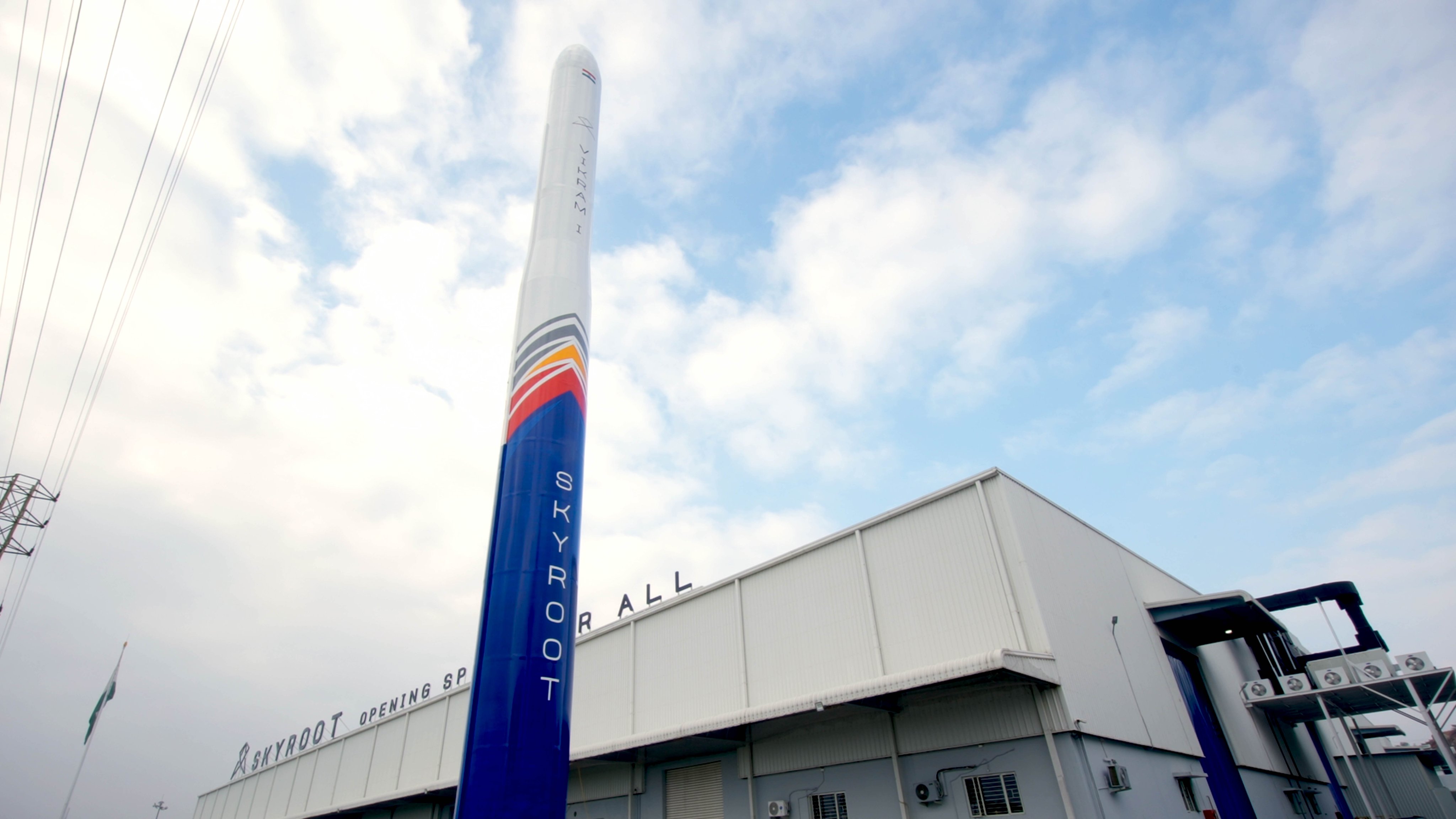
Model of the Vikram I rocket in front of Skyroot’s new Infinity Campus. (Image Credit: Skyroot Aerospace).
Chennai-based Agnikul Cosmos pivoted to a reusable launch vehicle, with a booster that can land on an ocean platform, and an upper stage that converts to a satellite. Agnikul has already established the first private launch pad in Sriharikota, and is building its second launch pad at ISRO’s second spaceport in Kulasekharapatnam. Agnikul also opened up the largest 3D metal printing unit in the country for manufacturing rockets. With a pair of rocket manufacturing facilities close to India’s only operational spaceport as well as the planned second spaceport, Agnikul aims to produce 500 rocket engines per year by 2028, with the capacity to launch over a hundred rockets every year. Agnikul is also expected to execute its first orbital flight in 2026.
Abyom’s dual use technologies
Hyderabad-based Abyom celebrated its fifth foundation day on 3 October, and has developed dual-use technologies such as an engine control system (ECS) as well as a spark torch ignition system that can be used in rockets, missiles, and defence-grade propulsion units. Its commercial test facility is now open for business, and can accommodate everything from advanced propulsion systems by industries to engines developed by students and enthusiasts. Abyom is scaling up gradually towards reusable rockets, and is starting with reusable sounding rockets. A demonstration of Abyom’s vertical takeoff vertical landing (VTVL) prototype is scheduled for 2026.
A Bouquet of Offerings
Indian Startups are producing novel satellites with unique capabilities, featuring a combination of hyperspectral, thermal and SAR imaging, along with intelligence based on Earth Observation Satellites. Pixxel completed its Firefly constellation made up of six hyperspectral imaging satellites in August. A consortium of startups made up of Pixxel, Dhruva Space, PierSight and SatSure were tapped by IN-SPACe to develop India’s first Earth Observation constellation under a Private-Public Partnership (PPP) model. Apparently the consortium priced the constellation at Rs 0. GalaxEye, that has developed a unique fusion of optical and Synthetic Aperture Radar (SAR) imaging. The Dhrishti satellite is scheduled to launch in Q1 2026.
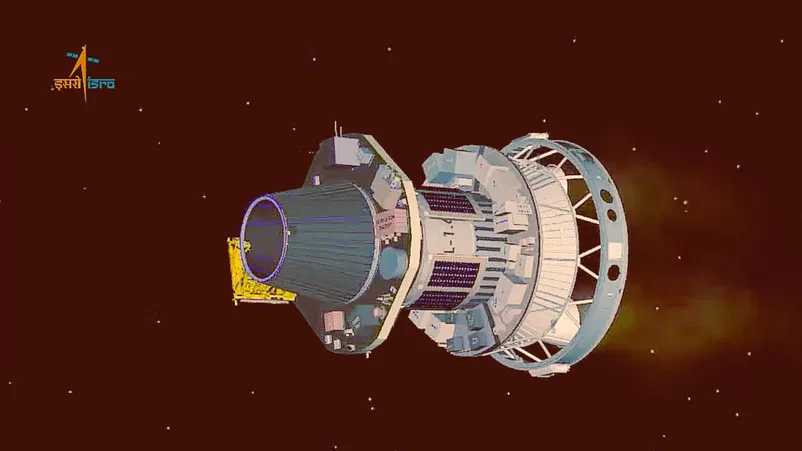
The POEM platform. (Image Credit: ISRO).
Within just six years of the private space sector opening up in India in 2019, factories to make rockets and satellites have cropped up, along with orbital hardware. ISRO is providing mentoring support to the New Space startups, as well as access to its facilities. IN-SPACe is mediating land grants for PPPs, ISpA is attracting foreign investors and NSIL is transferring technologies developed by ISRO to New Space startups. The POEM platform has been an incredible success, providing flight heritage to demonstrate technologies of companies such as Manastu and Bellatrix, allowing these startups to attract customers with hardware proven in space. The next year promises to be more exciting for this fast-moving sector.