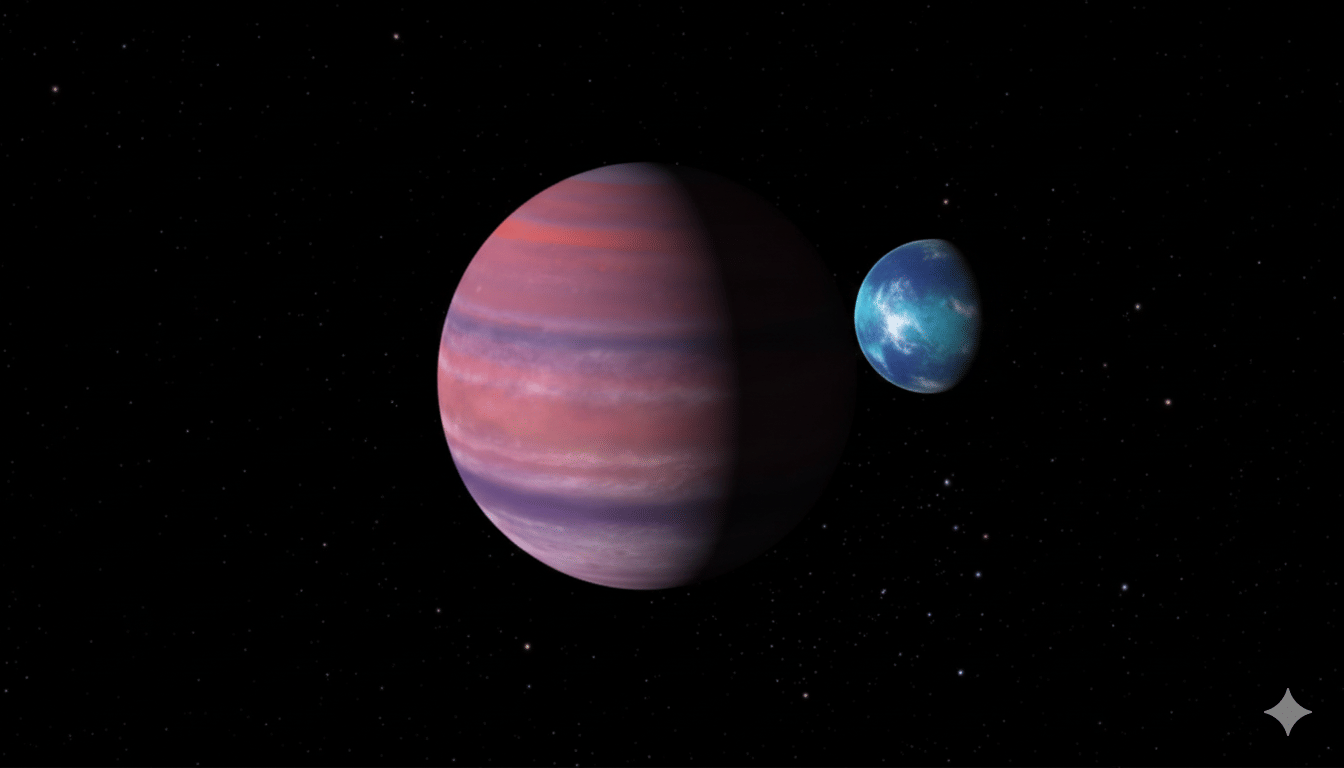
New Delhi: Astronomers have been tracking the motion of HD 206893 b using a large telescope in Chile. The object is 133 lightyears from the Earth and contains 28 times the mass of Jupiter, making it approach some brown dwarfs in size, that are exotic objects straddling the line between planets and stars. HD 206893 b has been directly imaged, and the astronomers observed it move against background stars with extreme precision over the course of a year. There is a planetary body closer to the host star than HD 206893 b, and after subtracting the gravitational influence of the two objects, a small wobble remained.
This leftover influence on the host star could be explained by a large, unseen moon orbiting HD 206893 b, which orbits the host star at a distance of 9.6 AU, or nearly 10 times the distance between the Sun and the Earth. The astronomers estimate that the moon could be about half the mass of Jupiter, circling its host once every nine months. Humans have discovered more than 6,000 exoplanets, but not a single exomoon so far, though there are some promising candidates. The wobble is very subtle, and could be caused by imperfections in the instruments. Follow-up observations are required to confirm the exomoon.
First exomoon candidate detected through astrometry
If confirmed, this would be the first exomoon detected through astrometry, or measuring the tiny wobbles caused by the gravitational influence of an object on the host that it orbits around. The results at least prove that telescopes can detect the gravitational tugs of objects a few times the mass of Neptune, and even smaller objects if the conditions are favourable. There are two young gas giant planets at distant orbits from their host stars where the technique can be used to find any exomoons, in the Beta Pictoris and AF Leporis systems. A paper describing the research has been selected for publication in Astronomy and Astrophysics.