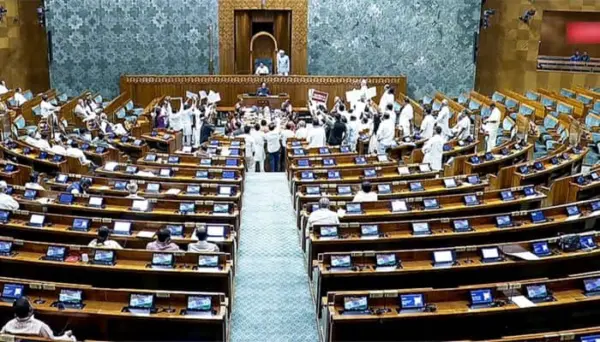
The Monsoon Session of Parliament will begin on July 20, and the buzz around the delimitation bill has once again gained prominence. Several high-profile meetings have taken place in the last few days, and the BJP leaders are working to get a two-thirds majority in the Lok Sabha.
A recent statement by NCP (Sharadchandra Pawar) leader Supriya Sule has added a new layer of intrigue to the parliamentary arithmetic required to pass this legislation. While the government is actively scouting for support from various opposition ranks, the keys to this 36-vote challenge appear to be held firmly by the DMK.
The NCP-SP Stance: Conditional Support
Supriya Sules remarks have introduced a fresh dynamic to the political equation. She indicated that her party is seeking clarity from the government on two critical issues before committing to any support:
* The expansion of the total number of Lok Sabha seats.
* The status of the 50 percent reservation cap.
Sule suggested that if the government is open to discussing these conditions, the NCP-SP might consider supporting the bill. However, she later clarified that the party has not yet finalized its official stance on the legislation.
Recent reports appearing in sections of the media regarding the stand of the Nationalist Congress Party Sharadchandra Pawar on the issue of delimitation are inaccurate and speculative. I wish to clarify that neither the party nor I have had any official discussion with any media organisation on this subject. As with every issue of constitutional importance, our party’s position is determined only after detailed consultations within the party and with our allies – India alliance. Therefore, any reports attributing a definitive stand to us are without basis,” said Sule.
Sule further stated that it would be inappropriate to comment on any proposal until the Centre formally tables the revised delimitation legislation in Parliament. “It would be inappropriate to comment on any proposal until the Government formally places the revised delimitation legislation before Parliament. Since no such Bill has yet been made available, any speculation regarding its contents or our position would be premature,” added Sule.
The Monsoon Session Challenge
The government is reportedly aiming to pass the 130th and 131st Constitution Amendment Bills during the Monsoon Session, which commences on July 20. Given that constitutional amendments require a two-thirds majority, the government faces a formidable task.
Recent high-level meetings have fueled political speculation. A late-night discussion between Union Home Minister Amit Shah and Maharashtra CM Eknath Shinde has drawn attention and is viewed by many as having significant implications for Maharashtra’s internal politics. Additionally, a meeting between CM Yogi Adityanath and Amit Shah has also become a major talking point.
Lok Sabha: The Math Behind the Majority
With the effective strength of the Lok Sabha at 540, a two-thirds majority requires 360 votes. The NDA currently holds 324 seats including rebel TMC and Sena MPs, leaving a gap of 36 additional votes.
The Governments Potential Outreach:
* Opposition Targets: The government is reportedly eyeing support from the Samajwadi Party (37), RJD (4), and NCP-SP (8).
* Strategic Contacts: Sources suggest that MPs from JMM (3), AAP (3), and the National Conference (2) are also in contact with the ruling side.
If the eight MPs from the NCP-SP align with the government, particularly if a consensus is reached on the seat-increase formula, the NDAs tally would rise to 332. However, this would still leave them 28 votes short of the required mark.
The “DMK Factor”
The DMK has emerged as the most critical player in this arithmetic. With 22 Lok Sabha MPs and 8 Rajya Sabha MPs, the party holds 30 seats in total.
* Support Scenario: If the DMK supports the bill, the governments tally would reach 354, just 6 short of the 360-mark.
* Abstention Scenario: If the DMK chooses to abstain rather than support, the total number of members present and voting in the House would decrease, thereby lowering the threshold for a two-thirds majority.
Consequently, whether the DMK chooses to extend support or strategically distance itself, its decision remains the decisive “key” to the passage of the Delimitation Bill. The government is of the view that if it cannot get a two-thirds majority, then it will try to ask some opposition parties to abstain on the voting day, thus paving the way for the passing of the legislation. IN case a party decides to abstain, then the majority is calculated on the basis of the total members present in the house.
Rajya Sabha: A Simpler Path?
The government’s task appears less daunting in the Upper House.
* Current Status: To achieve a two-thirds majority, 164 votes are needed. The government currently holds 155, which will rise to 158 following the by-elections for three Bengal seats.
* The Goal: The government needs the support of just 6 additional MPs. Alternatively, if 12 opposition MPs choose to abstain from voting, the math becomes significantly easier.
With 8 DMK MPs in the Rajya Sabha, the partys stance will once again be the deciding factor in ensuring the government’s smooth sailing through the Upper House.