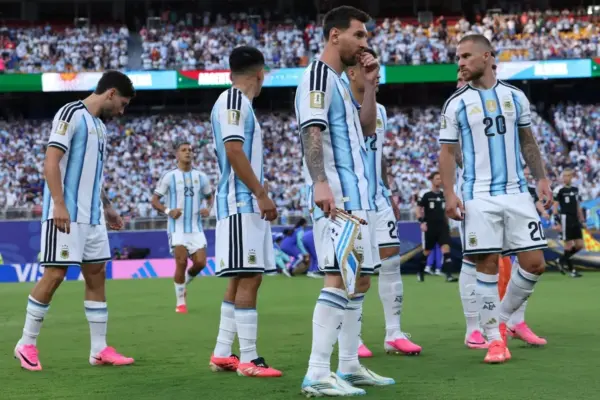
When Argentina arrived at the 2026 FIFA World Cup, they carried more than just the weight of defending their title. As the champions of Qatar 2022, Lionel Messi and his teammates were widely tipped to go deep once again.
But while their football has kept them among the tournament favourites, another narrative has grown just as quickly, one that has little to do with tactics or goals. It is no longer just about Argentina winning matches. It is about whether the rest of the football world believes those victories are entirely fair.
Almost every Argentina fixture has ended with social media flooded by the same accusations. Clips are replayed endlessly. Slow-motion replays dominate timelines. Fans, former players and television pundits dissect refereeing decisions frame by frame. Hashtags questioning FIFA, VAR and officiating trends repeatedly trend worldwide. The debate started almost immediately.
Many supporters of rival teams argued that Lionel Messi was fortunate not to receive a red card in Argentina’s opening match after an incident that sparked fierce disagreement online. While match officials judged the challenge differently, critics believed Argentina had already benefited from a significant decision. Instead of calming down, the controversy only intensified.
Throughout the tournament, opponents have repeatedly questioned officiating decisions involving Argentina. Supporters of rival countries have argued that fouls deserving yellow or red cards went unpunished, while others have pointed to penalty appeals and VAR interventions that, in their view, consistently favoured the defending champions.
Whether those claims are justified or not has become almost secondary. The perception itself has become the story. The match against Egypt reignited the debate, with several refereeing moments dominating post-match discussion more than the football itself. Days later, Argentina’s encounter with Switzerland created another storm. Social media exploded with accusations after contentious decisions, including debates over disallowed goals and challenges that many fans believed deserved a different outcome. Each incident added another chapter to an already growing narrative.
For many supporters outside Argentina, every close refereeing call now reinforces an existing belief that the defending champions are receiving favourable treatment. For Argentina’s fans, however, the criticism reflects confirmation bias, where every decision involving Messi’s side is automatically viewed through a lens of suspicion simply because of their success. History shows that football’s biggest teams often become lightning rods for conspiracy theories.
The presence of Lionel Messi only amplifies the scrutiny. Every tournament involving arguably football’s greatest player attracts unparalleled global attention. Every refereeing decision involving him is magnified, analysed repeatedly and shared with millions within minutes. In the age of VAR and social media, controversies no longer disappear after the final whistle. They live forever online. Every freeze frame becomes evidence for one side. Every replay becomes ammunition for the other. That has made the debate surrounding Argentina unlike almost anything seen at previous World Cups.
Whether FIFA has actually favoured Argentina remains unproven. Football’s governing body has consistently defended its refereeing standards, and contentious officiating decisions occur in matches involving many teams throughout every major tournament. Yet perception often shapes public opinion as much as reality. Right now, a significant section of the football community believes Argentina are benefiting from key moments, while another believes the defending champions are simply paying the price for being successful, and for having Lionel Messi wearing their colours.
As Argentina continue their pursuit of back-to-back World Cup titles, one thing is certain. Every tackle. Every VAR review. Every penalty appeal. Every offside decision. Will be examined far more intensely than those involving almost any other team. Whether Argentina eventually lift the trophy again or fall short, the debate over officiating may ultimately become one of the defining stories of the 2026 FIFA World Cup itself.