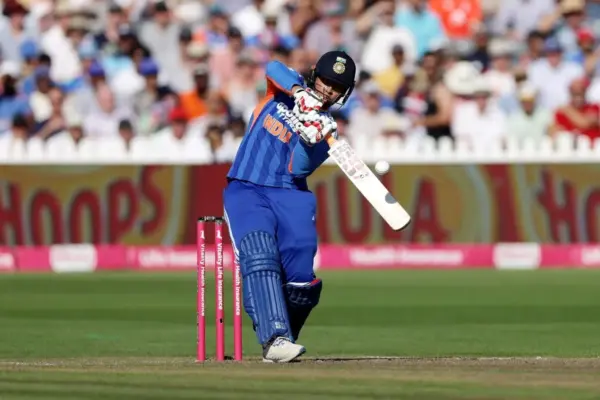
Seven days. That is all it took for Vaibhav Sooryavanshi to experience almost every emotion international cricket can offer. On July 4, the 15-year-old walked out at Old Trafford as India’s youngest international cricketer and announced himself by launching his Rajasthan Royals (RR) teammate Jofra Archer for a six off the very first ball he faced from him.
Here was a school-going cricketer, unafraid of one of the fastest bowlers in the world, playing with the same freedom that had made him one of the biggest stories of the IPL. Three innings later, after scores of 14, 13 and 15 in challenging English conditions, he found himself out of the playing XI for the fifth and final T20I. India lost that match too!
England’s 4-0 sweep was deserved. They adapted better to the conditions and exposed India’s shortcomings with both bat and ball. A batting line-up of individuals that had looked almost unstoppable during the IPL struggled to cope with pace and bounce. There will be discussions around combinations and preparation, and rightly so. But somewhere within that disappointing tour lies another conversation, one that could have a far greater impact on Indian cricket than the result of one bilateral series.
Short ball tactic
It begins with a simple question. What happens after Indian cricket identifies a prodigy? Sooryavanshi’s selection was backed by performances that demanded attention. The 15-year-old had piled up 776 runs for RR in IPL 2026 at a strike rate in excess of 237, playing an audacious brand of cricket that rarely seemed affected by the quality of the opposition. Captains tried different plans and yet he continued to score at a remarkable rate. The selectors saw enough to believe that his talent deserved an opportunity at the highest level.
Old Trafford briefly justified that belief. Archer ran in, Sooryavanshi trusted his instincts and the ball disappeared over the boundary. That shot summed up everything that had made him such an exciting prospect. At the same time, everyone knew that the real examination would begin after the first impression. International cricket has a habit of asking questions that domestic cricket never does.
Learning to negotiate international cricket is one challenge. Carrying the uncertainty of selection at the same time is quite another
England wasted little time finding those questions. The short ball became a recurring theme through the series. The extra bounce and pace forced Sooryavanshi onto the back foot, making him play strokes that had rarely been demanded of him during the IPL. Good international teams are relentless once they identify an area they believe they can exploit, and England kept returning to it. There was nothing unusual about that. Every young batter eventually reaches a tour where the opposition discovers something to work with. For Sooryavanshi, England became that first real examination.
Shastri, Gavaskar question Sooryavanshi’s omission
Virat Kohli’s first Test tour of England in 2014 was so difficult that it prompted questions about whether he could ever master those conditions. Four years later, he returned and produced one of the finest overseas performances of his career. Rohit Sharma spent years searching for consistency before becoming one of India’s most dependable white-ball batters. Looking back now, those difficult phases seem like necessary chapters rather than warning signs.
That is why the reaction to Sooryavanshi’s three innings deserves as much attention as the innings themselves. Former India head coach Ravi Shastri questioned the thinking behind dropping a 15-year-old after just three matches. His view was straightforward. If the selectors believed Sooryavanshi was good enough to be fast-tracked into international cricket in England, facing bowlers such as Archer, they also had to expect that there would be failures before the runs arrived consistently.
Sunil Gavaskar expressed a similar concern. At 15, Sooryavanshi is still learning his game. England had exposed a weakness against the short ball, exactly as strong international teams are expected to do. Gavaskar’s concern was what followed. A youngster of that age, he felt, should not be left wondering whether a handful of low scores would immediately put his place in jeopardy. Learning to negotiate international cricket is one challenge. Carrying the uncertainty of selection at the same time is quite another.
The IPL has become the world’s greatest talent factory. It has changed the age at which extraordinary cricketers announce themselves and accelerated the path to international cricket
That distinction is important because technical flaws are usually easier to correct than confidence. Coaches can help a batter improve his back-foot game or find better methods against the short ball. Rebuilding self-belief is often a slower process. At 15, every experience leaves a deeper impression than it does on an established international. Every dismissal and omission invites self-doubt. The cricket is only one part of the challenge but managing the emotional weight of early success and early failure is just as important.
Learning from failures
The selectors deserve credit for recognising exceptional talent. Picking a 15-year-old to play for India was never going to be the safe decision. It reflected genuine conviction in his potential. The responsibility, however, does not end with handing over an India cap. That is where it truly begins. Young players need clarity. They need to know whether they are being judged over three innings or thirty, whether the team is investing in their future or simply responding to the latest scorecard.
India’s defeat in England should not blur that distinction. Sooryavanshi was not the reason India lost the series, and his omission before the final match did not alter the outcome. England completed the clean sweep anyway, underlining that India’s shortcomings ran much deeper than one teenager’s returns. The bigger issues were collective, stretching from batting execution to bowling plans and adaptability in unfamiliar conditions.
The IPL has become the world’s greatest talent factory. It has changed the age at which extraordinary cricketers announce themselves and accelerated the path to international cricket. What it cannot accelerate is experience. That still has to be earned through difficult tours, unfamiliar conditions and bowling attacks that keep exposing new weaknesses. Those experiences are essential.
The scorecards from this series will eventually become another entry in the record books. What should matter more is what Indian cricket chooses to learn from it. Sooryavanshi may well have another 15 or 20 years ahead of him in international cricket. The challenge now is to ensure that these failures don’t scar. The difference between the two will depend less on the teenager and far more on the people entrusted with guiding his journey.