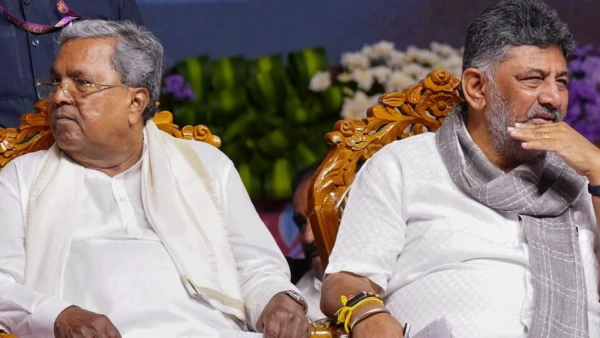
Karnataka Chief Minister Siddaramaiah announced his resignation from the post on Thursday, three years into his second term in office.
Though there is no official announcement yet, his deputy and veteran Congress leader DK Shivakumar is expected to succeed Siddaramaiah as the next Chief Minister of the southern state.
‘Troubleshooter’ gets his due
The change of guard in Karnataka also marks the culmination of an intense battle between the Siddaramaiah camp and the DKS camp over the post of Chief Minister. Widely recognized as a ‘troubleshooter’ for Congress, DKS had his eyes set on the CM’s chair for a long time, but it eluded him, until now.
What happened in 2023?
In 2023, when the Congress won the Karnataka Assembly election by a landslide victory, winning 135 seats, Karnataka Pradesh Congress Committee (KPCC) President and the de-facto face of the party’s campaign, DKS, was widely expected to become the new Chief Minister.
Shivakumar, who is credited with single-handedly turning around the Congress’s fortunes since taking charge as the KPCC President in 2020, wanted to be projected as the CM face for 2023. But after a strong opposition from the Siddaramaiah camp, the Congress high command declare they would contest the election under “collective leadership.”
Even after the historic election win, Siddaramaiah, who served as the Karnataka Chief Minister from 2013 to 2018 and had considerable backing within the party and ground support, was unwilling to let DKS take the helm. This led to days of intense negotiations, both in Bengaluru and Delhi, and at one point, it was even reported that DKS had threatened to resign if he was not made the Chief Minister. Despite pressure from the DKS camp, the Congress High Command went with Siddaramaiah, and Shivakumar was made his deputy.
Rotational CM agreement
According to the DKS camp, the Congress High Command had agreed on a rotational CM deal, where Siddaramaiah would step down mid-term to make way for Shivakumar. While the DKS camp maintained that an unofficial rotational agreement was struck, Siddaramaiah did not publicly acknowledge it and had maintained that he would serve his full five-year term as Chief Minister.
Siddaramaiah vs DKS in 2013
This was not the first time the two stalwarts had clashed; in fact, in 2013, when Siddaramaiah became the Karnataka Chief Minister for the first time, the duo had locked horns over Shivakumar’s inclusion in the cabinet.
Siddaramaiah, who wanted a ‘clean’ image for his cabinet, pushed hard to keep ‘tainted’ Shivakumar out of his council of ministers. Shivakumar was facing allegations and legal scrutiny regarding illegal mining and land scams at the time, and Siddaramaiah used this to keep the Vokkaliga strongman out of the cabinet.
However, under intense internal party pressure, Siddaramaiah was forced to induct Shivakumar into his Cabinet as the Minister for Energy.
Siddaramaiah, the ‘outsider’
Their uneasy history goes back to 2006, when Siddaramaiah, a former Janata Dal (Secular) leader who was expelled from the party by HD Devegowda, joined the Congress. While the Congress leadership welcomed Siddaramaiah, who had served as the Deputy CM of Karnataka twice, with open arms, for many leaders, including Shivakumar, he was an ‘outsider’.