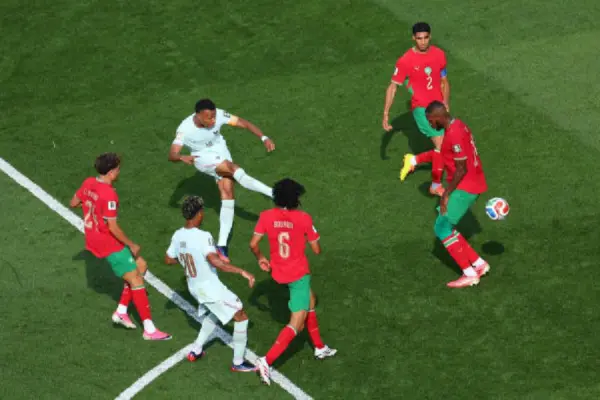
Whatever opponents try – a saved penalty, a low block, a tug of the shirt – nobody has yet found the measure of this French team. Morocco discovered as much on Thursday night at Boston Stadium, brushed aside 2-0 as France rolled into the World Cup semi-finals for the third tournament running.
The story of the night, inevitably, was Kylian Mbappe. Just before the first-half hydration break, he won a penalty off a free-flowing move – released by Michael Olise after Desire Doue had dispossessed Achraf Hakimi, then tripped in the box by Noussair Mazraoui. What followed was farce dressed up as procedure.
Argentine referee Facundo Tello waved away a VAR review, then noticed the ball wasn’t on the spot, then sent goalkeeper Yassine Bounou back to his line. Three minutes and eleven seconds elapsed between the foul and the kick – enough time, it turned out, to unsettle even someone of Mbappe’s calibre and poise. The France captain’s effort was tame, and Bounou read it well; the goalkeeper has now been beaten by only two of the nine penalties he’s faced at this World Cup, shootouts included. It was Mbappe’s first missed penalty in the competition.
The penalty miss hardly troubled Mbappe. Only Lionel Messi has managed the same trick at this tournament – miss from the spot, then answer with something extraordinary. Messi did it against Egypt. Mbappe did it against Morocco.
The goal, when it came, was a little masterclass in the art of finishing. Doue poked a loose ball into Mbappe’s path on the left edge of the box; centre-back Issa Diop stood between him and goal. Mbappe shimmied one way, then the other, opening the sliver of space he needed – and used Diop himself as a screen, curling the ball around him and beyond Bounou’s despairing dive into the top corner. Agreed, the goalkeeper didn’t quite have a clean sightline, but it wouldn’t have mattered if he had.
It was Mbappe’s 20th World Cup goal in 20 games – one behind Messi’s all-time mark – and his eighth of this tournament, level with the Argentine great. Dembele added a second soon after, ghosting into space Morocco simply gave him and driving low into the bottom corner; Bounou got a hand to it and nothing more.
Mbappe was withdrawn in the 77th minute, more as a precaution than an emergency after a nasty Diop tackle earlier in the half. He lay down briefly, waved to the bench, then to the crowd, then high-fived his way down the tunnel steps. Ice on the ankle afterwards, but he was back out for the celebrations. “I’m fine,” he said. “I took a hit on the ankle, but everything’s okay.”
Morocco, so heroic in Qatar four years ago, simply had no answers in Boston. Doue tormented Hakimi all night. Mbappe made Diop’s evening a misery long before the goal arrived, and Dembele took Anass Salah-Eddine apart down the other flank. Inmidfield, Olise toyed with Ayyoub Bouaddi, who only recently was turning out for France’s own U-21 side – a small, cruel irony. The second goal, when it arrived, felt like an inevitability.
The wider picture is almost unfair. Mbappe has scored half of France’s goals at this World Cup, yet he is nowhere near their only source. Dembele’s low finish against Morocco was his fifth of the tournament – a return that would headline most other squads. Bradley Barcola and Doue have three between them. France are only the second side in this century to have two players reach five goals apiece at a single World Cup, after Brazil’s Ronaldo (8) and Rivaldo (5) in 2002. Before that, it was the Polish duo of Grzegorz Lato (7) and Andrzej Szarmach (5)in the 1974 tournament inWest Germany.
By contrast, Messi has almost no help up front for Argentina, and neither does Erling Haaland for Norway. Only one other Argentinian forward has scored other than Messi (Lautaro Martinez, one); and one Norwegian forward has scored other than Haaland (Antonio Nusa, also one).
England captain Harry Kane, at least, has JudeBellingham’s four goals for company.
France’s coach Didier Deschamps, in what is likely his last tournament with this generation, deserves credit for resisting the urge to reinvent anything. His players arrive from different clubs with different footballing cultures; rather than impose a new one, he has built the team around the attack he already had – occasionally borrowing shorthand straight from Mbappe and Dembele’s PSG playbook. It has worked, efficientlyand ruthlessly.
What should worry the rest of the field is this: France have not trailed once at this World Cup. Nobody yet knows how they respond to adversity, because nobody has made them face any. It is precisely when they’re ahead that they’re most dangerous – opponents are forced to push forward and open the exact space this front line thrives in, as Morocco discovered when Dembele’s second arrived on the counter, moments after Mbappe’s opener.
Spain, England and Argentina all have the attacking quality to test France in ways Morocco could not. France may have the best starting XI and the deepest squad left in this tournament – but as history keeps insisting, campaigns can unravel in the time it takes to concede once.