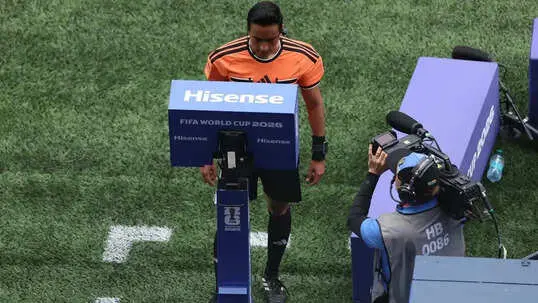
The FIFA World Cup has rarely been short of controversy, but the 2026 edition has sparked a debate unlike any before it. From Egypt’s dramatic Round of 16 exit against Argentina to Germany’s elimination and several other contentious moments across the knockout stages, the spotlight has shifted from the players to the officials.
Every decision has been replayed endlessly, slowed down frame by frame and scrutinised across television studios and social media, reigniting the question of whether technology is making football fairer or simply more complicated.
Few people are better placed to answer those questions than Goutam Kar. A former FIFA referee and one of India’s most respected refereeing educators, Kar has spent more than four decades in the game. Having served as the Director of Referees for the All India Football Federation (AIFF) and later as Referee Director for the All Nepal Football Association (ANFA), he has trained and mentored generations of match officials while witnessing the evolution of officiating from an era with no technological assistance to one increasingly shaped by VAR, semi-automated offside technology and data-driven decision-making.
VAR – Supporting Factor, Not Decisive Factor | FIFA World Cup 2026
Sports Now caught up with him ahead of the quarter-final clash between Spain and Belgium. When asked whether the technology had gradually moved away from its original purpose to eliminate clear and obvious errors, Kar responded by stating, “Not really, because you know technology will do its duty, because after all, this game where you will always need human intervention, right? Technology can help you to some extent, but the ultimate decision lies with the referee.”
“The Referee is trained to do his duties. If you look at the rules, or the laws of the game of football, they clearly state that whether VAR is functioning or not, or whether there is a technical problem with the VAR… It doesn’t nullify the referee’s decision. It implies that, at the end of the day, the human element decides. They are the supporting factor, not the decisive factor.”
One of the most fiercely debated moments of the tournament occurred during Argentina’s Round of 16 victory over Egypt. after VAR reviewed an incident earlier in the attacking phase. While the decision prompted widespread anger, Kar maintained that the officials acted in accordance with the Laws of the Game.
“The laws state that you can only nullify when it has happened, an incident has happened immediately before scoring. So, the decision of the referee goes with this, goes with the laws of the game. See, the machine doesn’t understand the laws of the game, but the referee does. Machine will tell you that something has happened here, right? Now, the referee may or may not take it into account,” while stressing, when probed, whether the right call was made or not, he said, “Certainly.”
FIFA’s decision to move its s from the centralised facility in Dallas back into the stadiums for the latter stages of the tournament was interpreted in some quarters as a reaction to mounting complaints. Kar, however, rejected the suggestion that it represented a structural rethink, explaining that the change was largely possible because fewer matches were being held simultaneously.
“For VAR, there is a centralized system, there is a decentralized system, right? When all the group matches were happening, there were many. So, everybody was at one central place. From there, everything was monitored. And the time lag is a few milliseconds. So, practically there is no time lag in the communication,” he pointed.
“But now we are closing towards the end of the event. We have more resources available for us to put it in the stadium. This is to avoid a situation where, in case of any technical issues with the central system, this system is there in the stadium as a backup. That’s my understanding. There is nothing new. And I have seen this in one of the events; I don’t remember where. But there was a central system, and then the stadium had a backup,” Kar recalled.
There Is More Pressure On Referees Now: Kar
While technology may have improved the likelihood of making correct decisions, it has also placed referees under unprecedented public scrutiny. Every call is now replayed instantly and judged by millions online. Kar acknowledged that the psychological burden on modern officials has increased significantly, which is why referees are often advised to stay away from social media during major tournaments.
“There is more pressure. That’s why referees are nowadays asked not to use social media or other devices during the event, so unnecessary criticism doesn’t affect them. And most of the referees follow the good advice because they are the best in the world. There is no doubt about it, because I have seen many of the referees who have done the World Cup very closely in the past. The preparation, the focus, their psychological fortification, everything, it’s of a top level.”
When asked about the opinions of some former footballers who think football is now being judged frame-by-frame rather than in real time, and its impact on the natural flow of the game, Kar opined, “You can say that to some extent, But at the World Cup level, you would like to see the perfection. Even if it breaks a bit of the flow, it is acceptable to the teams and the public because, at the end of the day, they want the decision to be correct. When there was no VAR during our time, it was the referee’s efficiency or the referee’s capability to maintain the game.”
VAR Only For Goal-Bound Moves Or Red Cards?
Having been part of the footballing eco-system for close to four decades, Kar, when asked if FIFA seeks his opinion on one reform to make VAR more acceptable, his immediate response was, “It’s a very difficult question. VAR is progressing. One thing I liked in this edition of the VAR instruction is that they say that if it is possible to rectify a corner kick into a goal kick before it is taken, it’s fine. It means there is no public view. VAR says it is a goal kick, not a corner kick. Revert it.”
“As far as the dissection is concerned, the dissections will continue; we cannot help it because this is an era of technology. Anyone can download it to their mobile and go frame by frame. But the referee doesn’t have that luxury to see it frame by frame,” while adding, “Frankly speaking, except for goal-bound moves and red card events in other places, VAR should be restricted.”
“In my view, the intrusion- I’ll not say interference; I’ll say interference of VAR is taking a percentage of the charm of the natural flow of the game,” he reckoned.