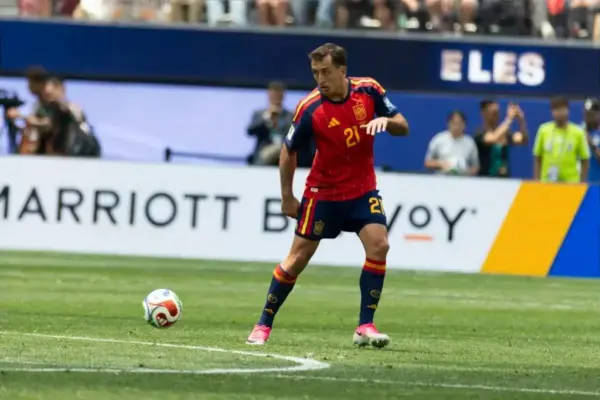
Mikel Oyarzabal is tearing up the World Cup, but don’t expect him to bask in the spotlight-he’s Spain’s reluctant hero, propelled into global headlines by a torrent of goals and a coach desperate for justice.
The 29-year-old Real Sociedad captain, long the quiet operator in Spanish football, has exploded onto the world stage in Los Angeles and Dallas, notching four goals-including a clinical brace against Austria-that now force even his harshest critics to pay attention. Spain’s coach Luis de la Fuente has seized the moment, repeatedly thanking journalists for simply mentioning Oyarzabal’s name and declaring him “a great among greats.” As Spain’s No. 21 climbs the World Cup top scorers’ list-alongside megastars like Mbappé, Messi, Haaland, Kane, and Dembélé-the world is finally asking: who is this understated forward transforming Spain’s attack?
For years, Oyarzabal has been the player everyone overlooked-by design. Raised in the Real Sociedad academy and fiercely loyal to his Basque roots, he’s shunned agents, transfer speculation, and the trappings of superstardom. His €75 million buyout clause, modest by today’s standards, has rarely even been tested. Oyarzabal doesn’t court headlines; he doesn’t care to. Even when pressed about his sudden statistical parity with football’s biggest names, he shrugs off the comparison: “I don’t care,” he told reporters after the Austria match, his deadpan delivery underlining a man impervious to hype or envy.
But numbers don’t lie-and Oyarzabal’s are now impossible to ignore. His transformation from a wide playmaker to Spain’s central attacking threat has been nothing short of seismic. Forced into a new role after a devastating knee injury kept him out of the last World Cup, Oyarzabal adapted, evolving into a versatile forward who thrives between the lines, moving with intelligence rather than raw pace or trickery. “Since I was little I’ve tried to understand play and why things happen,” Oyarzabal explained. “There are moments in which, just by positioning, you can help the team without even touching the ball. It’s then about making the most of the few you have.”
Spain coach Luis de la Fuente is on a mission to rewrite Oyarzabal’s narrative. At a press conference before facing Uruguay, De la Fuente pounced on the rare mention of his forward’s name: “Thank you. You mentioned Mikel Oyarzabal: at last, at last, we’re starting to recognise him in Spain. Madre mia! At last.” He went further, calling him “a great among greats,” and highlighting his unique intelligence and humility: “He’s one of the best strikers going into space, between lines, dropping to the wing. Very few footballers have his ability to interpret the game. He has the humility and understanding to keep his feet on the ground, because this is a merry-go-round. He is an example to everyone and I’m more delighted with him by the day. People who understand football value him extremely highly. Unfortunately, there are others who don’t see it but the weight he has in the Selección is brutal.”
Fabián Ruiz, Oyarzabal’s teammate, echoes this sentiment, describing him as “someone you listen to, because he always has the right opinion.” This quiet authority helped De la Fuente select him as one of Spain’s captains, bypassing the usual hierarchy in favor of experience and reliability.
The statistics are damning for the doubters. Since scoring the winning goal in the Euro 2024 final, Oyarzabal has directly contributed to more international goals than even Mbappé, Messi, Ronaldo, or Kane-only Haaland boasts better numbers. In his last 18 matches for Spain, he’s found the net 17 times and added eight assists, propelling his side to new heights and establishing himself as the engine of Spain’s attack. His club form is equally potent: last season, he notched a personal best 15 league goals for Real Sociedad, cementing his evolution from enigmatic winger to relentless finisher.
Yet, for all his recent heroics, Oyarzabal remains an enigma: ordinary in appearance, almost invisible in his movement, but lethal in execution. He doesn’t dribble past defenders with flair or fire screamers from distance; instead, he times his runs, interprets space, and delivers when it matters most-often without the world noticing until the numbers scream for attention.
The football world is finally waking up. Oyarzabal’s World Cup rampage has made ignorance impossible, and with Spain’s ambitions growing with every match, the question is no longer whether he belongs among the elite, but just how far his understated brilliance can carry a nation. The next test looms, and with Oyarzabal at the heart of it all, Spain’s quiet man may soon become its most deafening headline. As De la Fuente put it, “I celebrate the fact that we’re talking about him, truly I do, so thank you.” The conversation, at last, has begun.