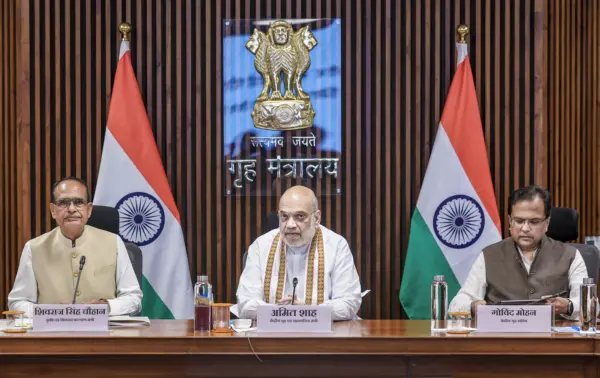
Union Home Minister Amit Shah on Friday said that the Government is continuously monitoring the situation arising out of below-normal rainfall and “potential drought conditions” in certain parts of the country due to El Niño and directed ministries concerned to remain “vigilant.”
Reviewing the situation with Union Agriculture Minister Shivraj Singh Chouhan, Shah directed the ministries concerned to advise farmers on the appropriate crops which can be sown in the wake of below-normal rainfall, according to an official statement.
In June, India as a whole witnessed a rainfall deficit of about 40 per cent, with Central India worst affected with a deficit of 50.4 per cent. The country experienced the fifth-lowest (99.5 mm) rainfall in June since 1901.
The monthly average rainfall over India is expected to be below normal during July, the India Meteorological Department said on Tuesday in its monthly forecast.
“Union Home Minister and Minister of Cooperation Amit Shah said the government is continuously monitoring the situation regarding below-normal rainfall and potential drought conditions in certain parts of the country due to El Niño,” the statement said.
Senior officials, including the Union home secretary and the Union agriculture and farmers welfare secretary, were present at the meeting, it said.
“The Minister directed the Ministry of Agriculture and all related ministries to remain vigilant and coordinate with state governments to advise farmers on the appropriate crops to sow,” it said.
The home minister instructed officials from the Department of Water Resources to monitor all water reservoirs across the country and also emphasised the need to focus on alternative crops that require less water, such as fodder, millets and pulses.
“Union Home Minister also directed the Secretary of the Union Ministry of Power to take necessary action to ensure a smooth and adequate supply of electricity,” it said.
Shah was informed that adequate quantities of essential food grains are available in the country, and the prices of essential commodities remain stable, the statement said.
Secretaries of Agriculture, Water Resources, River Development and Ganga Rejuvenation, Environment, Forest and Climate Change, Power, and Science and Technology attended the meeting besides other senior officials.
The home minister also directed the Inter-Ministerial Central Team (IMCT) of the MHA to be deputed to Assam and Arunachal Pradesh to assess the damage caused by recent heavy rainfall, flash floods, and landslide as both states have been affected, with Assam experiencing rising floodwaters in multiple districts and Arunachal Pradesh facing landslides and road blockages in several hilly areas.
The IMCT’s on-the-spot assessment is essential to evaluate the extent of damage to infrastructure, agriculture, and human habitations.
El Niño conditions are currently present over the equatorial Pacific Ocean and are expected to strengthen further during the June-September monsoon season.
El Nino is one of the three phases of the El Nino Southern Oscillation (ENSO) – a climate phenomenon characterised by changes in sea temperatures along the central and eastern tropical Pacific Ocean, accompanied by fluctuations in the atmosphere overhead.
While El Nino, which leads to less monsoon rainfall in India, is known to have a warming effect over the planet, its opposite phase, La Nina, usually results in a cooling effect. ENSO also has a neutral phase.
As Indian Ocean Dipole (IOD) conditions are currently neutral, they cannot help to counter the El Nino’s negative impact – positive IOD conditions typically result in more rainfall.