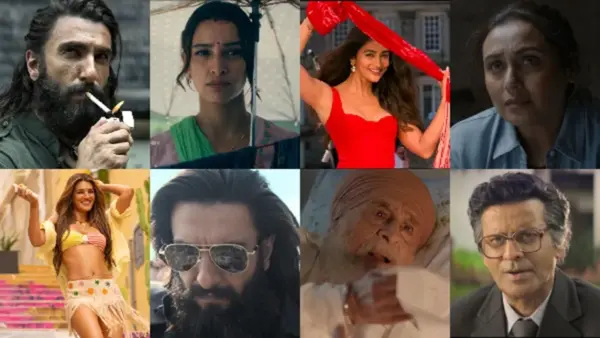
Bollywood’s first half of 2026 has been led less by spectacle alone and more by actors who made their parts feel lived-in. Big films arrived with familiar names, but the performances that stayed in conversation were those with emotional force, clear character work and moments audiences could carry out of theatres.
From Ranveer Singh taking on a double-layered action role to Triptii Dimri grounding a domestic drama with humour and hurt, the year has already offered a wide range of standout turns. The strongest performances so far have come from actors who did not simply fit into their films, but shaped how those films were received.
Ranveer Singh brings scale and intensity to Dhurandhar The Revenge
Ranveer Singh’s performance in Dhurandhar The Revenge stands out because it plays to both his strengths: controlled emotional volatility and larger-than-life screen presence. As Hamza Ali Mazari and Jaskirat Singh Rangi, he had to hold together a film built on action, conflict and shifting identities.
What made the act work was not just the physicality expected from a high-energy theatrical film. Singh brought urgency to the emotional beats, giving the action a stronger dramatic base. His performance reminded audiences why he remains one of Hindi cinema’s most flexible mainstream stars when given a role with scale and internal conflict.
Triptii Dimri makes Maa Behen a character-led win
Triptii Dimri’s rise has been closely watched, and Maa Behen gave her a role that demanded more than surface-level emotional expression. Playing a frustrated housewife, she carried the film with a mix of exhaustion, sharp humour and suppressed anger. It was a performance designed around small shifts rather than loud declarations.
Her much-discussed monologue gave the film one of its defining moments, but the strength of the performance lay in the build-up to it. Dimri made the character’s inner life visible before the script allowed her to fully speak it. That control helped turn Maa Behen into one of the year’s notable acting showcases.
Naseeruddin Shah proves restraint can still dominate the screen
Naseeruddin Shah’s work in Main Vaapas Aaunga has drawn attention for the same reason many of his performances endure: he does not need theatrical excess to command a frame. The veteran actor brought weight to the film through silences, pauses and carefully measured emotional turns.
In a year where several performances have leaned on volume and dramatic scale, Shah’s turn offered a reminder of the power of restraint. His portrayal gave the film emotional depth and helped it remain part of audience conversation beyond its theatrical run. Few actors can make stillness feel this expressive.
Pooja Hegde adds charm to David Dhawan’s rom-com space
Pooja Hegde’s role as Preet in David Dhawan’s Hai Jawani Toh Ishq Hona Hai brought a lighter but equally important kind of performance to the year’s list. Comedy and romance often depend on rhythm, and Hegde leaned into the film’s breezy tone without making the character feel one-note.
Her performance worked because it balanced brightness with emotional accessibility. In a genre that can easily slip into exaggeration, she kept the character warm and watchable. The result was a leading-lady turn that served the film’s rom-com world while giving the audience a character to root for.
Manoj Bajpayee gives Governor its quiet authority
Manoj Bajpayee’s portrayal of former RBI Governor S. Venkitaramanan in Governor: The Silent Saviour added another measured performance to his long list of dependable screen work. The role required maturity, dignity and a sense of institutional pressure, rather than overt dramatic flourish.
Bajpayee’s strength has often been his ability to suggest complexity without overexplaining it, and Governor appears to have used that quality well. His performance gave the film a firm centre, especially in scenes where quiet intensity mattered more than dialogue-heavy confrontation.
Rani Mukerji keeps the Mardaani franchise firmly her own
Rani Mukerji’s return as Shivani Shivaji Roy in Mardaani 3 reaffirmed how strongly the franchise depends on her presence. The character has always required a mix of toughness, moral clarity and emotional discipline, and Mukerji once again brought grit to the role.
What makes her performance important is the consistency with which she owns the world of Mardaani. Shivani is not written as a conventional larger-than-life hero, yet Mukerji makes her authority feel immediate. Her return gave the film the familiarity of a franchise and the force of a committed lead performance.
Kriti Sanon finds a standout moment in Cocktail 2
Kriti Sanon’s turn as Ally in Cocktail 2 has been one of the more talked-about mainstream performances of the year. Playing a free-spirited, glamorous woman in a modern love triangle, she had to balance style with emotional vulnerability.
The role could have easily been limited to charm and visual appeal, but Sanon gave Ally a sense of conflict beneath the gloss. That made her one of the film’s standout elements and showed her continuing growth in parts that mix mainstream appeal with emotional stakes.
Together, these performances show the range Bollywood has delivered in the first half of 2026. Action, comedy, drama, romance and franchise cinema all found actors willing to push beyond basic star turns. If the second half of the year matches this momentum, 2026 could be remembered as a strong year for performance-led Hindi cinema.