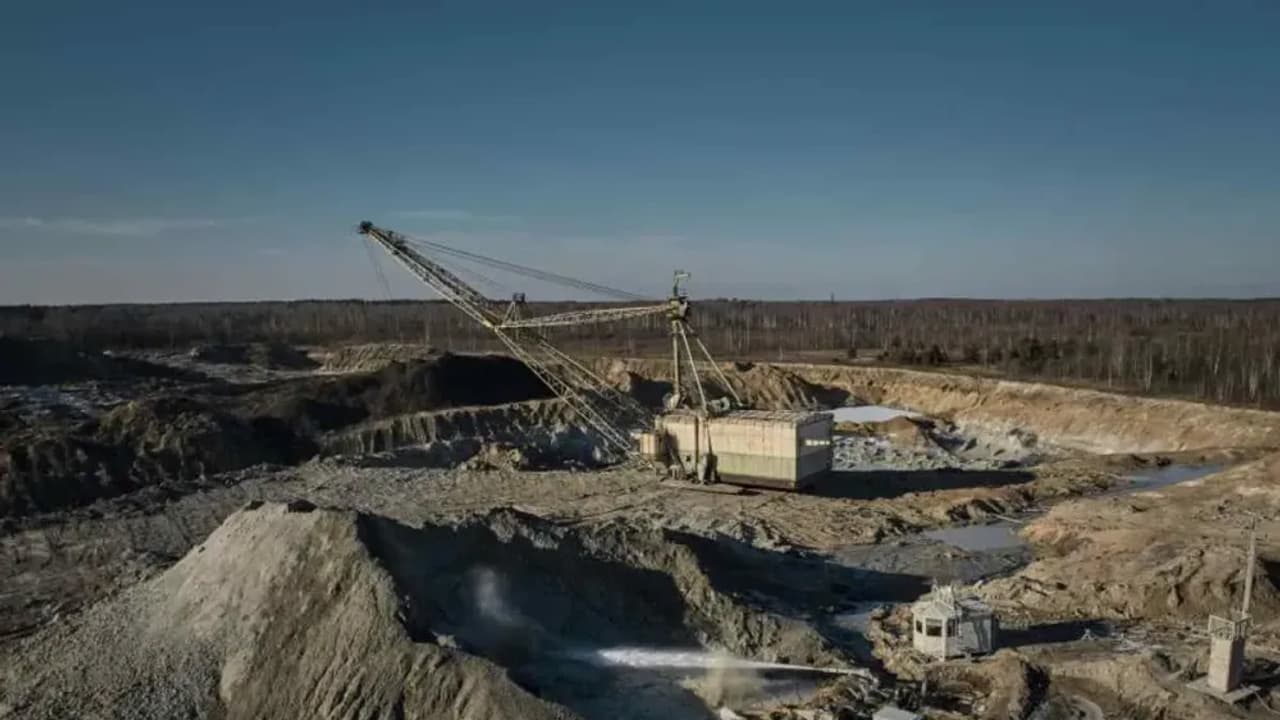
The initiative will support projects that recover and refine rare earth elements from unconventional sources, such as mine tailings, e-waste, and other waste materials.
- The funding builds on the DOE’s Rare Earth Demonstration Facility program to establish full-scale extraction and separation operations in the U.S.
- REEs like Praseodymium and Neodymium are vital for advanced manufacturing, defense systems, and high-performance magnets used in power generation and EVs.
- Rare earth stocks such as USAR, MP, and NB moved higher in premarket trading on Tuesday.
The U.S. Department of Energy’s Office (DOE) of Critical Minerals and Energy Innovation has, on Monday, issued a Notice of Funding Opportunity offering up to $134 million to boost domestic rare earth element (REE) supply chains.
The initiative aims to support projects that can commercially recover and refine REEs from unconventional sources such as mine tailings, electronic waste, and other discarded materials. The funding builds on the DOE’s Rare Earth Demonstration Facility program, which focuses on establishing full-scale extraction and separation operations within the country.
By expanding these capabilities, the DOE seeks to reduce reliance on foreign suppliers and reinforce energy independence.
“For too long, the United States has relied on foreign nations for the minerals and materials that power our economy. We have these resources here at home, but years of complacency ceded America’s mining and industrial base to other nations,” said U.S. Secretary of Energy Chris Wright.
REEs, including Praseodymium, Neodymium, Terbium, and Dysprosium, are essential in advanced manufacturing, defense technologies, and high-performance magnets used in power generation and electric vehicles.
USA Rare Earth (USAR) shares climbed 1.6% in premarket on Tuesday, while MP Materials (MP) and NioCorp Developments (NB) gained around 1% each.
Domestic Production Boost
Over the past few months, the White House has intensified its efforts to expand domestic production of critical minerals. The U.S. government has acquired stakes in multiple critical mineral miners and rare-earth magnet producers, including Lithium Americas, MP Materials, Critical Metals, Trilogy Metals, and Vulcan Elements.
In an effort to shore up domestic production and reduce reliance on Chinese imports, the U.S. government added copper, silver, and uranium, among others, to its list of critical minerals last month. The updated list now includes 60 minerals, up from 50 in 2022, with new additions such as metallurgical coal, potash, rhenium, silicon, and lead, as well as 15 rare earth elements.
Rare earth elements have become a central flashpoint in the tariff tensions between the U.S. and China. China controls about 70% of global rare-earth mining and nearly 90% of processing capacity, giving it strong market leverage. This dominance leaves the U.S. and its allies vulnerable to supply disruptions. Any interruption in these flows can inflict serious damage on high-value manufacturing industries.
The U.S. has been looking to tap into its allies’ resources to offset the supply chain imbalance. In October, it signed an $8.5 billion rare-earth deal with Australia. Recently, MP Materials formed a three-way joint venture with Saudi Arabia’s state-owned miner Maaden and the U.S. Department of War (DoW) to build a major rare-earth refinery in the Gulf country.
For updates and corrections, email newsroom[at]stocktwits[dot]com.<