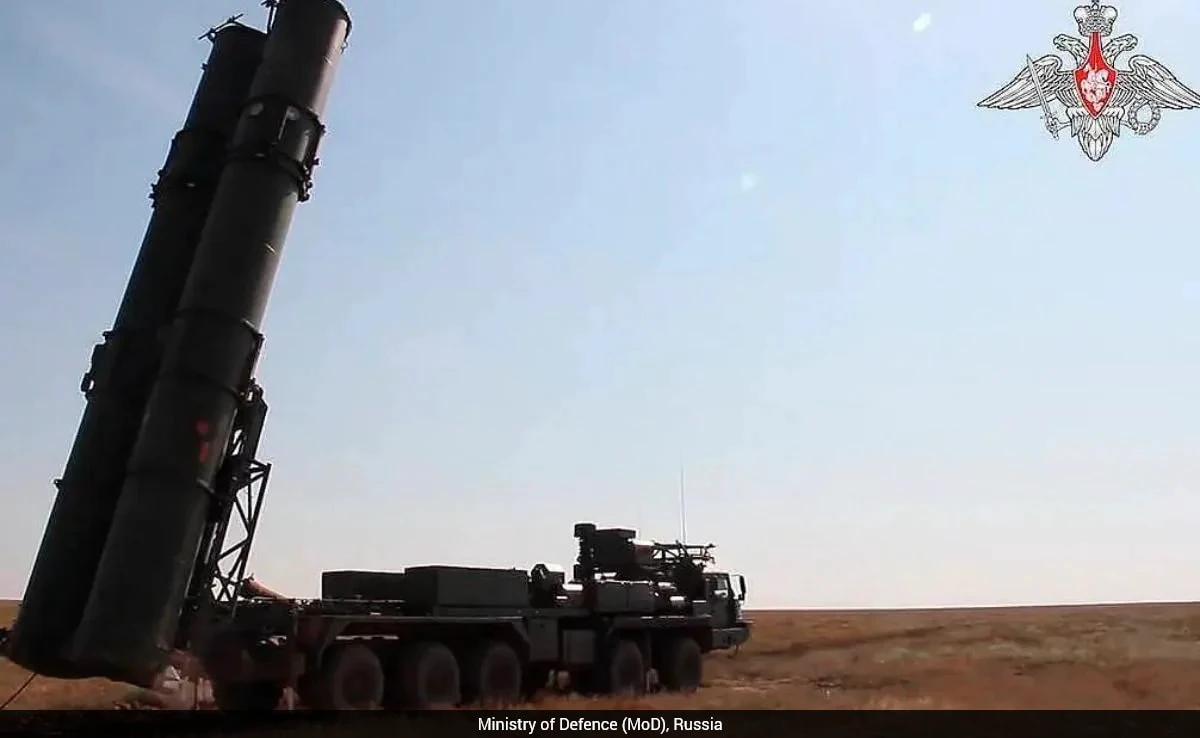
Easily one of the biggest weaponry success stories of Operation Sindoor is the Russian-built S-400 air defence missile system, five regiments of which were ordered from Moscow in 2018 as part of a $5.43 billion deal.
During India’s offensive operations in May this year, the S-400 detected, tracked, and shot down multiple Pakistani aircraft hundreds of kilometers inside Pakistani airspace and ensured complete air power dominance over the country.
It was so effective and proved such a powerful deterrent that India is now seeking five more S-400 regiments. An Indian S-400 regiment consists of 16 launcher vehicles divided into two batteries, with each battery activated by a command-and-control system and surveillance and engagement radar vehicle.
But as Russian President Vladimir Putin heads to India, the military main course is something else entirely. While the S-400 is clearly being expanded, the main dish on the table is the S-400’s far superior successor, the S-500 Prometheus. This is not merely an improved upgrade but a vastly different weapon system with far superior and expanded capabilities.
Crucially, unlike the S-400 deal, the S-500 is being pitched as a co-production agreement that will see an Indian partner team up with Russia’s Almaz Antey to manufacture parts of the missile locally.
The S-400 gives India air dominance. The S-500 is designed to give India air, missile, and near-space dominance. And the difference between the two is not cosmetic. Let’s look at some numbers.
The S-400 has a range of up to 400 km, while the S-500 stretches to roughly 500-600 km. The S-400 intercepts targets up to 30 km high, while the S-500 intercepts targets up to 180-200 km in the near-space layer.
The S-500 is a major level up in terms of what it can track and shoot down too.
The S-400 counters aircraft, drones and cruise missiles while S-500 counters all of those plus long-range ballistic missiles and is said to be effective against hypersonic glide vehicles too, though this remains in the realm of claim. While the S-400 supports theatre air defence, the S-500 supports national-level air, ballistic, and hypersonic defence.
The missiles used by these two systems are very different too. The S-400 uses 48N6 and 40N6 missiles, while the S-500 introduces 77N6-N and 77N6-N1 hit-to-kill interceptors.
Despite its formidable performance parameters, the S-400 handles tactical and operational threats, while the S-500 is built to handle strategic threats and, hopefully, future hypersonic warfare. The S-400 protects airspace over regions and sectors, while the S-500 protects cities, strategic infrastructure, and command nodes across the nation.
The S-400 has proven to integrate well with India’s intricate air defence network, which comprises a buffet of international systems, ranging from India’s own Akash system to the Israeli MRSAM and SpyDer systems.
The S-500 could potentially be India’s biggest ever single weaponry deal with Russia.
Range
S-400: 400 km
S-500: 500-600 km
Altitude
S-400: Up to 30 km
S-500: Up to 180-200 km
Target Types
S-400: Aircraft, drones, cruise missiles
S-500: All above + ballistic missiles, hypersonic weapons
Defence Role
S-400: Theatre air defence
S-500: National ballistic and hypersonic defence
Interceptor Family
S-400: 48N6, 40N6
S-500: 77N6-N, 77N6-N1
Threat Category
S-400: Tactical and operational
S-500: Tactical & Strategic
Coverage Effect
S-400: Protects region / theatre
S-500: Protects cities and critical national assets
Deterrence Outcome
S-400: Regional air advantage
S-500: Continental missile and hypersonic advantage