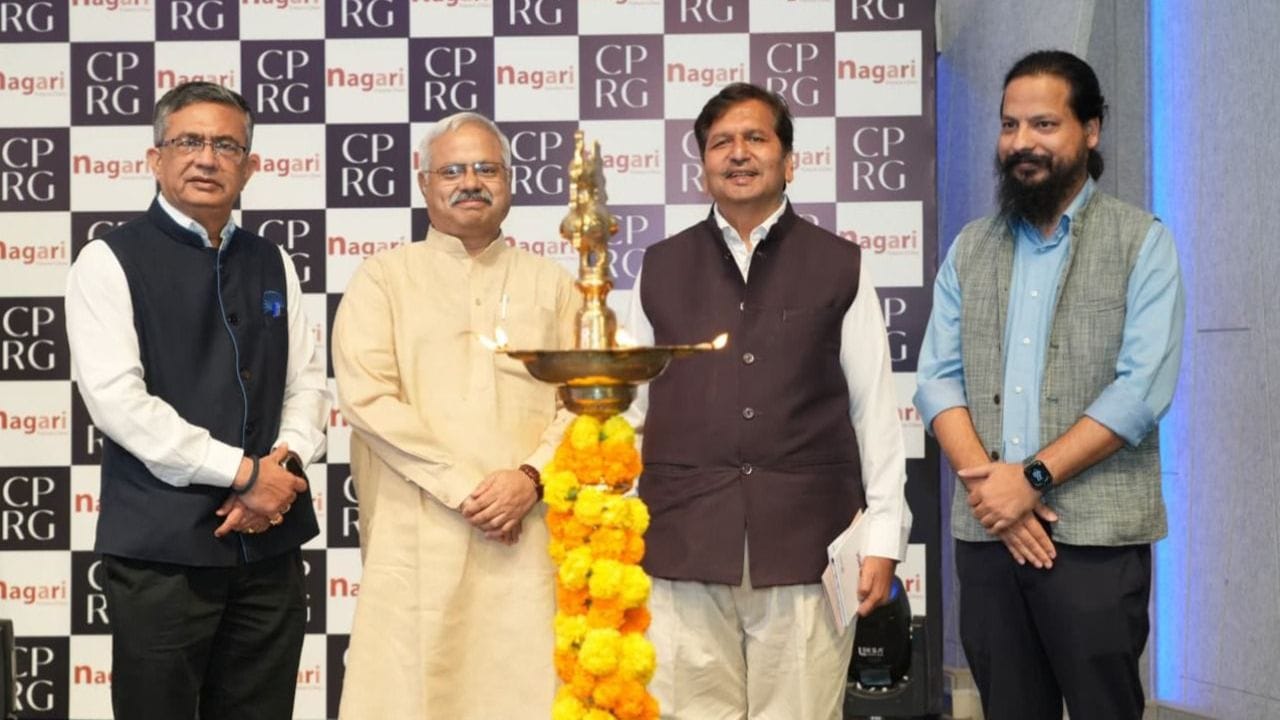
New Delhi: The Nagari – Future Cities Conclave, organised by the Center of Policy Research and Governance (CPRG) in collaboration with the National Stock Exchange (NSE), concluded today after a full day of discussions on accelerating India’s urban transformation. The Conclave brought together senior policymakers, administrators, economists, and urban experts to reflect on how Indian cities can become more resilient, sustainable, and people-centric in the decades ahead.
Addressing the gathering, Shri Mangal Prabhat Lodha, Hon’ble Cabinet Minister for Skill Development, Employment and Entrepreneurship (MSDE), Government of Maharashtra, said, “Urban planning shapes the way people live their everyday lives. India’s homes and neighbourhoods are full of ideas and enterprise, and our cities must be designed to support this energy. Ensuring safe and walkable access to workplaces is also essential for expanding opportunities for women.”
Sharing his perspective on India’s urban future, Shri Sanjeev Sanyal, Member, Economic Advisory Council to the Prime Minister (PM-EAC), said, “India has an opportunity to reimagine the character and growth of its cities. Developments like the Bandra Kurla Complex show what is possible, but the next step is to embrace more diverse, locally rooted design. Cities work best when they are designed around the needs and movement of people.”
Shri Ashish Kumar Chauhan, Managing Director, NSE, spoke about how cities evolve through shifts in infrastructure, technology, and governance, and reflected on the growing role of artificial intelligence in urban management.
As Chief Guest, Shri Sunil Ambekar, Akhil Bhartiya Prachar Pramukh, RSS, emphasised the deep link between livelihood and habitat. He underscored the importance of placing habitat at the centre of urban planning and discussed not only the economic but also the social and human dimensions of city development. He urged the audience to reconsider fundamental aspects of India’s urban structure to meet the needs of future generations.
The Conclave featured four high-level thematic discussions on different dimensions of India’s urban transformation:
1. Reimagining Future Cities: Structural Aspects and Their Impact on Jobs and the Economy
2. Building Cities the Bharatiya Way: Local Challenges and Indigenous Solutions
3. Designing Sustainable Cities: Green Infrastructure, Climate Resilience, and Future-Ready Growth
4. Technology-Enabled Cities: Cost, Convenience, AI, and Automation
Together, these sessions offered a comprehensive and grounded view of the choices, opportunities, and trade-offs involved in shaping India’s next-generation cities.
Senior experts and policymakers who addressed the Conclave included Shri Ravishankar Shrivastava, Principal Commissioner, Income Tax; Dr Soumya Kanti Ghosh, Part-Time Member, PM-EAC; Smt Alka Arya, Director, Delhi Development Authority (DDA); Shri Milind Sudhakar Marathe, Chairman, National Book Trust (NBT); Prof. Badri Narayan, Vice Chancellor, Tata Institute of Social Sciences (TISS); Dr Niranjan Hiranandani, Founder and Chairman, Hiranandani Group; Dr Radhakrishnan B., CMD, MAHAGENCO; Shri Atul Kulkarni, Director, Eurasia Special Technologies; Shri Bedanta Saikia, Vertical Head, Edifice Consultants Pvt. Ltd.; Shri Jitendra Bhople, Secretary General, Institute of Town Planners, India (ITPI); Shri Tarun Jha, Head of Marketing, JSW Steel; among other eminent urban practitioners and administrators.
Speaking on the significance of the Conclave, Dr Ramanand, Director, CPRG, said,
“Cities are where India’s social, economic and climate futures meet. The Nagari Conclave was an effort to think decades ahead and imagine what strong, people-centred urban development should look like. CPRG will continue to advance this long-term vision through collaborative and purposeful policy work.”
He also emphasised that urban policy must integrate social and environmental considerations and called for a more comprehensive approach to policymaking across multiple arms of government.
In the concluding session, Dr Niranjan Hiranandani highlighted the need for long-term, sustainable urban development. He stressed the importance of skill development to create jobs and make the economy more competitive, and called for the removal of obsolete laws that hinder progress.
Prof. Milind Marathe underscored the importance of literature and public knowledge in helping citizens understand the evolution, heritage, and identity of their cities.
The Conclave reaffirmed the need for sustained collaboration between government, industry, civil society, and research institutions to build cities that are adaptive, innovative, and responsive to citizens’ needs. CPRG will continue to host such platforms to advance India’s long-term urban vision and support ongoing work on governance, technology adoption, and city futures.
About the Center of Policy Research and Governance (CPRG)
The Center of Policy Research and Governance (CPRG) is an ICSSR-recognised think tank committed to promoting responsive and participatory policymaking. The Nagari Conclave is part of CPRG’s Future of Society Initiative, which examines how governance, technology, and urban systems are evolving in rapidly changing environments. Over the past year, CPRG has hosted several high-level national and international engagements under this initiative, including official events at major global platforms. CPRG also convened the PadhAI Conclave 2025, which brought together senior ministers, policymakers, and academics to discuss the future of education and workforce development. Building on this momentum, CPRG continues to bring together diverse stakeholders to shape India’s future policy agenda across technology, governance, and urban development.