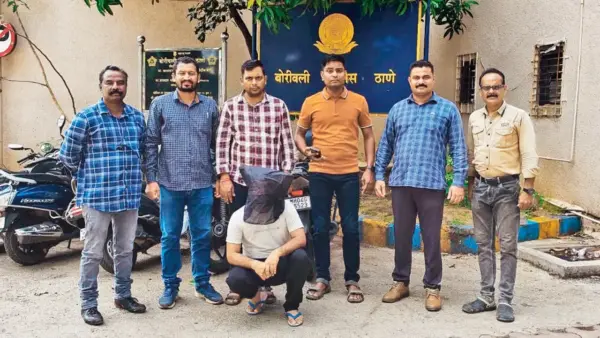
Acybercrime investigation into fake birth certificates has taken an unusual turn, with Borivli police arresting a 25-year-old BSc IT dropout who allegedly used artificial intelligence to sell forged birth certificates through a fake government-style portal — only to discover that he himself had allegedly been duped by a larger cyber fraud network running the counterfeit website.
Police believe Krishna Vinod Jaiswal acted as a sub-agent in a wider racket and are now hunting the operators behind the fake portal, which closely mimicked official government websites.
How the fraud surfaced
A 41-year-old Borivli West document service operator, who assists citizens with 2025 by a man identifying himself as “Krishna Jaiswal”.
Jaiswal claimed he had access to an “official” portal capable of generating birth certificates from any state in India. To convince him, he shared sample certificates bearing QR codes that appeared to verify the documents online.
Trusting the portal, the complainant:
>> Paid registration and service fees
>> Obtained login credentials
>> Generated birth certificates for customers
Doubts surfaced only after some certificates failed government verification.
The breakthrough
Police approached BMC’s Birth and Death Registration Department for verification. Officials found that all four birth certificates submitted for verification had no corresponding government records and were completely forged. An FIR was then registered and the accused was arrested.
AI’s role in the fraud
Police said Jaiswal allegedly used Google’s AI tool, Gemini, to build:
>> His own website
>> Phishing pages
>> UPI payment links
According to investigators, customers first received a payment link. After payment, they were redirected to a form seeking personal details including:
>> Name
>> Date and place of birth
>> Parents’ names
>> Aadhaar number
>> Address
>> Hospital name
>> Registration details
The information was automatically forwarded to Jaiswal via WhatsApp, following which he .
How the fake portal worked
Step by step
1. Register on a website resembling an official government portal.
2. Create a login ID.
3. Recharge a digital wallet via UPI.
4. Enter applicant details.
5. Receive a birth certificate PDF within minutes.
6. Scan the QR code and see matching details on a fake verification webpage.
Charges on the portal
>> Wallet recharge: Rs 149-Rs 300
>> Around Rs 149-Rs 150 generated up to five certificates.
Official speak
An officer said investigators wrote to the website seeking information. “Shortly afterwards, the portal went offline.” Police added that similar fake government portals can easily be found through Google searches because cybercriminals create websites with domain names closely resembling official government sites.
What’s next?
Police are now tracing:
>> Domain registrations
>> Hosting servers
>> Payment trails
>> UPI transactions
>> Communication records
Investigators believe the fake portal may be linked to a nationwide network manufacturing forged identity documents and impersonating government digital services.
What investigators found
According to police, Jaiswal:
>> Ran a document service centre
>> Dropped out after first-year BSc IT
>> Came from a financially stable family
>> Claimed to have generated nearly 40 fake birth certificates
>> Said he believed the certificates were genuine because the portal appeared official.
Investigation so far
Supervision
>> DCP Sandeep Ghuge
>> Senior Inspector Sachin Saste
Investigation team
>> PSI Parmod Nimbalkar
>> PSI Kalyan Patil
>> Constables Gaikwad, Tupe, Rewale and Garje
Police explain the scam
According to investigators:
>> The QR code appeared genuine because it redirected users to another fake webpage.
>> The certificate looked authentic to the public.
>> Only verification on the official government database exposed the forgery.
“To an ordinary person, the certificate looked completely authentic. However, if a government official verified the document through the official government portal, it would immediately be identified as fake,” an investigating officer said.
The twist: The accused was allegedly fooled too
During questioning, police learned that Jaiswal himself had allegedly purchased access to the fake portal from unknown operators.
Investigators believe:
>> He paid recurring fees, believing the portal was genuine.
>> He thought he had legitimate backend access.
>> He was unaware that the portal itself was fraudulent.
Police, however, allege he knowingly sold forged certificates to customers after collecting money.
Investigators suspect he functioned as a sub-agent rather than the mastermind.
Safety tips from police
Police have advised citizens to:
>> Always verify government websites before making payments.
>> Check whether the website belongs to an official government domain.
>> If unsure, copy the website link and ask an AI tool to analyse whether it is genuine or suspicious.
>> Never rely solely on QR codes displayed on documents.