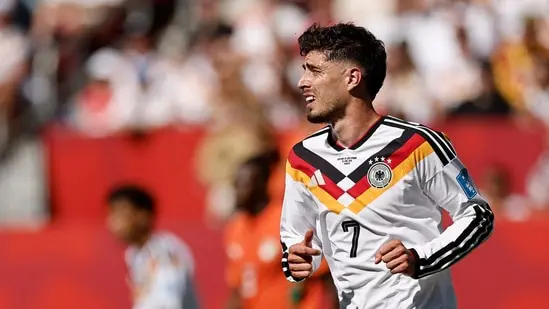
Kai Havertz has opened up on the strange emotional contrast of Arsenal’s season, Germany’s renewed World Cup belief and the criticism that continues to follow him despite his growing importance for club and country.
Speaking to The Guardian in an interview arranged in collaboration with Die Zeit, Havertz recalled the difficult hours after Arsenal’s Champions League final defeat to Paris Saint-Germain in Budapest. Arsenal were due to celebrate their Premier League title with a bus parade around north London the following day, but the German forward admitted the timing initially felt impossible.
“To be honest, it was tough,” Havertz said. “After the match, I initially thought we would call the whole thing off. By the next morning, things looked different.”
Arsenal’s league triumph had ended a 22-year wait, and Havertz said the players eventually realised the parade had to go ahead for the supporters.
“We had a huge season behind us,” he said. “The club had gone 22 years without a league title so that had to be celebrated properly with the fans. I have to say I’ve never experienced anything like it. So many people on the streets, so many supporting us. It ranks among my top three experiences as a professional.”
Havertz is now with Germany at the FIFA World Cup 2026, where Julian Nagelsmann’s side have already sealed top spot in Group E after wins over Curaçao and Côte d’Ivoire. Germany’s recent World Cup history has been painful, with group-stage exits in both 2018 and 2022, and Havertz said the current squad has been determined to change the mood.
“Qatar was anything but successful for us as a team and for me personally,” he said. “There’s a different energy in our squad now. I was quickly convinced that things would go better this year. We knew we had a duty not to fail early on again. We are Germany. But now the tournament is really just beginning.”
Havertz explains why his game is often misunderstood
The 27-year-old has been used as Germany’s starting centre-forward and scored twice in the 7-1 win over Curaçao. Yet debate over his role has continued, particularly after Deniz Undav came off the bench to score twice against Côte d’Ivoire.
Havertz believes part of the criticism he faces in Germany comes from the fact that he no longer plays in the Bundesliga.
“Probably because I don’t play in the Bundesliga,” Havertz said. “It was the same at times with Toni Kroos and Ilkay Gündogan, who were abroad for years. It is often said about me: ‘Havertz didn’t score again, he’s useless!’. And when I do score, they say: ‘Well, he’s supposed to, it’s about time!’ I don’t hold it against anyone; that’s perfectly normal.”
The Arsenal forward also explained the subtler parts of his game, especially the movement that may not always be visible in basic scoring numbers.
“Defenders should never know where I am, where I’m going, what I’m planning, or where I’ll be at any given moment,” he said. “That’s the worst for them. I try to be like a ghost to defenders.”
“I can’t just wait around in the penalty area, I need to be involved,” he added. “I also make runs which I know sometimes look pointless, but I’m creating space for the players coming up behind me.”
Havertz also addressed criticism of his body language, saying he no longer allows it to dominate his thinking.
“I’m aware of the debates that I’m too laid back or my body language is wrong,” he said. “That always comes up when I’m not playing well. But I’m not the sort of person who dwells on it too much. It used to be different. I don’t brood on things any more.”
Despite his calm exterior, Havertz said pressure is still part of his process.
“I know it doesn’t show from the outside, but I feel it,” he said. “Before a Champions League final, or at a World Cup. Or before penalties. I need that tension to stay focused.”
After an injury-hit period, Havertz admitted that the “last year and a half has gone badly” for him, but Germany’s World Cup campaign has offered him another major stage. He also praised the tournament atmosphere in North America, calling it “amazing”, though he was less enthusiastic about FIFA’s hydration breaks.
“They’re usually annoying, especially when you’ve just had two or three good situations and feel your flow is being interrupted,” Havertz said. “But others decide that.”
For Havertz, the wider lesson remains perseverance. Looking back at his teenage years, when he considered leaving school early, he said the decision to complete his education became a life lesson.
“At 17, you don’t think you need school any more,” he said. “At that age, you also don’t think about injuries or how things can suddenly take a completely different turn. It was a life lesson for me: seeing things through to the end instead of just quitting.”