Pickleball is expanding faster than virtually anyone expected. New pro circuits are sprouting up, international tournaments are growing, and countries thousands of miles away from the sport’s American roots are generating players who can challenge established stars.
But in the boom in popularity, one of pickleball’s most successful advocates thinks the sport is still finding out what it wants to be.
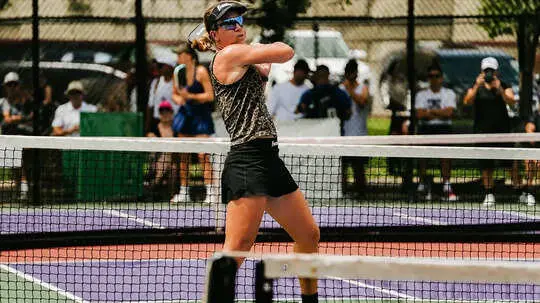
Megan Fudge has seen that development from a unique vantage point. She is a decorated professional, international traveller, instructor, and promoter of the sport, and has spent years helping pickleball reach new audiences while playing at the highest level. Together with her husband, Ryler DeHeart, she has watched the game expand from a local pleasure to a worldwide movement.
Fudge says the potential going forward is huge with Asia being one of pickleball’s fastest growing regions and countries like India investing heavily in the future of the sport. But she also cautions that expansion alone cannot be the objective. For pickleball to succeed in the long run, it has to find a way to remain faithful to the culture that helped make it.
More Than a Career Move
Looking back, Fudge does not view her family’s decision to pursue professional pickleball as a dramatic gamble or a leap into uncertainty. “When Ryler and I entered the pro scene, we were fortunate to have sponsors support us on our journey, so it didn’t feel like a major leap of faith,” Fudge said.
Rather than viewing the sport purely through a professional lens, she saw it as an opportunity to create experiences that extended far beyond competition. “It felt like an exciting adventure that we were taking our kids on to see the world. Pickleball has been our vessel to do that as a family.”
That mentality went a long way toward shaping how Fudge approaches the sport now. While rankings and outcomes remain essential, the ability to engage with diverse groups and to see the game evolve across continents has become equally meaningful.
The Wild West of Modern Sport
Few athletes are better positioned to compare pickleball’s current landscape with more established professional sports. Having come from professional tennis, Fudge has seen both worlds and feels pickleball is still far less organised than many outsiders think. “Pickleball still seems like the Wild Wild West compared to tennis,” she said.
Pickleball is still finding its way. Tennis, by contrast, has had decades to hone its paths, customs and commercial strategies. New formats are routinely trialled, tours are always evolving, and promoters are seeking the best viable strategy to flourish into the future.
That ambiguity can be upsetting to many players. And for Fudge, it’s one of the defining aspects of the sport.
Why India Stands Out
Among the many countries embracing pickleball, India left an immediate impression on Fudge. “It’s been amazing to see the explosion of the sport of pickleball in Asia,” she said.
“My first Asian stop was India three years ago, and we knew instantly that pickleball was going to be huge here due to the badminton, tennis and overall competitive nature of the people.”
Since then, the expansion has further strengthened that idea. The number of participants continues to grow in major cities as well as in emerging areas. New competitions are coming online, private investors are moving into the area, and a generation of young athletes is starting to perceive pickleball as a viable sports pathway, not just a recreational hobby.
What makes India’s rise especially important is that desire, as much as infrastructure, has been the fuel for progress. The pickleball ecosystem in the country is more and more like to a startup atmosphere, with innovation, content development, community building and competition all happening at the same time.
Protecting the Soul of the Sport
As the opportunity to grow professionally expands, so does the pressure that goes with it. In recent years, pickleball has been revolutionised with more prize money, sponsorship deals and commercial interest. But Fudge believes expansion should not come at the price of the sport’s essential ideals.
“As more and more money has entered the sport, I’ve been a huge ambassador to remain inclusive and supportive of the essence of pickleball so that we do not become just an elitist sport.”
That concern is shared by many long-time players who believe that quick professionalisation could push the game away from the community-driven culture that made it popular in the first place.
A Future Still Taking Shape
Perhaps the most revealing aspect of Fudge’s outlook is her belief that no one yet knows exactly what pickleball’s future will look like. While many sports operate within clearly established structures, pickleball remains remarkably flexible. That uncertainty, in her view, should be embraced rather than feared.
“Pickleball is still so new that the successful structure is not yet defined,” she said before adding, “It is still in the startup phase. Trial and error.”
Rather than rushing toward a single blueprint, Fudge believes the sport should continue exploring different approaches. “I’d love for more methods to be tried.”
That openness may ultimately become one of pickleball’s greatest strengths. Different countries are approaching growth in different ways, and emerging markets such as India could end up shaping the sport’s future just as much as its traditional power centres.
For now, pickleball remains a sport in transition. But if Fudge’s experiences across the world are any indication, the next chapter may be written far beyond the United States, by players, promoters and communities determined to leave their own mark on a game that is still discovering its full potential.