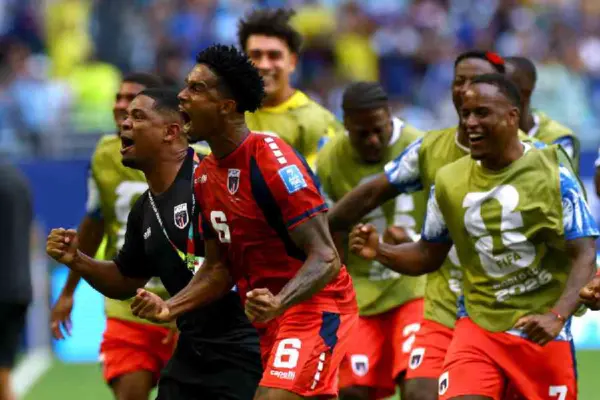
Two draws in two matches, Cape Verde have become the story of the 2026 World Cup.
When the draw for the World Cup was made in December last year, at the John F. Kennedy Centre for the Performing Arts in Washington, Group H seemed to be a sealed deal.
Spain and Uruguay were expected to rule over Saudi Arabia and debutants Cape Verde. But what transpired in the last two weeks once again proved that in football, there is nothing called impossible.
Cape Verde, a group of islands off Africa’s West coast, with a population of barely half a million, have snatched points from Spain and Uruguay. Goalless against Spain, one of the tournament favourites, last week and 2-2 on Sunday versus Uruguay in Miami. Do not forget Uruguay (1930, 1950) and Spain (2010) have three World Cup titles between them. As for Fifa rankings, Spain are No. 2 and Uruguay No. 16. Cape Verde? Sixty-seven.
Cape Verde are now third in the group, on goal difference, and if they beat Saudi Arabia in their last match on Friday (5.30am IST, Saturday), the rank outsiders could find themselves in the round of 32!
They have proved how wrong the Uefa president Aleksander Ceferin was when he said the expanded 48-team format would lead to many “uninteresting” matches.
Cape Verde have shown they are not in North America to make up the numbers. They have come well prepared, having earned a berth from a qualifying group of Africa, which also had Cameroon.
A team made up mostly of the vast Cape Verdean diaspora across Europe has made a giant leap. If their strategy against Spain was to play low block, on Sunday, knowing Argentine coach Marcelo Bielsa loves to play an attacking game, Cape Verde relied on fast counter-attacks and punched holes in the Uruguayan defence.
Their first goal of the tournament came through Kevin Pina, who split Uruguay’s wall and blasted a strike past diving goalie Fernando Muslera for a 1-0 lead.
The second goal was equally dramatic. Helio Varela, minutes after coming into the game in the second half, took advantage of a bad pass by Mathias Olivera and caught Muslera way off his line to make it 2-2. For the record, that was his first international goal.
“This is something we owe to other smaller national teams – teams that struggled to qualify for a world tournament,” Cape Verde coach Pedro Leitao Brito, commonly known as Bubista, said after the match.
“We’re also here to show that a country may be small, may struggle financially,” he added, “But if they are resilient, if they can endure struggle, they can also stand shoulder to shoulder with other major teams and with players who are on another level.”
This was something similar to what last edition’s semi-finalists Morocco coach Walid Regragui had said after one of the many upset wins. “We are the Rocky Balboa of this World Cup”, he had famously said.
Not for once Cape Verde have given the impression that they were surprised by their performance till now. “Once you are on the pitch, a lot of things become equal,” the coach said.
“Two draws against teams that you wouldn’t expect to get a result against,” former England striker Gary Lineker said on the Netflix show .
“It’s the most interesting group, isn’t it? Nobody saw this coming. The way they played today (Sunday), watching them, they looked solid, they looked athletic, and they were not just sitting back,” agreed former England player Joe Cole.
World Cup produces unlikely heroes. Lineker himself became a worldwide name after his six-goal exploit in the 1986 World Cup.
Cape Verde goalkeeper Vozinha has seen his followers on Instagram shoot up after his memorable performance against Spain. The US State Department ensured his mother got the visa and reached Miami in time for the match against Uruguay. This was after Vozinha said his mother could not travel to the US due to visa costs.
Cape Verde coach Bubista has already said that his players are not just playing in the World Cup, they are also showcasing the country’s culture, history and identity. This success can boost tourism, attract investment, encourage sponsorship and inspire infrastructure development.
For a small economy, even marginal increases in tourism or foreign partnerships can have a big impact. A club or nation’s success in a major tournament boosts tourism. A visit to Madrid or Barcelona will not be complete without a trip to the Bernabeu or Camp Nou.
Cape Verde’s success will have a domino effect on the country’s economy. And that will be the best thing.